

By the time you finish reading this article, the ultra-wealthy would have amassed more wealth than you can possibly spend your entire life.
If you are a lawyer working at a rate of $250/hr, it would take you 720,000,000 hours, or 30,000,000 days or roughly 82,192 years to earn the equivalent of one man's net worth. Jeff Bezos' net worth is roughly $180,000,000,000. Unfathomable doesn't quite capture what it means to have that much money.
Bill Gates is the second richest person in the world behind Jeff Bezos with a net worth of $103,000,000,000, followed by either a Mark Zuckerberg or Warren Buffet who trade spots for third at over $80,000,000,000 each. Collectively, these four individuals alone own more wealth than half the population of the United States or 164,000,000 Americans. The average middle income of someone living in California is $77,000. Jeff's net worth alone is equivalent to the average middle income of nearly 2 million Californians.
The ultra-wealthy are in a category that is unlike anything resembling the now infamous top 1%. Billionaires are not millionaires, and the top 1% are not all millionaires, let alone billionaires. The roughly 800 billionaires in America today are in a distinct category of their own. With a combined $3.4 trillion in assets owned, they represent 15.8% of the US 2019 GDP. The amount of money the ultra-wealthy have amassed in the last 50 years is obscene, and what we call Capitalism in America has encouraged the technology industry to perpetuate this horrific economic inequality.
Financial Mechanisms that Enable Disparity
In the last 50 years, we have seen an unprecedented consolidation of wealth, while at the same time we have also seen the cost of daily goods skyrocket, and big money make its way through our political system. The Bureau of Labor Statistics Consumer Price Index Inflation Calculator indicates that in July of 1970, $20 had the same buying power as $132.87 in July of 2020.
Of the Top 10 wealthiest Americans outlined by Forbes in 2020, only two have amassed their wealth outside the tech industry: Alice Walton and Warren Buffet.
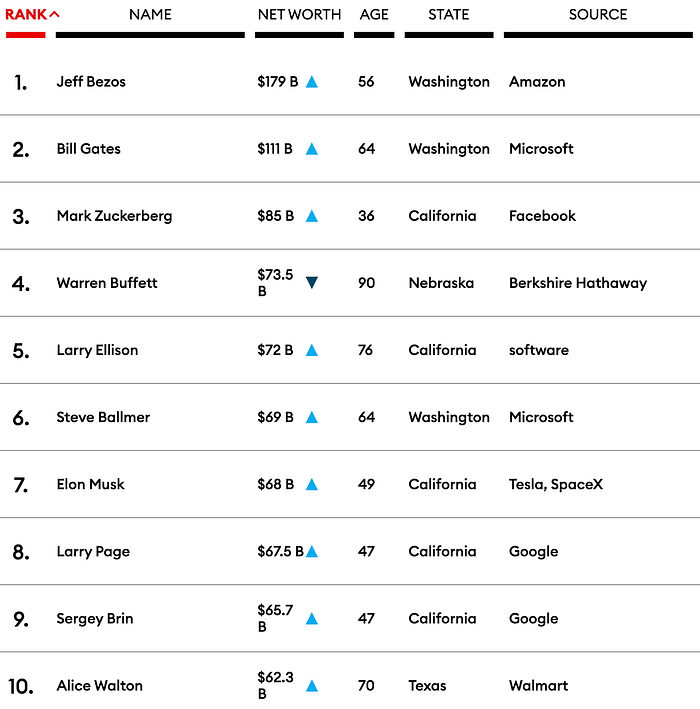
The economic system in place works against the vast majority of Americans. The notion that it is more expensive to be poor than it is to be rich should outrage you. Nonetheless, the system in place values economic growth and increased shareholder value above all else. In other words, profit at any cost.
Take for example credit cards. Credit cards for the rich typically offer a high return in value through rewards programs. Qualifying for a line of credit with a low-interest rate, and a substantial rewards program is not possible for the vast majority of the poor. Typically, a poor person will have a high-interest rate and no rewards program at all. It is more expensive for the poor to live on credit than it is for a wealthy person. What makes this even worse is that every purchase made through that high-interest rate credit card is then used to subsidize the wealthy by funding the rewards program.
If you are not convinced yet, and you think that you are safe because you don't have to use credit cars, think again. A similar process takes place with debit cards and paying with cash. When someone pays with a debit card, the vendor typically absorbs the cost of the transaction that they must pay to their merchant services provider in order to process the payment. The merchant service provider uses the revenue generated by the funds produced by each transaction to further fund their operations, which includes the creation and maintenance of incentive programs, e.g. rewards programs. Vendors raise the cost of their goods to cover the fees. Without a rewards program, or if you are paying with cash/debit, you ultimately end up paying more for the same goods. The rich on the other hand, without a need to worry about cash flow, can purchase all their goods through credit, pay off their debts without being charged interest, and reap the benefits.
This is a system of values that rewards those who have money and use it in a certain way and penalizes those who do not. As a result, the overall cost of living is inversely related to the amount of wealth you own. The wealthier you are, the lower the cost of living. The financial mechanisms that make this possible are enabled by publicly-owned technology.
Your Behavior is the Product Tech Companies Sell
You may think that every time you make a purchase with a card, or when you pay with cash, you are using a tool of convenience to purchase a product. The card or cash is the means by which you exchange something of value for some product, but you are mistaken. What is being sold and purchased is your behavior. In regards to transactions and how technology enables the monetization of that transaction, the product is your behavior. Companies are betting on you making a purchase with a specific vendor in a very specific way.
Because all exchanges (or transactions) are now mediated in one form or another electronically, someone is paying someone else every time it occurs. To illustrate this better, let's look at a more recent, but equally insidious example, online advertising in social media.
In 2018, when Mark Zuckerberg testified in Congress. He was questioned by then-Senator Orrin Hatch (R-UT) about Facebook's business model and if the company's objective was to remain free. His answer was more revealing than most realized. He answered, "Senator, we run ads."
Ironically, Hatch was on to something, but didn't realize it and glossed over Zuckerberg's answer with an emphatic "I see. That's great." Zuckerberg dodged having to answer the pivotal questions around how ads make money that allow Facebook to operate. He side-stepped explaining the business model entirely, and instead refocused the conversation on privacy around user-generated content that is already willingly shared online by Facebook's users.
Social Media Advertising 101
The objective of social media is to change your behavior for the purpose of selling ads. Ads are perceived as a harmless or at worst annoying byproduct of using a free service. People see themselves again as utilizing a tool, when in fact they are the product being sold to advertisers. Harmless and annoying could not be further from the truth about the level of manipulation.
Companies like Facebook collect behavioral data about you. Regardless of Zuckerberg emphasizing privacy around user content in his response to Hatch, Facebook does not care about your photos, videos, or your comments. Those can all be private, without impacting their core business model. Facebook, instead, cares about how much time you spend utilizing their services, how many times you click on a specific type of content, and how they can increase your use of their services in order to obtain more behavioral data they can analyze. The behavioral data they collect is used to catalog user-profiles. As a result, advertisers can purchase ads from Facebook, and with precision target an audience that is most likely to respond favorably.
The user-data you create you will never see and you will have no way of knowing who does. But, you can know with certainty that your actions and behaviors are collected, analyzed, stored, and sold. We know this with certainty because Zuckerberg confirmed that Facebook's core business model is supported through the sale of ads. That revelation gives us insight into what is important to Facebook and who its customers are. Facebook's customers are not its users. Its customers are advertisers that are purchasing the opportunity to meet you virtually. Facebook has consistently for the last decade created ever more techniques to manipulate you, to keep you on its platform, to increase the number of times they can sell those opportunities to its customers.
Despite the external costs such as increasing levels of isolation, depression, misinformation, polarization in our politics, and even risking corruption of the democratic process entirely, Facebook has done very little to change. They've opted instead to pursue profit at any cost.
Closing Remarks
Despite progress in a variety of fields of knowledge designed to improve quality of life, the current generation is on the path of decreased prosperity. A minority of the population enjoys the benefits of the economic system in place at the expense of the poor with no sign of change in the near future. The poor are enslaved by this economic system and have very little opportunity to break the cycle of poverty. Education provides individuals with a means to a better life, but often the quality of one's education is predicated on where someone was born and grew up. Early childhood education is not valued and as a society, we have not invested in it. By the time you are in high school, for the most part, your future has likely already been determined.
Modern capitalism is an economic system that exploits the vulnerable and rewards those in power for doing so. It is absurd that Warren Buffet, whose net worth is not even half of Jeff Bezos', can make $1.5 million dollars per hour, or $25,000 per minute, or $416 per second. No one can work that hard and earn that much money without someone else losing. Those losses are not included in the calculations we make as a society. They are what economists refer to as externalities, i.e. the cost or benefit that affects a third party who did not choose to incur that cost or benefit (1).
Capitalism is not only an economic system, it is a political system with a specific perspective on human value(s). Individuals are not viewed as equal members of society that are bonded together by way of a social contract. Instead, there is a hierarchy in society. The higher your economic value, the more control you have over others. The poor are products to be exploited by those in power whether they are collectively consciously aware of it or not. Regardless of the obvious consequences, the current pursuit of profit and your economic value as a person are the primary variables used in making financial decisions. Because people are now the product, economic models need to change. They are not capable of addressing and evaluating economic success in a way that promotes the well being of our society.
(1) Buchanan, James; Wm. Craig Stubblebine (November 1962). "Externality". Economica. 29 (116): 371 — 84. doi:10.2307/2551386. JSTOR 2551386.