

This is a short free course on taking notes around books. It requires time and the willingness to practice the method presented and make it your own. Sit comfortably, choose a book to which you want to apply what you will learn here, and then let me know how it went. Enjoy!
Introduction
Taking notes is an art.
As with any art, there is no single note-taking recipe. Yet, there are techniques to leverage its power.
One of you asked me for a "fully baked practical example" of the technique I described in How I Organize Tons of Notes (It Works Regardless of Digital Technology). This short course is based on an example of taking notes around a book.
Examples must be specific.
So, I describe how I take notes around one of the most brilliant books I've ever read: The Science of Storytelling: Why Stories Make Us Human and How to Tell Them Better (nonaffiliated link) by Will Storr.
How can we condense those sharp 304 pages into meaningful notes that expand our knowledge? The answer is a 3-word technique: taxonomy, glossary, and thesaurus.
Let's dive into the example. But remember that it is art: my notes aren't your notes, even given the same source.
Read as a note-taker

Note-taking begins when highlighting text while reading. Straightforward.
Beware that this is only the starting point. Highlighting alone doesn't take far. You must elaborate, too.
How? I'm a digital reader. I first elaborate on the same app I used to read: the Kindle app. Any other reading app may also work, but Kindle is my choice. It provides me with all I need:
- Highlighting text
- Adding a note to the highlighted text
- Starring highlighted text
Note-taking step-by-step
#1. Highlight text

Taking notes is a choice exercise.
Why do you read that book? The answer guides you in highlighting texts that resonate with that 'why.'
In my case, I read 'The Science of Storytelling' to expand my intuition that humans are the stories they tell each other.
#2. Add notes to the most relevant highlights

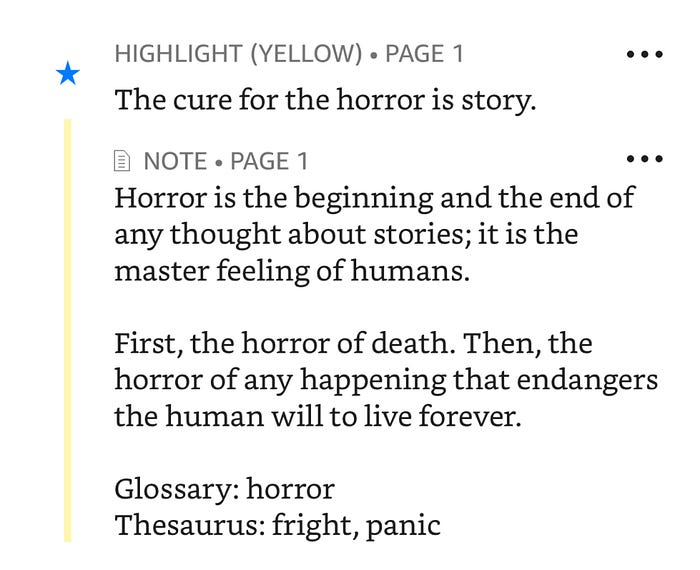
The first step towards acquiring the knowledge the book transmits is to rewrite each highlighted text in your own words. This step is essential. Skip it, and you'll lose the note-taking game.
Rewriting the highlighted text has many crucial roles. In addition to helping you remember ideas, it leads to discovering which keyword the highlighted text corresponds to in your mind. It's the keyword that resonates with you. It's a keyword to insert in your glossary of the book.
In the example in the screenshot above, the highlighted text corresponds to "The cure for the horror is the story" and focuses on horror. 'Horror' is a keyword I add to the glossary.
Yet, no sentence can be condensed into one word. For this reason, I added a couple of alternative words that expand the meaning of the keyword. They are for the book's thesaurus.
For people who are not familiar with the terms glossary and thesaurus, their definitions, in short, are:
• A glossary explains what a word means within a specific context.
• A thesaurus suggests alternative words with similar or opposite meanings.
Thesaurus is where the meaning expands until it evokes contact with other meanings that create new knowledge.
But we don't have to run too much. We're not yet at the creative moment.
#3. Star highlighted text
When books have hundreds of pages, you can highlight hundreds of paragraphs at the end of the reading. That may be too much to keep control. You must decide which ones are relevant for the 'why' that made you read the book.
Star only highlighted texts that are indispensable for that 'why.' In my case, I ended up with 164 highlights, of which only 12 starred.
Only glossary and thesaurus terms of starred highlighted texts go into the next—and last—phase: mind mapping.
Elaborate as a mind mapper
This is where I switch from digital to analog (it's my choice; feel free to use any mind-mapping software you like). I craft the mind map with pen and paper in three steps:
- Building glossary terms' taxonomy
- Expanding the meaning with thesaurus terms
- Crafting connections among terms
Mind mapping step-by-step
#1. Build glossary terms' taxonomy
Taxonomy is about declaring parent-child relationships.
During the previous phase, you decorated each starred note with a glossary term, which maps the note in a single word. Now, it is time to look at all glossary terms and connect them through parent-child relationships – whenever it makes sense.
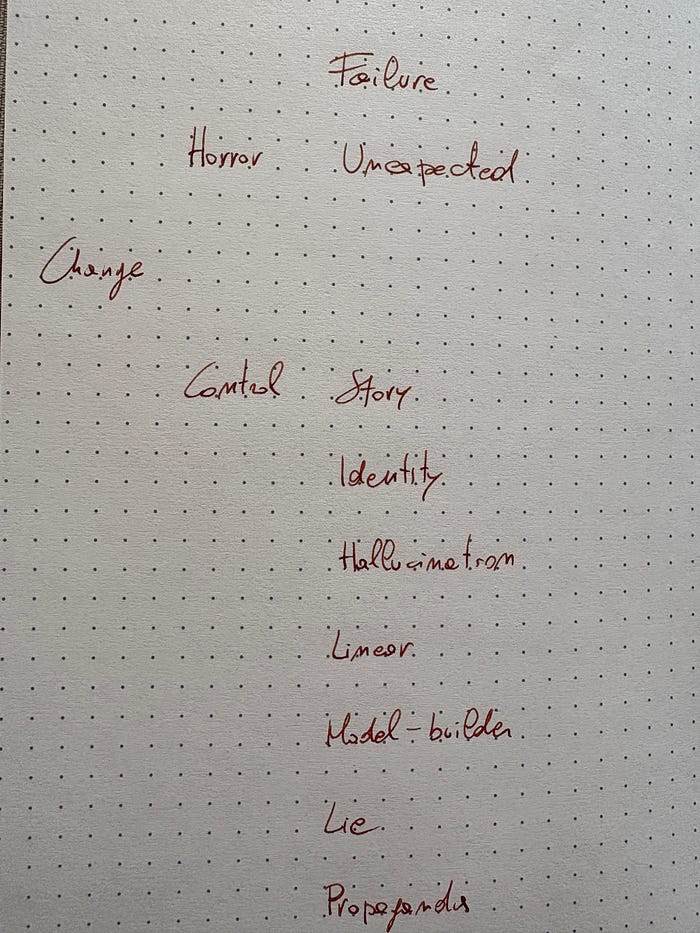
The first step is to put all glossary terms in a flat list regardless of the order. This was my list:
- Horror
- Change
- Control
- Hallucination
- Story
- Linear
- Unexpected
- Failure
- Model-builder
- Lie
- Identity
- Propaganda
Then, consider the first term in the list and, among the other terms, look for
- Terms that belong to the first term's meaning category – child relationship
- Terms whose meaning includes the first term's meaning – parent relationship
Write it down in a graph like this:
#2. Decorate taxonomy with thesaurus terms
When assigning keywords to highlighted texts, I also link two other words that build the thesaurus. Now, I add those other words to the diagram.
After decorating the taxonomy with that thesaurus, I circle the thesaurus terms that are also taxonomy terms. For example, 'change' is a thesaurus term linked to 'unexpected' but also the root term of the taxonomy:

What if you don't find any match between taxonomy and thesaurus terms? Well, it means that when highlighting the book, you didn't get its internal connections, if any. You can't go to the next step — mind mapping — since there's nothing to map: The thesaurus-decorated taxonomy is all the knowledge you extracted from the book.
Instead, if you get some matching, go to the next and last step.
#3. Craft connections among terms – mind mapping
Based on the matching you found in the previous step, you can draw arrows from taxonomy to thesaurus, like in the image below:

A little more effort and endeavor so far will be paid off!
It is now a matter of shaping the newly discovered connections and making them flow into a mind map from which to draw the summary of the book from your point of view.
This is mine:
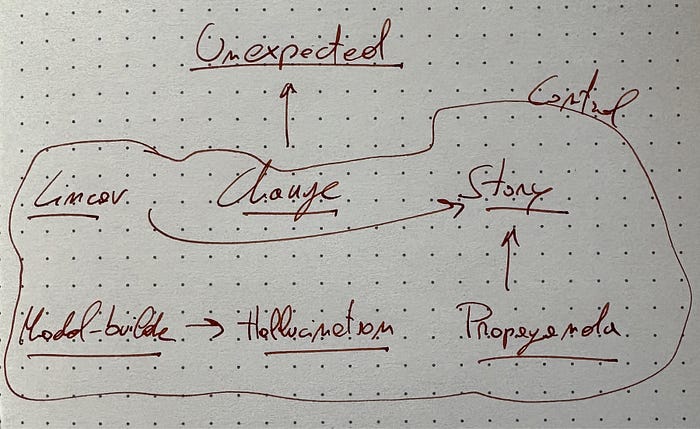
The underlined terms and connections come from the thesaurus-decorated taxonomy above. I grouped everything under the term 'control' except 'unexpected' because striving to control is the human reaction to the unexpected that the book frequently recalls.
Eventually, travel across the map to tell a short and relevant story that, according to the map, synthesizes the book, which will enter your personal knowledge management system.
In my case, this is the result to store (bold words come from the map):
The response to unexpected changes often involves a desire to regain control over situations. Stories serve as a tool for managing and influencing human perceptions through various forms of communication, including propaganda. In this context, our brains function as model-builders, constructing narratives that can be seen as linear interpretations of reality. Ultimately, our understanding of the world is shaped by these constructed narratives, suggesting that our perceptions are, in many ways, a series of hallucinations rather than objective truths.
Is this a synthesis of what Will Storr wanted to say? Wrong question.
This synthesis is:
- How Storr's book resonates with me.
- How I decided to embed what I got from Storr's knowledge into my knowledge.
- An entry in my Obsidian notes.
Conclusion
At the end of the process that I described step-by-step, you get your synthesis of the book.
But you are not yet done.
There's a last validation to do. I didn't add it to the method because it's intuitive and impossible to formalize. The best way to describe it is:
While reading your synthesis, think of your reading experience of the book. Do they speak to each other? Does this dialogue between experience (reading the book) and writing (synthesizing the book) resonate within you? If so, your note-taking is now actual knowledge.
Thank you for stopping by! Did you find this free course helpful? Please share it!
My belief (not faith): Thinking is Writing ⇒ If you don't write, you don't think: You react instead.