


History
Being a housewife was a social norm in India, until recently when people vouched for women's education and pushed them into the workforce.
Parents would usually marry off girls soon after their school was over, and once married, the only responsibility they had was to take care of the home and bear children.
The concept of joint families was prevalent back in the 90s, as opposed to now when millions of Indians are living as nuclear units.
In a joint family, not only did the husband's parents would live along with your family, but sometimes even the families of the husband's brothers would reside in the same house. So, you can imagine anywhere between 8 to 30 (or more) people living on the same property!
In such houses, if you have kids, it would mean they would share the room with their parents till they are teenagers. There is no concept of having a separate room for the baby, like in western countries. Mothers are supposed to co-sleep with their child, till the child is at least 10 (and sometimes even older!)
Sharing a bed with your parents was so common in India, that when I was in school, a big dream of the majority of the girls would be to have a separate room of their own!
Once the men of the house were off to work, and the kids were gone to their schools, the women were left behind to take care of the household chores, cooking, cleaning, washing, and doing everything that we have machines for today.
In India, there are many people living in small towns and villages, that still live in joint families. Living with so many people had its own challenges.
And the biggest one was privacy!

Once the husband would return from his work, the family would sit together to have dinner. After dinner usually, there would be a routine to chat with everyone, to just sit there, spend time and discuss things about your day, your work, and other stuff. This would also be the time that busy fathers would look at the progress report of their kids from school.
If the wife desired to spend some saucy time with her husband, it would only be possible after the kids had gone to deep sleep. It would be easier with babies and toddlers, but as the kids would grow older, it would become tougher.
If the couple planned to have sex on a particular night, they would coerce the grandparents to take the kids!
Sometimes the kids would revolt, saying that they want to sleep with their parents. But the grandparents would bribe the kids with sweets and take them to sleep with them.
With such a closed environment at home, lack of privacy, and taboo around important subjects like sex, it was almost impossible for the women to reach out to anyone for support. Even the mother-in-law would shame the daughter-in-law for asking anything about such topics.
Another big problem was that gynecologists were not that readily available or abundant in number, back in the 90s. Many issues related to fertility and irregular menstruation remained unaddressed.
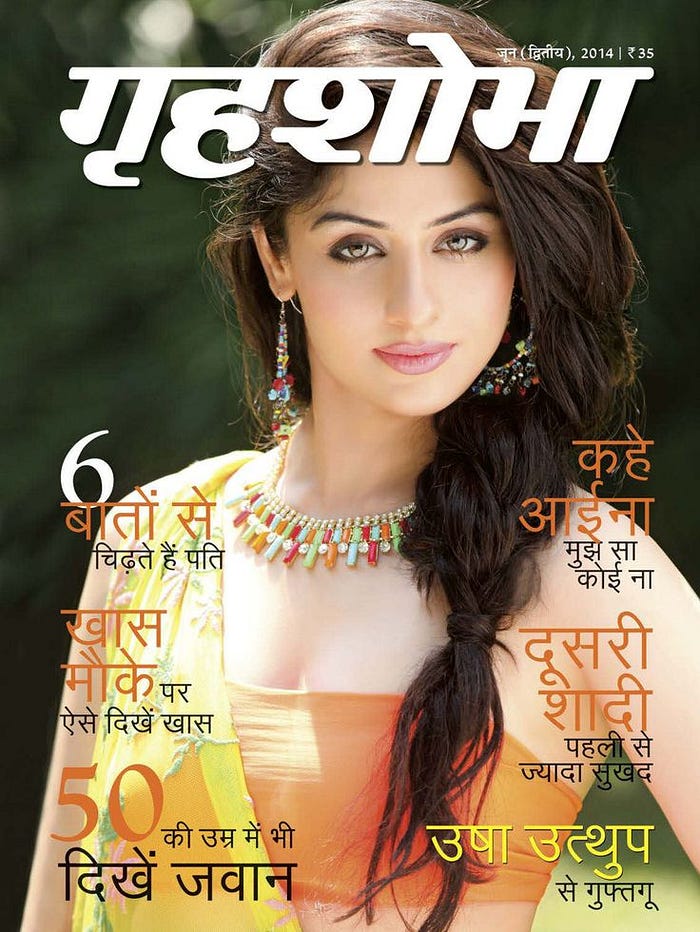
Enters — Grihshobha
And then arrives one magazine that changes the entire social scenario. A magazine that was insanely popular among housewives throughout the country, titled 'Grihshobha'.
The magazine not only acted as a source of entertainment for the housewives, but also as an advisor, a problem solver, and sometimes even a doctor or medical expert when it came to discussing intimate issues.
It acted as a pocket internet for the women of that time. It was so popular that women would gather together in the evenings to read out articles and stories from it.
Through the magazine, they also got a glimpse of the life of women in big cities. Working women who had a plethora of different problems. Women who were living a fast life and also women, who married the man of their choice!
It seemed like a big thing because, in India, even today arranged marriages are a common occurrence. Back in the 90s, love marriages were uncommon and even shamed.
For women, in particular, it was not seen as a decent thing to even talk to a boy of her age. Schools were not co-educational. Colleges were also segregated. For many women, the first man they ever interacted with, was their husband.
In such a case, getting to know the story of a woman living in a faraway city, who has been having sex with her partner before marriage, was such a huge thing! You can not even imagine how this magazine became one of the most prized possession of the Indian housewives.
They would read it when no one was around. They would keep it hidden and in a secretive place, where no one would find it. They would discuss the contents of it, with their close confidantes and friends.
Grihshobha soon turned into a cult.
A cult that no one spoke about, but secretly almost every housewife was a part of. If a woman did not have the financial means to subscribe to this monthly magazine, she would borrow it from her friend or neighbor to read. That's how insanely popular it was.
This was also the era when love and romance were being openly shown in Bollywood movies. TV was slowly emerging as a large entertainment platform, but a cable connection was still more expensive to afford than a magazine.
Grihshobha also inspired many women to start organizing weekly meet-ups, kitty parties, and start women's clubs — where they would contribute money for financial independence, share stories of empowerment, and even help each other land a job!
While the women continued to read this magazine, the social scenario also started to change. Women were now more comfortable discussing things out in the open. Grihshobha had many columns where women could write about their problems anonymously, and wait for answers in the next edition.
Something About The History Of Grihshobha
The magazine is owned by a publishing house named 'Delhi Press', which was started by Mr. Vishwanath back in 1939. India had not become an independent country yet, and the publishing house started by publishing their first magazine, titled 'Caravan', which is continuing even today!
They later added more focused magazines into their basket including 'Sarita' and 'Grihshobha', which were aimed at Indian housewives, and the content of these magazines was written in simple, easy-to-understand Hindi language. A language, commonly spoken by more than 40% of the people in India.
The key reason behind the popularity of Grihshobha was that it never 'advertised' what it sold. And women, had no problem with it!
India is a sensitive nation when it comes to touchy issues. If the magazine had promoted itself as a solution to relationship problems, discussions about love affairs, menstruation, pregnancy, or even sex, people would have gotten in the streets to burn effigies of the publishing house and would have taken it down.
Being the highly patriarchal society that we were, back in the 90s (not saying that we aren't patriarchal now, but we are much better and surely getting there!), it was impossible for the women to do anything if the magazine would have shut down. They could not even raise a voice for themselves inside their own houses, taking a stand for a magazine was a faraway thing!
But Grihshobha marketers were smart. They knew how to sell touchy subjects, without showing that they were selling touchy subjects!
They marketed the magazine as a piece of entertainment, with film actresses on the covers, and headlines about news from the film industry. All of this was happening in the garb of Bollywood news!
The first time, when I got my hands on a Grihshobha at my home, I thought it was a film magazine and always wondered why my mom would waste her time reading it when she was not interested in movies at all?
It was only years later that I actually sat down to read the columns inside, and I got to know why women were crazy for it.
Inside the magazine, you would find columns from gynecologists discussing medical issues. There were columns where relationship experts would give solutions to women regarding their problems.
There were columns where women would discuss their sexuality by being anonymous. Columns where teen pregnancy and abortions were discussed.
If not columns, then there were many fictional stories that revolved around issues that women faced. They were discussing PCOS and menopause in the stories. There were stories that would inspire women to be someone. Stories that gave them hope for the future.
The magazine was truly one of a kind, given the fact that they were publishing such forward content back in the 90s.
Grihshobha found its way into almost every single Indian middle-class household, back in the time, and to think of achieving such a feat now, sounds like a massive challenge.
Today, the readership of the magazine has sunk, because we have the internet, and the majority of women are no longer housewives or living in joint families. Today we have access to social media to discuss all our problems with strangers across the world.
But back in the days, it was the original, old-school legend for the housewives!
References:
1. History of the Delhi Press.
2. Grihshobha - The household name