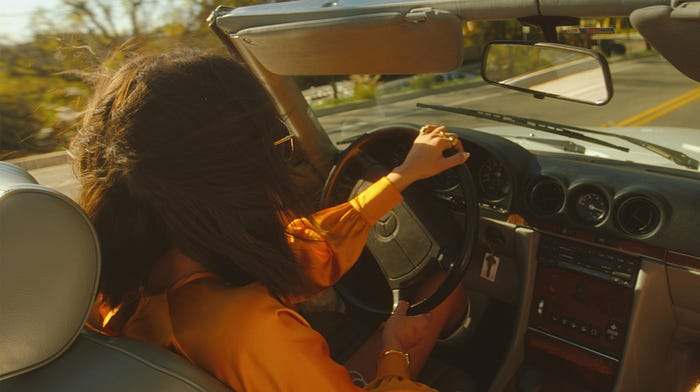


I'm an advanced driver, and I'm a woman. No, that's not an oxymoron.
In my first "proper" job, I drove hundreds of miles daily as a sales and marketing executive.
Then, as a police officer, I was paid to drive on the wrong side of the road and exceed the speed limit. With my siren wailing and blue lights flashing, other cars pulled over as I drove toward emergencies.
I'm a good driver, and I like driving.
No, men are not better drivers than women
Most men think they are better drivers than women.
You know what, I couldn't give two hoots whether men or women are better drivers because that's an unhelpful generalised mish-mash and only serves to create divides.
Some men will be better drivers than me; some men won't. Simple.
But what I do have an issue with is people assuming I am a poor driver based on what genitals they also assume I have.
Eighty percent of people think they are above-average drivers. I'm no mathematician, but even I recognise the flaw in this.
There's a reason car insurance is cheaper for women than it is for men, and that's because men take greater driving risks, are more likely to speed, and engage in behaviour such as drunk driving.
Yes, I'm afraid to inform you, but men being better drivers than women is a big fat myth.
So, where does this nonsense stem from?
Would it surprise you to learn that this rubbish was being espoused back in the 1920s?
According to Berger, the author of a study titled Women Drivers!: The Emergence of Folklore and Stereotypic Opinions Concerning Feminine Automotive Behavior, maligning women as bad drivers was used as a control tactic to keep women where they "belong" — at home.
The regurgitation of derogatory and unsubstantiated comments about women drivers has been passed on through the decades and is still the subject of much tedium and many jokes.
Just like zombified Trump supporters, some people will believe anything they hear.
Does my presence on the road threaten your manhood?
A number of years ago, while travelling to visit my friend, I had to execute a difficult manoeuvre on a single-track road. The vehicle driver awaiting me to pass lowered his window and signalled for me to stop.
Naively, I followed his guidance, thinking he was about to depart some crucial information about the road up ahead. I've met some arsehole people in my life, but I never anticipated someone would be such a knob.
The driver thought it was his place to challenge me on my decision-making skills for performing the manoeuvre I had just executed.
With his condescending tone, he spoke to me as if I were a child. I sat, stupefied, in shock that anyone would be such an arsehole.
What would you have done? In hindsight, there are many things I wish I had said.
I just drove off, agitated and disgruntled, but not quite knowing why until I reflected upon it.
The fact is if my partner had been in the car with me, or if my partner were driving, this chauvinistic arsehole wouldn't have said anything.
It makes me wonder, are women more prone to being victims of male road rage?
Discussing this topic with a group of friends, all the women said they had been followed for a few miles, been honked at or had aggressive men waiving their fists at them, while none of the men in discussion could claim such experiences.
Anecdotal, maybe, but a lived experience of many that can't be rejected.
Interestingly, this study suggests that young men are most likely to be perpetrators of road rage.
I don't take the privilege of driving a car for granted
Having spent several years of my childhood in Saudi Arabia, where, at the time, my mum was not legally permitted to drive for her sin of being a woman, I know all too well the intersection between women's rights and driving.
Fortunately, in 2018, the powers that be in Saudi Arabia realised that you don't need a penis to drive a car, and their laws preventing women drivers were rescinded.
It took years of unrest and brave women facing the full force of the law by driving illegally. On the face of it, Saudi Arabia has caught up with the rest. But at the time of the lifting of the ban, many activists remained detained.
But with the curtailment and regression of women's rights spreading out around the world — from the travesty in Afghanistan to the reversal of abortion access in America — I can't help but wonder if the right-wing governments will soon come after our driving licences.
Women are taking the driver's seat
Driving isn't just a convenient way of travelling; it's become a lucrative business in the form of sport.
Guess how many women feature in this list of top 100 drivers?
A big, fat, squiggly zero.
Women are decades behind men in our access to the sport.
The European Grand Prix originated in the 1920s, and in 1946, it gave rise to what is known today as Formula One.
But it wasn't until 1956 that Formula One featured its first-ever female driver, the pioneering Maria Teresa de Filippis. After just three years of racing, Maria retired and the sport didn't see another woman racer until 1975.
Worse than that, to this day, only five women have entered a Grand Prix, and the last time a woman raced in a Grand Prix was in 1992.
It's not because women can't drive or don't want to. It's because we're constantly told that cars are not for us.
We are still seeing generations coming of age who have been indoctrinated with the bull shit that cars are for boys and dolls are for girls.
This gendered codswallop translates seamlessly into adulthood, and we see it play out in reality. Men drive around and play in their cars while women look after the baby.
For fuck sake, give me strength.
Driving is part of women's liberation
I know women struggle to get access to the driver's seat, both physically and metaphorically.
It's not just the physical act of driving but the empowerment of having agency over one's direction.
We know the reputation women have for being poor drivers is nothing short of maligned misinformation used as a control tactic.
So please — for the love of equality — give your little girl a toy car to play with.