

We constantly use the word infinity in both our conversational language and to describe scientific concepts. However, infinity as a physical concept is impossible to visualize. One example is the statement 'the Universe is infinite'. It's a fine statement to make, but no human being can visualize an infinite universe. You can articulate that the universe is infinite, but you cannot appreciate what that actually means in terms of physical appearance.
I can actually prove this, under the assumption that our lives are finite. Here's my proof. Imagine that you are visualizing the universe. You start at a point in your visualization and you move forward. One of two things happen. Either you stop visualizing and make a comment like 'and so on forever'. Thereby you have made your visualization finite. Or you never stop moving forward in your visualization until you die, and then you have stopped and your visualization is finite.
So, in order to understand and work with infinite quantity, we need to think about it abstractly. We need to develop a way of understanding infinity that does not require diagrams or visuals. Luckily, that is what mathematicians are very, very good at.
How do mathematicians think about infinity?
To mathematicians, there are two types of set. There are finite sets — meaning that you can count the elements of the set and you can be sure that your counting will stop at a certain point.
Or there are non-finite sets. Non-finite sets are sets where there is no way of counting the elements in a way that your count will terminate. There are two important consequences of this:
- We cannot think of the size of a non-finite set in the way that we think about the size of finite sets. With finite sets we can use simple arithmetical logic — for example. the union of two disjoint sets of size 3 and 8 is a set of size 11, or if set A has 5 elements and set B has 5 elements we can say that sets A and B are the same size.
- We need to have a new way to compare non-finite sets to determine if they are the same size or not.
With that second statement, I know some of you might be thinking 'what?' But bear with me. I'm going to show you that there are in fact different sizes of non-finite sets.
Bijections between sets
How do we think about whether two non-finite sets are the same size? Well, let's consider what happens when we count the elements of a finite set, and then generalize that method to the case of non-finite sets.
Consider the set of letters in the English alphabet. That is a finite set, and we know there are 26 letters. Let's imagine that we want to verify that there are 26 letters. We would write them all down in alphabetical order, and then count them. One, Two, Three, …., Twenty-Six. Pretty simple.
Mathematically, though, how do we describe such a count? Well, we are effectively saying that there is a one-to-one mapping between the set of letters of the alphabet and the set of numbers {1, 2, 3, … , 26}, right? For every letter, we can assign a unique number in the set {1, 2, 3, …, 26}, and for every number {1, 2, 3, …, 26} we can assign a unique letter. We call a one-to-one mapping like this a bijection.
Now we can observe that the idea of a bijection has no regard for the size of sets, so we have this basic principle of set theory:
For sets A and B, A and B have the same size if and only if a bijection exists between A and B.
Applying our principle to non-finite sets
Remember we said earlier that basic arithmetic doesn't work when we are dealing with non-finite sets? Here we can see our first example of this. Let's ask the question: are the set ℤ of all integers and the set ℤ+ of only positive integers the same size?
Instinctively we think no, right? Surely there are twice as many integers as there are positive integers. But that's not how mathematicians think about non-finite sets. Let's go back to our principle and ask: can we define a bijection between ℤ and ℤ+?
Yes, we can — as follows:
- 0 ↔ 1
- negative integers -1, -2, -3, …↔ odd positive integers 3, 5, 7, … (So -k ↔ 2k +1 for k > 0).
- positive integers 1, 2, 3, … ↔ even positive integers 2, 4, 6, … (So k ↔ 2k for k > 0).
This is a bijection because it is a one-to-one mapping between ℤ and ℤ+. Therefore, mathematically, these two non-finite sets have the same size.
Recalling our example about counting letters of the alphabet, any set for which there is a bijection with the positive integers or some subset of the positive integers is called a countable set. The set may or may not be finite, but we know we can order the elements in a way that they can be itemized one by one and mapped bijectively to the positive integers.
What other non-finite sets are countable?
Any transformation of the integers is a countable set. Even if we divide the integers by 1,000,000, we still have a countable set. (Can you define the bijection which proves this?)
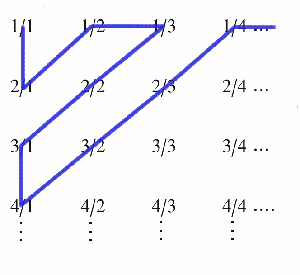
In fact, let's take the set ℚ of all rational numbers, that is, all fractions of the form a/b where a and b are integers (b ≠0). Is this countable? Surely not? It seems so much 'bigger' than the set of positive integers.
But again, if we conclude this we are not thinking like a mathematician. We need to ask ourselves if there is a way of ordering ℚ in a way that there is a bijection with ℤ+? Diagrammatically, here's a way to do this, known as a Cantor Count, after the mathematician Georg Cantor who first developed the theory of non-finite sets in the late 1800s:
Are there non-finite sets that are not countable?
Yes, there are. Countable non-finite sets are, in fact, regarded as the 'smallest' type of non-finite sets. Let's look at a common set which we can prove is not countable. Let's consider the set of all points on a straight line.
For convenience, let's say that the line goes from the point 0 to the point 1. Then we can say that any point in between is of the form:

where each digit a_ij is a positive integer.
Now assume that we can order all the elements of the set of points on our line in a way where we can define a bijection between those points and ℤ+. Let the ordering be:
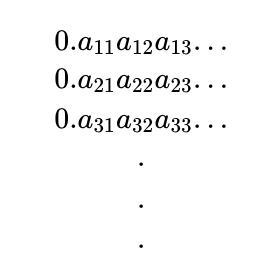
Now define a number as follows:
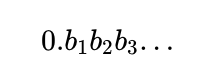
such that

Clearly our new number is in the set of points on our line, but it is not in our ordered list. Therefore no matter how we order our points, we can find a point in our set that is not in our ordering. So our set cannot be bijectively mapped to ℤ+. It is an infinite set which is not countable.
What else?
Mathematicians have started to use the Hebrew letter א (Aleph) to denote various types of infinite size. The 'smallest' form of infinity — the size of countably non-finite sets like ℤ and ℚ — is usually denoted by א with a subscript of zero. One result which has been proven is that for any non-finite set, a 'larger' set can always be defined for which there is no bijection. This is the power set, or the set of all subsets of the original set. It can be shown that the real numbers (our set of points on a line) is equivalent to the power set of the positive integers. One corollary of this observation about power sets, is that we can construct an infinite chain of non-finite sets of increasing size, simply by starting with a countable set and taking repeated power sets.
So we can generate a countably infinite sequence of increasing sizes of infinity.
One of the most interesting intellectual suggestions in this area is known as the Continuum Hypothesis, which states that there is no set that has a size strictly between that of the integers and that of the real numbers. This topic takes us to the edges of mathematical reality and starts to border on the philosophy of mathematics. For example, it was shown by the mathematicians Kurt Gödel and Paul Cohen that it is possible to both prove and disprove the Continuum Hypothesis using the most commonly accepted axioms of set theory, rendering the hypothesis independent of the most commonly accepted mathematical rules that we play by.
What are your reactions to how mathematicians think about non-finite sets? Feel free to comment.