

Years ago, I decided to turn myself into a science experiment and see how much I could improve my physical fitness in one year. I was spending hours a day at the gym, hired a trainer and a nutrition coach. For the most part, I felt pretty good.
One night, I went to a meetup for science writers in New York and was talking to a friend for a while before I took off my sweater, revealing my arms for the first time to him since I'd started seriously lifting weights. "What the hell?" he exclaimed. "BRO, DO YOU EVEN LIFT?" he repeated, loudly. (This guy now writes for The New Yorker.)
Months later, I was visiting an old high school friend in Chicago. After a few drinks, he leaned in to tell me something. "I'm sorry to tell you this, but men don't find those muscles attractive."
"No, I know guys at the gym who do," I said.
"Well, I'm sure they'd say that to your face. But I'm telling you the truth — what guys say when they're with each other. Trust me, I know." Spoiler alert: he didn't. We often mistake our knowledge for fact because we don't realize when we're in an echo chamber.
Even when the experts all agree, they may well be mistaken. -Bertrand Russell
Donella Meadows, one of the founders of systems thinking, wrote a brilliant essay on how to intervene in a system — the best places to make changes for complex problems. In short, you can't just snuff out a problem where you can see it: you have to go upstream.
The trick is to figure out where things are going wrong. Too often, people impose changes at the top, and think that the change will magically trickle down.
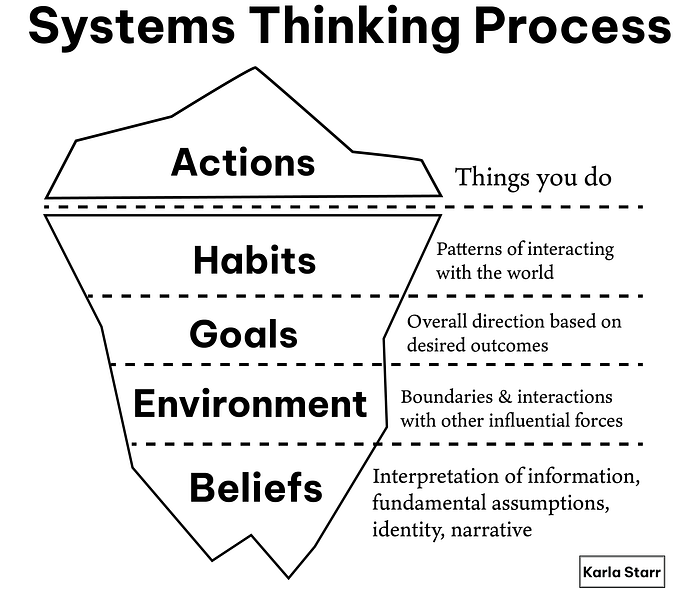
In the past, I've tried making changes like:
- Getting up earlier so I'd start working out, or taking a side project seriously
- Tweaking my eating habits to lose weight
- Declining invitations to go out, so I'd drink less
All of these attempts to make lasting change backfired, because they were all at the whim of something that could change: my environment, my wake-up time, my momentary self-control. Eventually, I'd get up late, find myself at a restaurant with friends, tempted at the grocery store, or getting wine to take home.
I lapsed and lapsed and couldn't get back on track. The problem wasn't with my habits, goals, or even my mistakes: the problem was how I was interpreting and adding meaning to the situation. When the problem lies with your fundamental assumptions, you'll always be interpreting events in self-defeating ways.
Why your actions aren't enough
Have you ever tried to change your long-term behavior by making it fun, easy, and satisfying? That's what I did when I started working out a few years ago: I bought all the nicest workout clothes, went to the gym when my 🔥🔥🔥 trainer was there, and made friends with some of the other gym rats. But in the beginning, I was still bringing my counterproductive attitudes to the gym: if I didn't make a lift, I'd get down on myself and complain that the programming wasn't working. If I gained a pound, I'd spend hours online researching supplements and better meal plans. I never felt fast or strong enough.
I still didn't feel like an athlete. I didn't feel like I belonged. I assumed that others were judging or making fun of me. I assumed that other people had it easier — they'd started earlier, had athletic families, didn't have such quirky bodies.
In short, I always felt like I had to do a million things to prove my right to be there, and I was stressing myself along the way.
I needed to work on my core beliefs.
If you can interpret information in a more helpful way, real change has the chance to take root. That's the power of our fundamental assumptions: because they stay with us in every environment, they're not fragile. They're resilient.
At the gym, my core belief needed to change from I am an out-of-shape disaster to I'm learning how to get better. I'm having fun. I used wise interventions like self-affirmations, self-compassion, and adopting a beginner's mindset.
But it was still difficult… I wanted to think I was the boss of the gym — or at least, that I had the right to be there. So what was so hard? I started paying attention to everything that was interfering with my ability to be 100% comfortable doing CrossFit.

The hidden influence of our social environment
A lot of self-improvement advice talks about the importance of your environment: get rid of phones if you want to focus! Hide your TV if you want to watch less of it! Put your exercise equipment in plain view if you want to work out! But we don't talk enough about our social environment. I suspect it's because a lot of self-help advice is written by people in positions of privilege, who often face fewer constraints on their behavior.
It's harder to hire people to outsource things if you grew up in an environment that prioritized saving money. It's harder to maintain healthy eating habits when your family or friends make snide comments because they feel self-conscious when you say "no" to dessert. It's harder to work on your side hustle or passion project if your friends hate their 9–5 jobs and assume that everyone putting in more hours is a workaholic.
Despite being surrounded by my trainer and my friends at the gym, I was still surrounded by oodles of messages pulling me in the other direction. How was I supposed to know that they were just self-conscious about their bodies and lashing out at me because of their insecurities? How was I supposed to know that Pete and Mike weren't speaking for all men — but just their own social groups? Like me, these men grew up nerdy and didn't think of themselves as athletes. They grew up with negative assumptions about athletes and what people's bodies should look like. This kind of normative social influence is underdetected.
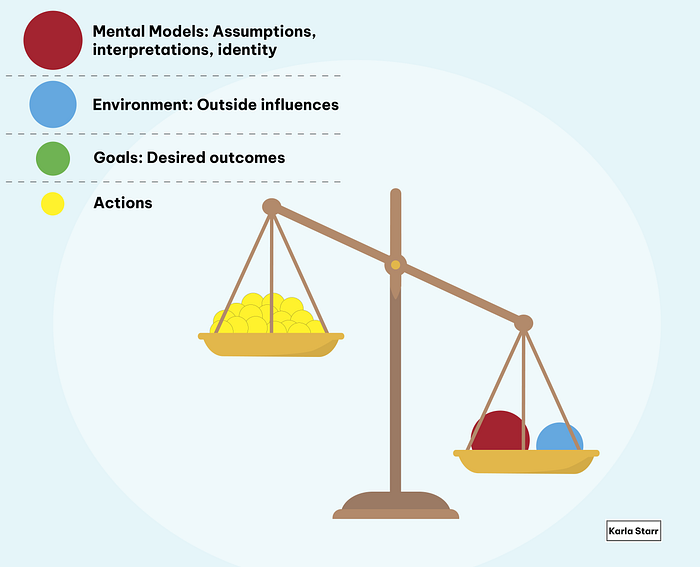
The best way to see how much something is affecting you is to make a big change.
I drew boundaries with people who were mocking physical fitness, body shaming me, and trying to define what a woman's body should look like. I drew boundaries with people whose mental models of the world made it acceptable for them to discourage me from getting healthy. (There were more of them than you'd realize.)
I became less judgmental of myself and others. Because my identity as an athlete wasn't tied to what I did, so I didn't stress out if I couldn't do a whole workout, or didn't always break my previous records. I treated my body better at home. I didn't stress about missing workouts because that didn't make me less of an athlete. When I couldn't get to the gym, I relished in self-care at home and made recovery a priority. I wasn't stressing myself out at the gym because I didn't have anything to prove. I had more fun. I saw more results in less time.
Contrary to popular books like Atomic Habits, there's no magic number of times needed to repeat an action before it becomes a habit, a goal, or even a part of our identity. Our behaviors are emergent processes — actions resulting from a combination of all of the little variables of life, like our environment, energy, constraints, and goals.
Changing what I thought about myself, and my situation, was the only time I was able to make my change last. But to change what I thought about myself in the long-term, I had to become aware of the things in my environment that were discouraging my goals:
- Body-shaming media
- The belief that I wouldn't find people who supported my journey
- Spending less time with critical people
- Asking why people were so interested in what I ate/did, and reminding them that they weren't my doctor
Our environment influences our identity, and vice versa. Having a professional work environment can help you take your work more seriously.
It's only once my identity isn't contingent on anything — once I fully know and accept myself — that my environment becomes an afterthought. By now, I've been writing for so long that I don't care about my setup. Give me a roll of toilet paper and a crayon: as long as I'm getting money or really have something to say, this shit's getting written.
Years ago, I was in an awful relationship with someone who slowly whittled away at my confidence by constantly asserting that his work was more important than mine. I didn't realize that this was killing my work until years later, when I was able to see it from a distance. If you have a negative view of yourself, your productivity, or lack confidence in your work, you'll never find the right work setup. You'll always second-guess your schedule or how you arrange your computer.
We talk about the inner game so often that we can fail to recognize what's right in front of our face: the people, places, and things that have helped shape your mindset to begin with. And that's the biggest reason why we may not even realize how much our social environment gets under our skin and prevents lasting change: these influences, subtle pressures, and constraints have already been there for a while. We may not realize how unhealthy or extreme they are. And, by now, we're used to it.