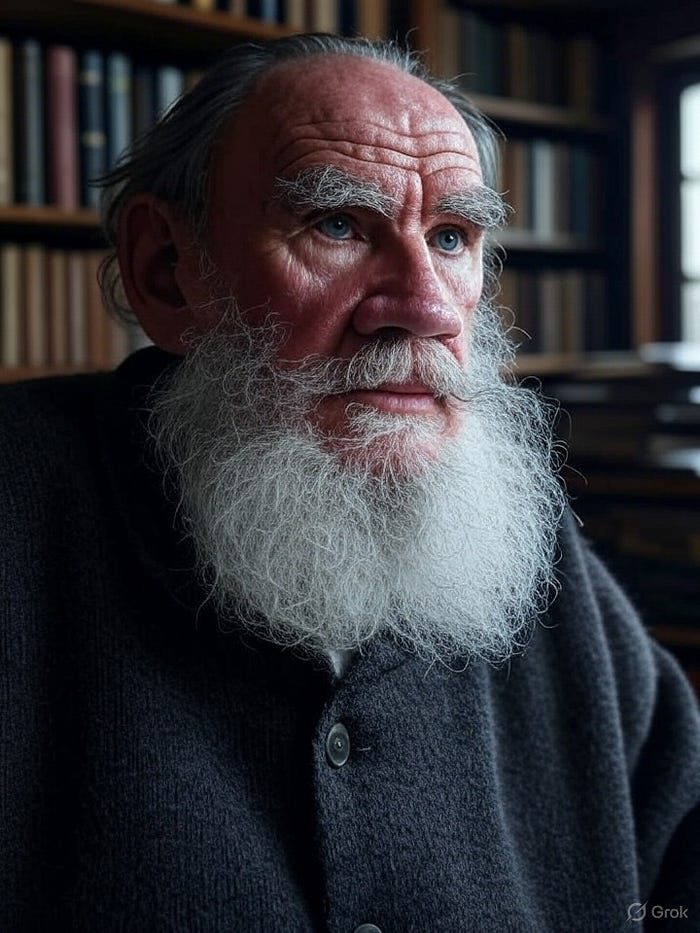

My whole life, I've been interested in these big questions. The ones you know — Why are we here? What's the point of it all? Does anything really matter? I'd used to lie awake at night with these thoughts, going round and round, like a record jammed on repeat. But little would I know that one of the most influential writers in the annals of time went down this same road of questioning the meaning of existence, and his quest would forever transform the way I view meaning of life.
The Crisis That Changed Everything
Leo Tolstoy was no ordinary writer — he was a literary colossus whose works include "War and Peace" and "Anna Karenina." By his 50th birthday, he had everything most people aspire to: colossal wealth, fame around the world, a loving family and a spectacular estate. But something profound happened to him that I deeply resonate with.
And, despite all his success, Tolstoy hit what I can only call an emotional wall. Suddenly, his entire store of happiness, which decades had accumulated, seemed to evaporate. Now he was asking the same kinds of questions, which were troubling me: "why am I here? What's my life's purpose? Why should I invest in anything if everybody's just going to die?"
The thing that most stood out to me about Tolstoy's crisis was that it didn't come as the result of failure or tragedy — it came in the midst of his greatest successes. And that taught me something really important: external accomplishments don't necessarily translate into internal meaning. You can have all the money and the recognition and all the relationships in the world and still feel totally empty inside.
Only sleep provided Tolstoy with any relief from these all-consuming thoughts. I read at a point that he had to actively avoid killing himself during this time. The burden of existential questioning had grown so unbearable that he existed in perpetual mental agony, "like an emotional toddler" who never stopped asking why. about everything.
The Four Paths People Take When Life Feels Meaningless

From his observations and his own battles, Tolstoy identified four paths through which people typically respond when life seems barren of meaning. I have found these pieces of wisdom so helpful to apply to my journey and to those around me.
Path 1: Embracing the Absurd
The first type is the one that just says life is absurd and it doesn't ask the deeper questions. Their response amounts to, so what? — life doesn't make sense, but why should it? Let's just live it anyway.
Today, I see this sentiment all around me. People immerse themselves in their daily grind, their Netflix queue, their coffee dates with friends, and purposefully avoid staring too hard into the abyss. There's something attractive about this approach — it's much less emotionally draining than 24/7 existential dread.
But this is what I've learned from Tolstoy's observation, and what I know from my own experience: This sort of thinking only works when you actually can turn off your thinking mind. If you are of a sudden volubility disposition, it's as difficult to ignore life's big questions as a fire alarm. At some point, something — a death in the family, a major life change, just years going by — forces you to confront these thoughts in any case.
Path 2: The Pleasure Trap
The second group has become the Epicureans, or, as Tolstoy would call it, living for pleasure; that is, material contentment. They stuff their lives with money, sex, music, travel, and any excess they can imagine.
I've tried this method myself. I had times where I thought that if I made enough money, purchased enough material items or enjoyed enough adventures, I would stumble upon that purpose I was searching for. And you know what? It does work — temporarily.
The problem is that gratifying yourself is like being on a hamster wheel. You're high off that new purchase, that new lover, that new vacation — but it doesn't last, and then you need something bigger and better to get the same effect. Tolstoy likened this to the honey drops in his well-known parable — sweet for a moment, but really just a distraction from what is important in life.
Path 3: The Ultimate Escape
The third course that Tolstoy saw was the most tragic — people who are so overwhelmed by the apparent meaninglessness of life that they think the only possible move is to end it. I want to be very clear: if you're grappling with these thoughts, please seek help right away. There are caring people and resources available.
What interests me about Tolstoy's observation is that he nearly reached this point and recoiled. He understood that even at the height of existential despair there remained something to be investigated, still questions to be asked. His refusal to stop looking, as opposed to giving up, was to become a cornerstone of his whole philosophy.
Path 4: Existential Limbo
The fourth one drew me to despair, for in it, I saw myself. Here are people who completely get that the absurd is utterly senseless — but have no more energy for it. They don't seem to be actively pursuing pleasure, nor have they yet stumbled upon faith, nor are they weighing the question of ending their life — they're simply stuck.
Tolstoy called this "spiritual weariness" — a kind of dulled tolerance of painful numbness that is somehow separate from authentic living. You're just going through the motions of living, with no feeling of purpose or joy. It's like being emotionally flatlined.
I personally experienced years of this state, and it's maybe the most frustrating of all four paths simply because you know what the problem is and can't seem to fix it. You're not blissfully ignorant, nor are you keyed up on the hunt for solutions — you're just stuck in a gray matter doldrums of acceptance.
The Revelation That Changed Everything
Tolstoy's breakthrough was an unlikely one: after watching poor peasants working in a field. And yet these very people, amidst adversity so severe, poorly clad; so much physical labor; and so fearful an outlook, held to a faith in God that could not be shaken. This faith was something Tolstoy's riches and intellect were unable to bring them: a purpose that was greater than their own circumstances.
This realization led Tolstoy to a difficult point of confrontation: his rational, intellectual quest for meaning had come to a dead end. Philosophy might explain to him why life felt so senseless, and science might be able to describe the mechanics of existence, but neither of these could give him the sense of meaning he so desperately sought.
What turned me to this leg of Tolstoy's journey was how it contradicts our modern assumption that smarts and pedagogy are corrugated forms that correspond to our happiness. Sometimes, the cleverest analysis of life's problems doesn't move us any closer to peace. Every now and then, we need something more than just pure reason.
My Personal Take on Faith and Meaning

And this is where I want to offer my own reading of Tolstoy's spiritual turn. The first time I read about his embrace of faith I was dubious. I was, like many today, under the impression that religious belief is a form of intellectual surrender, or some other form of wishful thinking.
But the deeper I looked into Tolstoy's method, the more I saw that he wasn't recommending blind faith or throwing critical thinking out the window. Instead he was acknowledging that humanity required something to fulfil them because simply falling into a life of material wealth and intellectual prowess would not do it.
Whether you call it God, the universe, love, or just "something bigger than yourself," often we get those moments when we know that there's something deeper to life than the scientific and measurable parts of our existence. Tolstoy's genius was in considering that this feeling — that we are helpless and in need of protection — while not a weakness to be corrected, perhaps points to something fundamental about human nature.
I don't believe everyone must adopt traditional religion to find meaning — but I do think Tolstoy was touching on something crucial: We need to become aligned with something larger and more lasting than our own impossibly transient lives and problems.
Understanding: Making Sense of Chaos
Another source of purpose I've identified is the quest for insight. Given that this power to change yourself is limitless, what's something you wish to learn or understand?
There is something deeply satisfying about picking apart something that starts off confusing or mysterious with the intention of slowly making sense of it all. Mind cast Whether it's trying to parse why you do the things you do in relationships, how the economy works or the wonders of astronomy, the process of moving from confusion to clarity creates a sense of movement — and of purpose.
What I've learned is that, more than any individual subject, it is the process of understanding that matters. The human brain appears to come wired with a thirst for meaning, for finding its own place in a world of life and consciousness and human understanding. When we are actively seeking to understand something — anything — striving for some resemblance of truth, we are moving forward more than we are surviving.
Service: Beyond Ourselves
The third source of meaning that speaks both to Tolstoy's words and to my experience has to do with service. This doesn't necessarily mean being a doctor or social worker (though those are great roles). Maybe it's baking cookies for your neighbours, writing songs that make others feel alive, giving support to a friend who's struggling.
What I do know is that some of the times I've experienced the most joy in my life, the times when I had that shimmer in my eye, have come when I've been able to make a difference for someone else or do something that mattered beyond my immediate situation. There is something about rising above ourselves and our habitual solipsistic perspective about what's in our interest that gives rise to immediate meaning.
The big lesson here is that service tends to feel like it has meaning when it because it connects genuinely to what you are interested in and what you are able to do. Being coerced into something or helping others out of guilt isn't the same as becoming personally invested in the reason you find your purpose.
Building a Meaningful Life in Practice

So what do we need if not economically meaningful lives? From what I've learned through his journey and from my own experiments, there are a few practical strategies that I've found useful:
Start Small and Be Patient
The Meaning of Life can't be expected to get solved in just one night. Tolstoy's crisis dragged on for years before he discovered his way forward. As with most things, the full meaning arrives not with a crash but in quiet increments, through small, daily acts.
Instead, I've found it better to look at the every day and add meaningful minutes into it, instead of waiting around for the big purpose to arrive. Doing one genuine thing in conversation each week, learning one new thing, or helping one person can act like a stone dropped in a puddle, starting circles of momentum toward a life that actually has meaning.
What I've Learned About the Meaning of Life
But after years of struggling with these questions about life's meaning, and studying Tolstoy's journey, here's what I believe about the meaning of life:
Life comes without prepackaged meaning — not to imply that life is meaningless. Rather, we can and do make meaning through our decisions, connections, and conduct.
The purpose of life, as I have discovered, is to seek human flourishing through truthful communication, ongoing learning, and genuine service to others. It's not about reaching some ultimate state of enlightenment in which you solve all of life's existential questions — it's about being fully immersed in the experience of being human.
What I love about this method is that everyone can do it, no matter where they are, no matter what their constraints. You don't have to be rich, like Tolstoy was, or famous, or even particularly gifted. You only need to be willing to engage genuinely with other human beings, continue learning and evolving, and to devise a means by which to have a positive impact on the world around you.