
Hi! I wanted to share the key lessons I learned from building and failing a B2C software startup called Boxio as a first-time founder. Although I wrote this as a playbook for myself to do things better next time, I hope this helps some first-time founders, too, at least to avoid common pitfalls.
TL;DR
If I had a time machine, I would give these four pieces of advice to myself:
- You are wrong! The number of crucial insights we learned along the way surprised me totally. Thus, I didn't initially understand how many of my assumptions would turn out to be wrong. So, be aware that your initial idea will be flawed in many ways; you just don't know how yet.
- Sell First! Like many, we rushed to build our product without first validating the problem, only to realize months later it wasn't urgent enough. So, iterate your plan in the right order: start with the customer and the problem. Then, iterate the product concept before building it.
- Listen carefully! I should have talked with potential customers more to discover their real problems. And despite knowing basic startup advice, I mistakenly thought Boxio was an exception. So, listen to customers to build the right product and experienced founders to build it right.
- Focus fanatically! I initially wasted time on tasks that felt urgent besides listening to customers and building the product. Once we disciplined ourselves with sprints to focus only on the most critical objectives, our execution speed skyrocketed. So, focus on tasks that lead you to PMF.
Summary
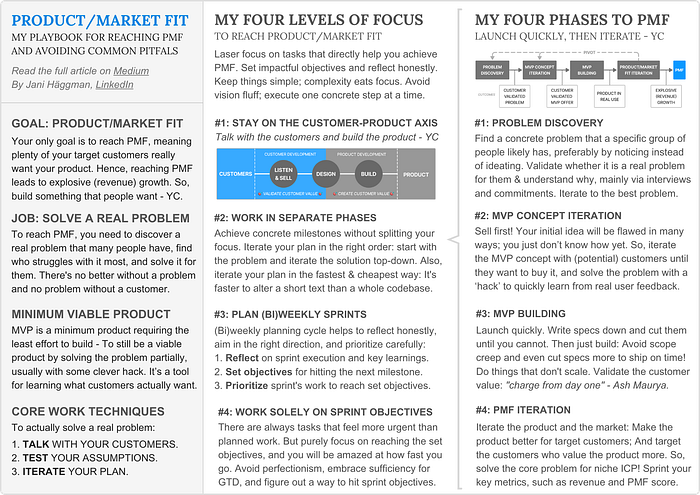
The one-pager summarizes the key takeaways from both parts: this overview and phases to reach PMF (link at the end). Although there's no magic recipe for reaching PMF, the basic execution advice is quite general. So, most of the advice included is originally from people wiser than myself.
Ps. I would love to get your feedback via LinkedIn DM or just comment here.
Background
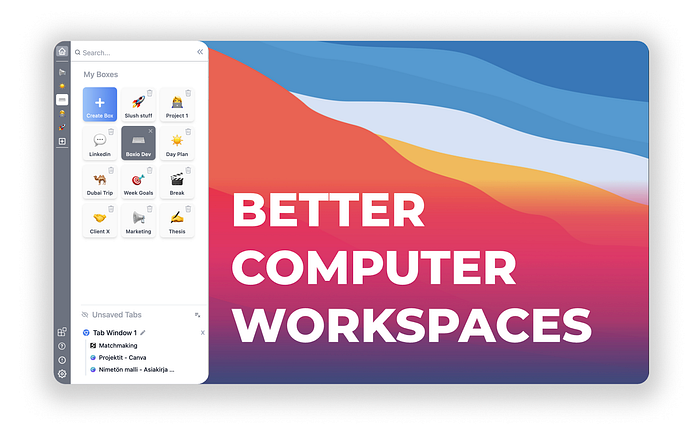
I was lucky to work with two incredible co-founders, Tuomas and Julia. The idea of Boxio was to solve the project-switching problem on a computer better than existing (multiple) desktops on Mac and Windows. It may sound like a cool idea, but it didn't matter when the problem wasn't urgent enough. In short, after six months and 500+ app installations, we left Boxio as a side project due to poor user retention. So, we never reached PMF.
Fundamentals
Just start the startup and do your best
The only sure way to fail a startup is to not start it at all. And the only way to learn how to build a startup is to build one. Boxio was my best startup opportunity, and without starting it, I might never have started a startup.
Also, be kind to yourself; no one is a perfect founder. Just do your best and reflect honestly on how you could move closer to doing things 'by the book'. Taking action and doing things well enough is what truly matters.

Your only goal: Product/Market Fit
When a significant number of your target customers want your product, it is logically called a product/market fit. Thus, reaching PMF leads to explosive (revenue) growth. The market refers to all your potential customers to whom you aim to sell and optimize the product. So, build something that your target customers want. Nothing else matters.
"You can always feel product/market fit when it's happening. The customers are buying the product just as fast as you can make it — or usage is growing just as fast as you can add more servers." — Marc Andreessen [1].

Your only job: Solve a real problem
The only way to reach PMF is by solving a real problem that many people have. If your customers find the product useful, it solves a problem for them. It might not be a 'hair-on-fire' issue, but it needs to be urgent enough to push them to buy your product. So, your sole job is to discover the problem, find who struggles with it most, and solve it for them. There is no better without a problem, and no problem without a customer.
Validate the problem to avoid solution-matching
"It sounds obvious to say you should only work on problems that exist. And yet by far the most common mistake startups make is to solve problems no one has." — Paul Graham [7].
I know how obvious it can feel that your product will be useful. That's why we also rushed to build Boxio without first validating the problem. But like many other founders, we realized months later that people didn't really want the product. We started with a vague customer profile of knowledge workers, which led us to try to match the product to many professions — without success. Many founders even try to match their products with very different problems. YC calls this a solution in search of a problem, SISP [3].

Nowadays, whenever I think my idea is useful without validating a concrete problem it solves for a specific customer group, I slap myself. It hurts much less than spending months solving a problem that doesn't exist.
Core work techniques: Talk, Test & Iterate
To solve a real customer problem, nearly every startup book advises to:
- Talk with (potential) customers from day one and never stop it — To deeply understand the problem that you are solving for them.
- Test your assumptions continuously and be hypothesis-driven. Always aim to turn your guesses into facts, starting with problem validation.
- Iterate your plan instead of blindly executing the original idea. Iterate your product, target customer, etc., rapidly based on new learnings.
My Four levels of focus to reach PMF
The only way to move fast is to laser-focus on tasks that directly help you achieve PMF. Initially, I wasted so much time on tasks that felt very urgent but didn't really help us to reach PMF. I also learned that complexity and vision fluff will eat the focus, killing the execution speed. So, I created these focus levels for myself to keep things simple and focus on the right things at the right time — to actually solve a concrete customer problem.
#1 Stay on the customer-product axis
YC urges founders to focus on two things to reach PMF: talking to users and building the product. So, stay on the customer-product axis to validate and create customer value. Do other things only for heavy reasons. For example, raise money as a time-boxed project when the time is right. Nothing else matters if your product is not valuable for your customers.

That said, be part of the startup community. I learned so much from more experienced founders. And although you might not have an average work-life balance, keep always work-recovery balance. So, enjoy the startup life!
#2 Work in separate phases
Initial startup ideas will always be flawed in many ways; you just don't know how yet. So, iterate your plan effectively with separate phases.
Firstly, iterate your plan in the right order by working backwards, as it is called at Amazon [4]. Discover the problem and customer profile first since they determine what a good solution even is. Then, iterate the solution top-down: if the product concept cannot solve the problem, then even the most performant software built on that concept still won't.

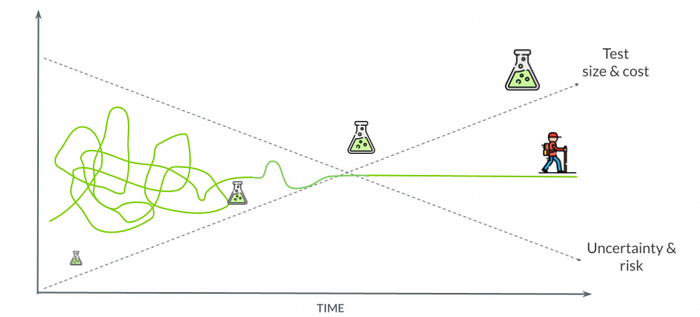
Secondly, test and iterate the plan in the fastest and cheapest way. Although many issues only show up with real product use, it's foolish not to uncover what you can by simply talking to (potential) customers first. Trust me, testing a product concept with thousands of code lines takes longer than with a short description. And, you don't need to build the 'ultimate product' to learn those usage-dependent issues. Just build an MVP that customers can use to partially solve the problem — to learn what they actually want.
#3 Plan (bi)weekly sprints
(bi) Weekly planning sessions allow you to reflect honestly, aim in the right direction, and carefully prioritise the work — So, that you can focus solely on getting things done during the sprint without constantly doubting tasks.
I prefer to split sprint planning sessions into three parts:
- Reflect honestly on how well you completed the planned work, achieved sprint objectives, and moved the needle closer to the next milestone. Discuss on learnings and what you could have done better.
- Set objectives (outcomes) to reach the next milestone. Select concrete objectives that are most critical to your success at the moment. Initially, select objectives for validating customer value: validate the riskiest things that your success depends on most. Later, add objectives for creating customer value, preferably as metrics like improving retention.
- Prioritise work (outputs) for the sprint to achieve set objectives. For customer value objectives, prioritise what to build: features, bug fixes, or improvements. To validate selected customer value assumptions, pick the most effective tactic, like conducting ten customer interviews.
Tip: Have clear decision-making roles Discussing and making decisions as a team is crucial. That said, having a decider (per topic) who makes the call leads to faster and better decisions, in my experience. Decider takes it more seriously since they're accountable for the outcome. Also, someone likely has more expertise than others.
#4: Work solely on sprint objectives
Focus solely on achieving the sprint objectives by getting the planned work done, and you will be amazed at how quickly you progress. However, this requires conscious effort: With Boxio, there were always 'fires' that felt more urgent than the planned work. Also, never settle for not achieving the sprint's objectives! If the planned work isn't enough, find a better way.
Tip: Keep the discussion continuous Each co-founder should know what others are doing while having zero friction in asking for help. For example, work at the same table or keep video chat open. Also, keep morning meetings: reflect on yesterday's results, share customer feedback, and plan the work for the day.
Tip: Avoid perfectionism and messy feedback Embrace sufficiency to get work done: things can be iterated later if really needed. For me, moving away from perfectionism was hard but incredibly valuable. And, avoid iterating things based on your differing opinions instead of customer feedback. For example, give suggestions (to fix things) during the sprint, and save the learning feedback for the planning session.
My four separate phases to reach PMF
Continue reading in the next part — on how to go from the problem to PMF.

References
[1] The only thing that matters by Marc Andreessen's (2007, blog) [2] How to Build An MVP by Michael Seibel, YC (2023, video) [3] How to get startup ideas by Jared Friedman, YC (2023, video) [4] Working Backwards by Colin Bryar and Bill Carr (2021, book) [5] UX Process, the Double Diamond by Rafaela Sobrinho (2023, blog) [6] The Startup Owner's Manual by Steve Blank and Bob Dorf (2012, book) [7] How to get startup ideas by Paul Graham (2012, blog) [8] Do Things That Don't Scale by Paul Graham (2013, blog) [9] What is a Minimum Viable Product (MVP)? by Ash Maurya (2024, blog)