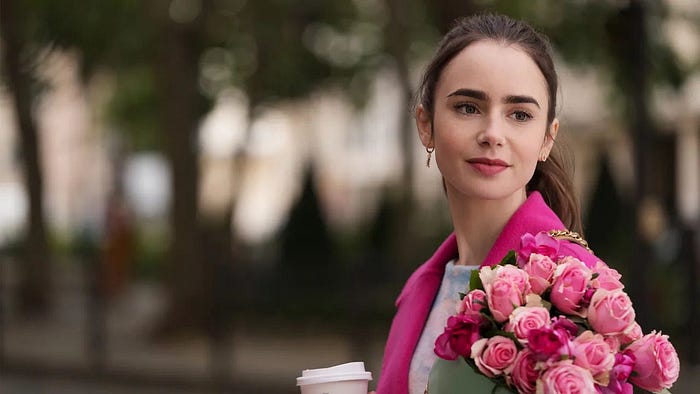


Netflix's original series Emily in Paris has long been roasted by viewers and critics alike, with criticism ranging from its narrative flaws, which include insufferably unidimensional characters and uninteresting storylines, to the countless accusations of racism and xenophobia targeting French people, racial minorities, Ukrainian women, and more. Yet, no controversy was big enough to stop the streaming giant from renewing the show for a fourth season.
To be fair, Netflix wouldn't renew the show if it didn't pass their viewing ratings standards. After all, David Fincher's brilliant Mindhunter was canceled despite its critical acclaim because its ratings were not high enough. But that begs the question:
Who keeps watching 'Emily in Paris' and why?
Considering that the Internet proliferates with people vocally hating the show, one is left to wonder where Emily's fans are — or whether or not they even exist. And yet, the cash flow says they do.
After some research, I found a few online op-eds that not only defend Emily in Paris but do so rather fiercely. One of them immediately stood out: 'Delightfully delulu': in defence of Emily in Paris, written for The Guardian by Jess Bacon. In the article, Bacon describes the show as "deliciously sweet" and claims that its true purpose and brilliance is its escapism, which, in the author's words, includes the "cute outfits," "daily pastries," and Emily's overall "dreamy life." Bacon also specifies that Emily's life in the show is designed for "the female heterosexual gaze."
As for those who don't enjoy Emily in Paris, or, as Bacon describes them, the "haters who really have it in for [the show]," the author suggests that such people are simply oblivious to or unappreciative of the show's true purpose: "blissful escapism." As for the supposed flaws of the show, Bacon discards them as petty and laughable, like the supposed claim that everybody in the show, including French actors, has a terrible French accent.
But the op-ed itself highlights the main issue behind Emily in Paris, which happens to be the very reason for its massive success. Bacon herself is a white woman in her twenties, just like Emily. She routinely travels across Europe and posts photogenic pictures of her numerous trips and fashionable outfits on her official Instagram page, as Emily does in the show. Though British instead of American, she is a white woman who can afford to live a life not too dissimilar from Emily's.
If you were to read Bacon's review of the show, you would notice how she carelessly glosses over the blatant racism and xenophobia of the series or even the way that the show glamorizes financial ignorance — something that can have particularly damaging effects on the youngest and most credulous of viewers.
Virtually the same exact opinion on the show is reflected in yet another article by The Guardian,¹ this time written by writer and editor Rebecca Liu, who is also British. Liu describes the show's "haters" as "snooty critics and Parisians," while praising the series, yet again, for its escapism:
Here was a show that resembled a sweet shop — bright pastels, fairytale cobblestoned streets, a city awash with light. Pastries and designer clothes and farmers' markets were all presented with a beautiful glow. And while millennials on television were typically bruisingly insecure, Emily moved around the world with a breezy, uncomplicated self-belief. Without much effort, she won over her clients, found an Instagram fan in Brigitte Macron and was given a modelling stint that made her the talk of the town.
When it comes to the show's negatives, Liu is rather curt: "I saw all of Emily in Paris's failings. I understood them. And I loved the show all the same." To be clear, Liu avoids confronting the racism and xenophobia of the show (much like Bacon did) and describes the show's stereotypes about France not as inaccurate but as "painfully obvious." By contrast, the YouTuber FriendlySpaceNinja — who, unlike Bacon or Liu, is actually French and actually from Paris — had this to say:
"Everything that is represented on screen is either some lazy made-up bullsh*t or an extremely degrading cliché that has no basis whatsoever. 'Emily in Paris' isn't a love letter to France. It's an American vanity project."
All in all, the demographic praising Emily in Paris, as exemplified by Bacon and Liu, seems to confirm the idea that the show is primarily meant for women who are similar enough to Emily — white, cisgender, heterosexual, and ignorant of any culture other than their own— while not as wealthy, privileged, or "lucky" (which is really just a combination of the former two). This minimal difference leaves just enough room for the dream scenario to kick in and sweep the viewer off their feet with its romanticized, America-centric, xenophobic, and culturally insensitive view of France and French people.
For the average viewer who finds Emily in Paris to be a "delightful escape" from everyday life, harmful stereotypes about other nations, disenfranchised communities, or foreign cultures are of no interest. What is of interest is the dreamy, pastel-colored, Instagram-friendly "Parisian aesthetic," which is, in itself, a fabrication of the American mind.
People whose lifestyle and background resemble Emily's tend to be blind to their own privilege, just as they tend to be blind to others' struggles and disadvantages. Therefore, for such viewers, it is not a problem that virtually the entirety of Emily in Paris' cast is white, that the show only has three recurring POC characters, and that one of them, played by Samuel Arnold, is the most stereotypical caricature of a homosexual man since Sex & The City's Stanford Blatch — which is perhaps not so surprising, considering that the two shows have the same creator (Darren Star).
People who claim to enjoy Emily in Paris refer to it as a "comfort show," but the truth is that this show is designed to only provide comfort to a very specific (and unsurprisingly very large) demographic. And the reason why Emily in Paris is so successful with this demographic is the same as why the creators set out to make the show: Emily Cooper is the quintessential privileged white American girl. But, even more importantly, she is the quintessential privileged white American girl's fantasy brought to life: she looks like an Instagram filter, with actress Lily Collins' face airbrushed to have no skin texture at all; she dons one haute couture outfit after another (with the €70,000 clothing budget for Season 3 speaking for itself); she magnetically attracts every handsome French man that she encounters, including her best friend's boyfriend (because no love fantasy would be complete without a taste of the forbidden), and, of course, she is living a dream life in a European capital, which she navigates seamlessly, without ever having to worry about the high costs of living in Paris or even knowing the country's language.
In the America-centric view of the show, the city of Paris is nothing more than a playground for Emily to stroll in. Emily's "adventure" in Paris consists almost exclusively of stereotypical "girly" moments, such as her numerous romantic rendezvous, her endless series of Chanel outfits, her picture-perfect Parisian breakfasts, and her casual encounters with The Man of Her Dreams, which virtually occur every five minutes because, well, destiny is bringing them together.
The utopian dream of Emily in Paris even covers the narcissistic social media vanity of its target audience: Emily becomes an Instagram celebrity only days after her arrival in Paris, and her French vlogs immediately take off, making her a social media sensation. As is the case with much of Emily's personal success in the show, she doesn't have to work for it: it just happens. Emily didn't have to work hard or fill in hundreds of paperwork to land a job in Paris, or even bother to learn the country's language. In fact, the very reason why she got the job in the first place was nothing but a fortuitous turn of events. The implication is subtle but clear: good things keep happening to Emily without her having to work for them because she is a privileged white American girl.
As a European who used to live in the U.S., I can't say I am surprised by American media appropriating, misrepresenting, and vilifying foreign cultures. In fact, I believe it is safe to say that Europeans have it a lot better when it comes to representation in American media than any other non-white community in the world. But is that even a consolation?
Stereotypes about other countries and cultures are so deeply ingrained in American culture that they are seemingly unquestionable: Italians are loud and speak with their hands, French people are cheaters, Eastern European women are materialistic gold diggers — all stereotypes that Emily in Paris explicitly reinforces, apart from the first one, even though, considering that the show's new season is set in Rome, I feel rather concerned, especially as somebody who was born and raised in Italy and, specifically, in Rome…
But the sad reality of Emily in Paris's success is not only that a show as culturally and racially insensitive as this could be made in this day and age, but also and especially that its target audience is as blind to the insulting nature of the show as it seemingly is to their own privilege. After all, why would you bother trying to understand somebody else's not-so-dreamy experiences when you can indulge in an American-made fantasy of a romantic vacation in Europe? And who needs critical race theory or financial literacy anyway? That is, as long as you're privileged and white…
¹ One is left to wonder if there is something more to The Guardian's love affair with Emily in Paris…
Join our Anti-Review contest here.
If you enjoyed this story, please consider showing your support and appreciation to the author by buying her a coffee!