

Every day we wake up in the morning, tidy up, grab breakfast quickly and hurry to reach office on time. We spend thousands of hours solving problems for companies that we work for. We lose out on sleep, miss vacations and leisure hours so as to attend to office matters and spend most part of our days on work-related issues. We do this in the hope that what we create and contribute in the workplace will be useful to people in some way. There are personal benefits like a salary that we take home to feed ourselves. But when we initially sign up a mental contract to dedicate our presence to a workplace for a prolonged period of time, we look beyond the monetary benefits.
We aspire to work on relevant problems, we look forward to collaborating and learning from others and create meaningful work. An important need amidst everything else is to engage in a place that is kind and respectful, i.e. be among kind people, connect with colleagues, be appreciated, and have honest conversations and feedback. Although this is what we need, we are very much conscious that today's workplaces can be hard, unforgiving, rote and inhumanely at worst. We pass through those days with the hope that things will get better in the future. Or we totally disconnect from our needs and keep going on as we can't find ways to make kindness happen around us.
While it is easy to look around and find negativity, frustration, political conflicts in today's world, the importance of responding to others with kindness can't be expressed enough.
Harvard Research says "Fear and anxiety impacts our cognitive control in a negative way. Thus, the most compassionate response will give you the most powerful results in workplaces."
Kindness is a strength as opposed to it being seen as weakness in work environments. Being kind ensures employee's loyalty and improves their performance. Through the law of reciprocity, practicing kindness is key to building a work culture that appreciates empathy and genuine human connections thereby repressing workplace bullying or isolation.
The question that comes to mind is how to practice and spread kindness?
The first approach to this is to catch people doing something right, however small it is and appreciate them for doing so.
The second is to notice subtle suffering around us and participate in kind actions to alleviate the pain.
There are good leaders who understand this and practice this through oral communication or through other means. But most of us lack an opportunity to express our thoughts (as employers or employees) and to share them in a safe place.
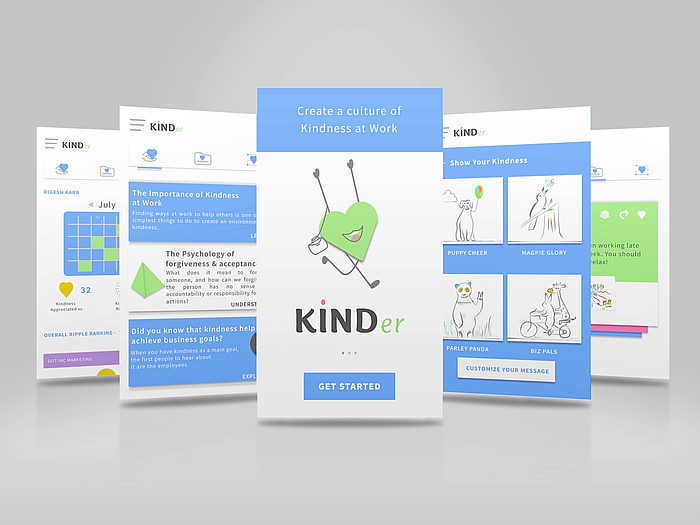
Meet Kinder, an app that cultivates kindness in workplaces, thereby improving the quality of lives of every working person. Whether you're a boss or an employee, this app is designed to cultivate human interactions that nurture honest, positive, and encouraging conversations by making them convenient to happen in a safe and digital space.
Design Process
As cultivating kindness can take place only as a result of changing the social conditioning in our minds, the overall goal is to design for social impact and outcome. Since this is my first UX project, I want to keep the design process simple. The 3 steps that I followed in creating the final prototype are Understanding, Planning, Designing.
Understanding
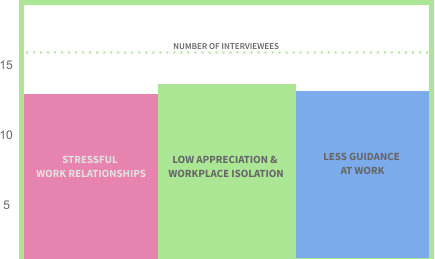
With the initial conception of the idea, I set out to grasp user needs and requirements. The research involved 16 working individuals (team leads, bosses, and employees, ages 26 to 42 years) from various companies.
What I came to find is that 13 of them found their workplaces to be unkind and stressful.
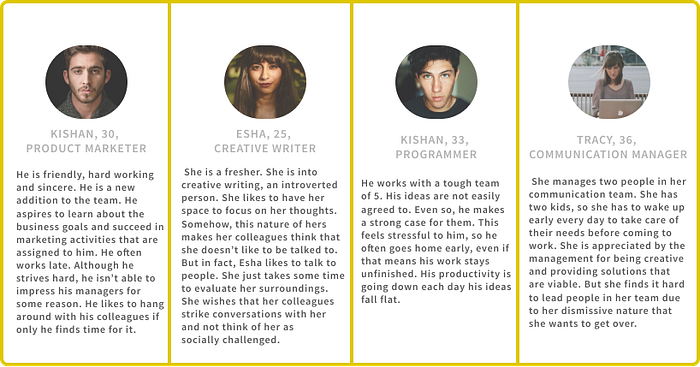
After validating the idea through user research, there was a brief persona study for discovering the user types.
To understand the flow of tasks, user scenarios were outlined on Trello.
Planning

Before designing the prototype, the app's Information Architecture was laid out, along with wireframes. For brevity, I am sharing one of the screenshots here.

Designing
The tool is designed to help rewire the user's understanding of kindness, encourage the habit of communicating with compassion at work in the long term.
The app has three sections; Show, See, Track (Kindness). To show kindness, there are various pre-thought out cards to choose from, or it can also be a custom message from the user. The feed in the Show screen contains resource articles that help unlock the kindness potential of the user, thereby embarking a journey in building kindness at work.
A user can see his or her Kindness cards received from workmates in the See section. For each card received, he is given the options to Appreciate, Archive, Reply or Block the message. To ensure privacy, if 3 or more of a sender's messages are blocked, his account will be revoked for inquiry.
Tracking kindness allows the user to visualize Kindness Appreciated (KA) & Kindness Ripple (KR) quotients created by him. KR is the aggregate number of kind events that eventually occurred in the team because of the kindness showed by one particular user. For boosting kindness in teams, users can also discern the Overall KR (sum of individual KRs) of teams they are a part of.
Here's the final prototype if you are interested in checking it out.
Conclusion
Doing this project has helped me get my feet wet in understanding the basics of User Experience Design. I have come to learn to conduct user research, identify the pain points of users, meddle with different possible solutions, create wireframes before designing the final prototype using a design tool called Figma. While designing the app, I intentionally stayed away from the well-used gradients model. I wanted to keep the design simple and effective. I made the vector images on my own to realize the importance of visual aids in app design. I hope this knowledge serves me in making effective design projects in the future.
This is a personal behavioral change project that is designed to bring back humanity in work environments. If we want to create such changes in reality, it is not just up to the leaders but all of the working individuals to bring out the best in people around us and to engage in team activities that celebrate what's going right and fixes what needs help. Because, when people feel belonged, they will be more creative, loyal and inspired to produce meaningful work.
How do you think we can cultivating kindness at work? Let me know in the comments.
Thank you for reading so far! I welcome freelance design projects that help change social behaviors, improve living conditions of communities. Hit me up at preethishreeya1@gmail.com for working with me. Much love. ❤