

When you wish upon a falling star, you're actually offering your hopes and dreams to a small piece of space rock burning up as it plummets through earth's atmosphere known as "Meteors".
These brilliant streaks of light have entranced humans for centuries, especially when they arrive in bursts of blazing glory during sky shows called "Meteor Showers".
Is Meteor Showers are Space Debris?
Yes, Meteors are space debris and about 50 tons of space debris are crash onto the earth everyday.
While some debris shyly dissipate into the atmosphere, other displays a "Spectacular Light Show".
Meteor showers occur when the earth's orbit intersect with the orbit of a "Comet".
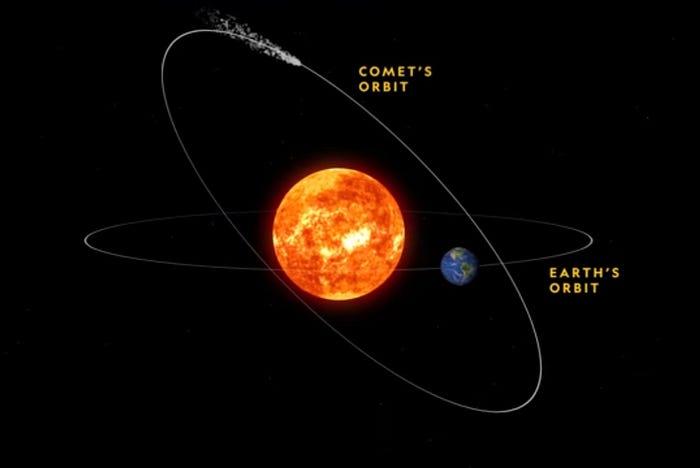
In which the earth orbit is intersects the comets orbit.
As comets travel, they leave behind trails of rocky materials, often times the size of pebbles or grains of sand, but sometimes as large as Boulders.
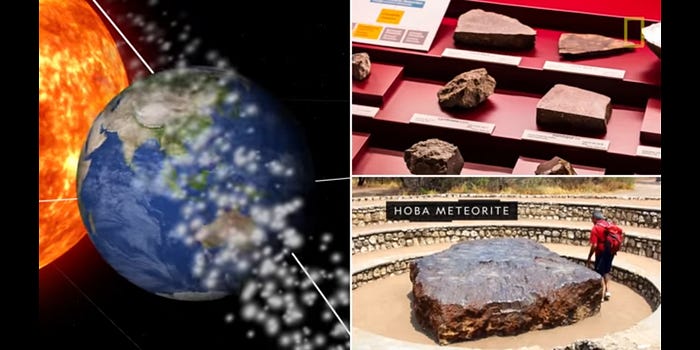
In this small pebbles or grains of sand to the large as Boulders. In this the largest meteor is "Hoba Meteorite" in the Earth discovered in the Namiba 1920and weights roughly 119,000lbs(Pounds) or 53,977.42 Kilograms.
Scientists estimate the most meteors are the size of a pebble and 99% are approximately 50 Tonnes Space debris are falls on earth surface every day of that size.
Every year, the Earth crosses these trials of debris known as Meteoroid Streams, and the planets becomes sprinkled with Rocky Materials.
And we are not alone; meteor showers also happen on Mars, although the red planet sees different displays based on the cometary paths it crosses.
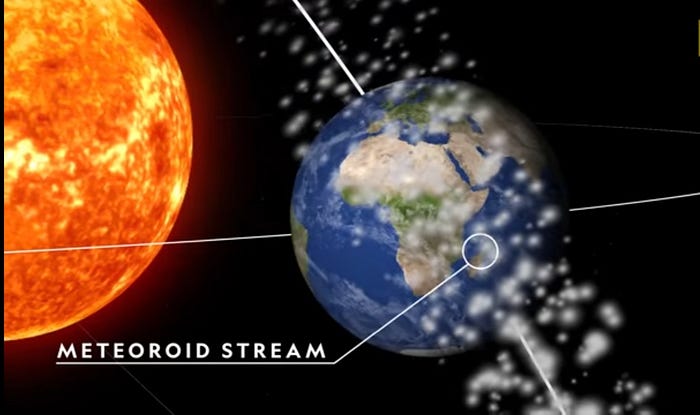
Crosses these debris to earth's orbit and it becomes a Meteoroid Streams.
The debris then race through the earth's atmosphere, creating friction with air Particles and generating vast amounts of Heat.
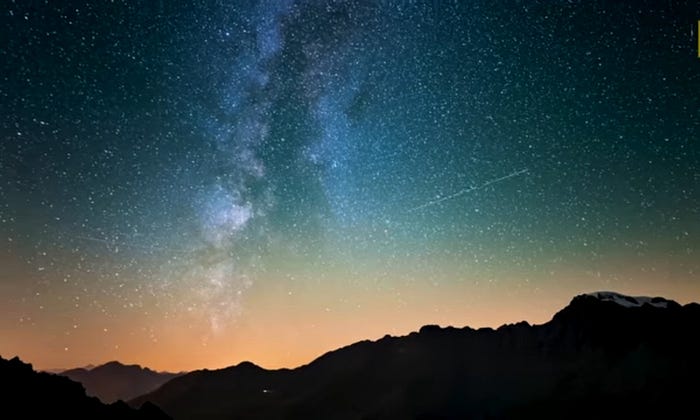
This heat vaporizes and illuminates the debris as they fall, creating streaks of light in the sky, popularly known as "Shooting Stars".
These celestials light shows are often named after the constellation where they appear to originate as seen from Earth's Surface.
Celestial object which is located outside of earth's atmosphere, such as Moon, Stars, Planets or astroids.

The constellation looks like the Perseus and only happens every year of August.
Meteor showers are famously known as Constellation and the four major constellations are:
- Perseus (Perseids),
- Gemini(Geminids),
- LEO, and
- Lyra.
Meteor showers that seem to fall from the constellation "Perseus" are called the "Perseids", and these appearing from the constellation "Gemini" are called "Geminids".

The constellation is look like Gemini and is only happens every Mid of December.
About 30 Meteor showers can be seen from Earth throughout the course of a year, and because the showers are timed with Earth's orbit, the celestial phenomenon are cyclical and occur at regular intervals.
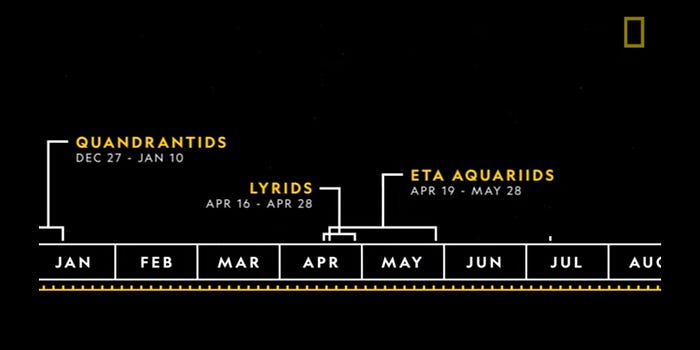

For example, Perseids Meteor showers happens every August, and the Gemind Meteor shower happens every December.
Meteor enters the earth's atmosphere as speed ranges from 25,000 MPH to 160,000 MPH it is frightening to imagine that interplanetary debris flying towards us.
Scientists have known since the mid-1800s that almost all meteor showers are born from icy comets.
When one of these visitors from deep space enters the inner part of the solar system, heat from the sun causes ices on the comet's surface to change from ice to gas, a process called "Sublimation". This is what produces a Comet's ☄️ beautiful tail.
Cameras around the World are captured Meteor showers falling from the sky and all those some of the eventually hit and most of them are disintegrate and burnoff their remaining pieces are falls to the oceans.
When their survived fall and hit the land we called them as "Meteorites".
In Christian tradition, the perseid meteor showers symbolize the tears of a Saint.
"Saint Lawrence", who was executed that in August of the year 258 and in the first century A.D.
The Astronomer "Ptolemy" believed that Shooting stars were a sign of the gods looking upon mortals and listening to their wishes.
Inspiring everything from making wishes to reveling at the sky, Meteor showers are a reminder of our place in a dynamic and beautiful "Cosmic Ecosystem".

Meteor Showers looks like in the above picture.
How can we experience the Meteor Shower?
The best way to experience a natural meteor shower is to head into darker rural areas.
Away from the light pollution, and wait for the shower's radiant constellation to rise high in the sky. Allow your eyes to adjust to the dark, and then watch out for the ephemeral bursts of light
A few meteors may fall on any given night, but the best time to watch for them is during the peak of an annual Meteor shower.
Unfortunately, Astronomers can't predict a given meteor shower will produce especially dazzling displays with much accuracy.
And some of the major meteor showers are best seen from either the Southern or Northern hemisphere, depending on their associated constellation. To offer a more controlled experience, one company in Japan has proposed a way to create "Artificial Meteor Showers" using satellites and specially designed "meteors" made of chemical-filled pellets.
But a Meteor is not a "Shooting Star", because it may be a Satellite falling into the earth's atmosphere.
This is when Earth crosses through a particularly dense part of a comet's debris stream, an event that happens at predictable times each year.