
A Directed Acyclic Graph (DAG) is a powerful data structure used in data pipelines, workflow engines, blockchain, Airflow, and analytics systems. Learn what a DAG is, why it matters, and how it powers modern data engineering.
Introduction
If you've ever worked with Airflow, Argo Workflows, Spark, Databricks, blockchain networks, or ETL pipelines, you've likely heard the term DAG. But what exactly is a DAG, and why do modern data and cloud systems rely on it?
This blog breaks it down in the simplest way possible — with examples you can easily relate to in real-world cloud and DevOps environments.
What Is a DAG?
DAG stands for Directed Acyclic Graph. Let's break this down:
1️⃣ Directed
The graph has direction — A → B → C. You always move forward, never backward.
2️⃣ Acyclic
There are no loops or cycles. You can't go A → B → C → A.
3️⃣ Graph
It's a set of nodes (tasks) connected by edges (dependencies).
In simple words:
> A DAG is a flow of tasks where each task depends on the previous one, and the flow never loops back.
Why Are DAGs Important?
DAGs are used to design safe, predictable, logical workflows where order matters.
✔ Ensures tasks run only when dependencies are ready
Example:
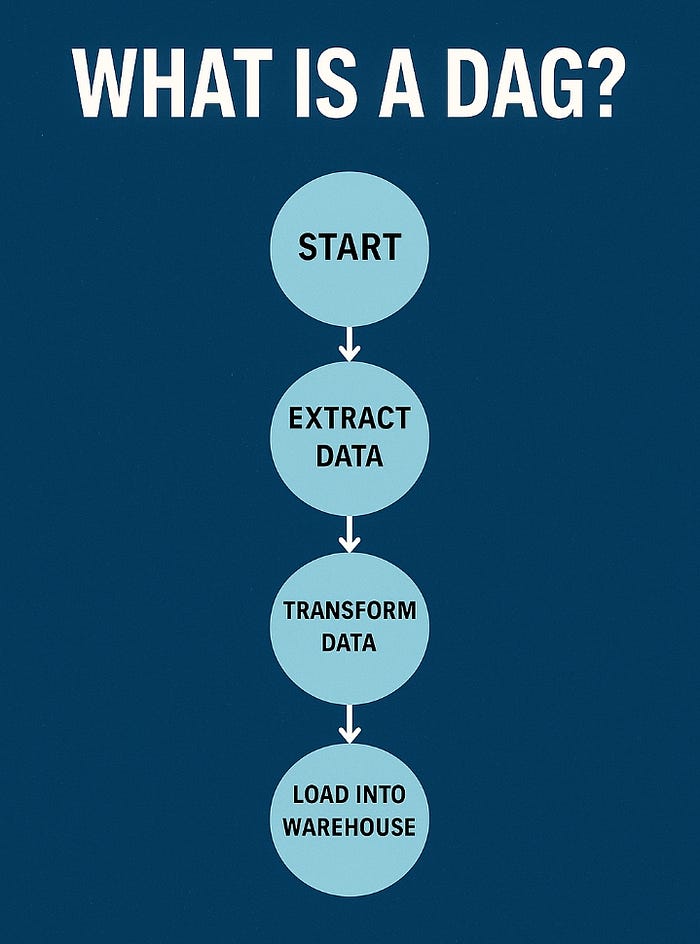
Step 1: Extract data
Step 2: Transform data
Step 3: Load data Step 3 will never run unless Step 2 finishes successfully. ✔ Prevents infinite loops
Systems always move forward — this ensures stability.
✔ Makes pipelines reproducible and reliable
Exactly the same result every time you run the DAG.
Real-World Use Cases of DAGs
1. Airflow DAGs (Most Popular Example)
Airflow uses DAGs to define:
Scheduling
Dependencies
Task execution order Example: Data ingestion → Clean → Validate → Load → Notify Each step is a node in the DAG.
2. Data Engineering Pipelines
Databricks, Spark, Glue ETL, and BigQuery all internally use DAGs to decide:
When to run a task
What the next step is
How to handle task failures
3. Cloud Infrastructure Automation
Tools like Terraform generate internal DAGs to understand resource dependencies, such as:
Create Network before VM
Create IAM before enabling service
Create dataset before listing in Analytics Hub This ensures correct order of deployment.
4. Blockchain Systems (Like IOTA, Hedera)
Some blockchains use DAGs instead of traditional chains for:
Parallel transaction execution
Higher scalability
Faster processing
5. Machine Learning Pipelines
ML systems use DAGs to structure:
Data preprocessing
Feature engineering
Model training
Model evaluation
Model deployment
DAG Diagram (Simple Visual)
Start ↓ Extract Data ↓ Transform Data ↓ Load into Warehouse ↓ Send Notification ↓ End
Each step is a node. The arrows represent direction. No step loops back → acyclic.
Benefits of Using DAGs
High reliability
Clear task dependencies
Efficient execution
Simplifies complex pipelines
Parallel execution where possible
Easy debugging
DAGs in DevOps & Cloud — Why You Should Care
As a DevOps or Cloud Engineer, DAGs show up everywhere — even if you don't notice them. You use them when working with:
Airflow
Terraform
Dataflow / Databricks
Kubeflow Pipelines
Cloud Composer
Serverless workflows
GitHub Actions
CI/CD Pipelines (Jenkins stages form a DAG internally)
Understanding DAGs helps you:
✔ Build better pipelines ✔ Troubleshoot failures faster ✔ Improve workflow efficiency ✔ Understand dependency graphs used by cloud services
Conclusion
A DAG (Directed Acyclic Graph) is one of the most important concepts in modern cloud computing, data engineering, DevOps, and workflow orchestration. It ensures your systems run smoothly, predictably, and without loops.
Whether you're designing Airflow pipelines, Terraform modules, ETL jobs, or ML workflows — you're already using DAGs.
Venkat C S