

I went to Vietnam with my 27-year-old son, expecting to learn something about history.
I did not expect to come home thinking about power.
Somewhere between the tunnels in the south, the tunnels near the former DMZ, the prison museum in Hanoi, and long conversations over late night coffee in Saigon, I realized I was watching something bigger than a country telling its past.
I was watching how stories are shaped.
It was also the first time I heard it called 'the American War.'
We heard it first in Saigon at the War Remnants Museum. The first time I heard it, it caught me off guard. It sounded almost accusatory.
And then I realized, of course. From their perspective, that is exactly what it was. Just as we call it the Vietnam War to distinguish it from the other wars we have fought.
Same war. Just seen from the other side.
More than once we heard someone say, whoever wins the war writes the history books. And the museums.
It was said like a simple fact.
And that line stuck with me.
The Stories We Tell
In the north, the story felt more controlled.
At the Hanoi prison museum, American POWs were described as treated well. Given better rations. Allowed to play sports. Photos of smiling men on the walls.
Nothing they said was technically false.
But it wasn't the whole picture. It focused on the last 6 months, not the entire 8 years.
There was no mention of the injuries that lasted decades. The isolation. The psychological toll.
It wasn't a lie.
It was selective.
And I kept thinking about how often that happens everywhere. Not just in war. In organizations. In families. In public life.
We tell the version that makes sense from where we stand. Or the version that lets us sleep at night.
Two Kinds of Tunnels
Before this trip, I didn't fully understand what "the tunnels" meant.
The Cu Chi tunnels in the south were built and used by the Viet Cong. They were an underground network for guerrilla warfare. Fighters could move unseen, store weapons, stage surprise attacks, and disappear.
We went to a less popular section that had not been widened for tourists. Crawling through even a short stretch was hot, tight, and uncomfortable. You immediately understood how small they actually were.
Henry is six feet tall and about 220 pounds. Watching him crawl through those tunnels made it real in a way no documentary ever could. At one point he came up and said he could not imagine being a soldier on either side, younger than he is now, crawling through that in the dark, not knowing what was ahead or behind you.
It stopped feeling historical. It felt human.
A few days later we visited the Vinh Moc tunnels near the former 17th parallel.
These were not military tunnels. They were built by villagers whose homes happened to sit just north of the DMZ. Their location made them constant targets during bombing campaigns.
So they went underground.
More than 300 people lived there for years. Families. Almost 60 children were born there. They even dug wells down there.
It wasn't about fighting. It was about staying alive.
Vinh Moc just felt different.
Cu Chi showed how war was fought. And Vinh Moc showed who had to live through it.
That difference is hard to unsee.
Khe Sanh
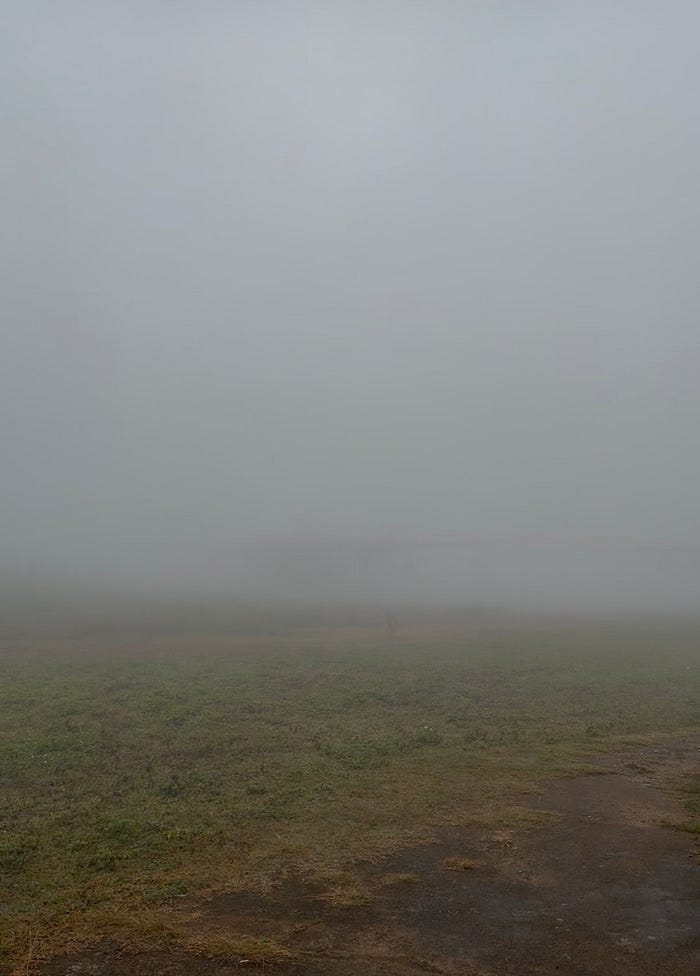
When we arrived at Khe Sanh, it was cold and misting. Thick fog hung over everything. You couldn't see more than twenty feet in front of you. It felt isolated. Almost forgotten. Just miles from anything.
For most people, it's another former battlefield.
For me, it's tied to a man I never met. My mom's fiancé was killed near Hill 881S, not far from Khe Sanh, in 1967. He had just turned 22. His remains were not returned until 2005.
Standing there, I tried to imagine what that hill meant to my mom at twenty one. How grief shaped her. How the absence of one man changed the direction of her life. Which eventually changed mine.
The fog made it even harder to get your bearings. You quickly realize how little control anyone had in that terrain.
Wars are often described in terms of strategy and territory and numbers.
But when you stand there, it feels very personal.
Sometimes all it takes is one moment. One decision. And someone doesn't come home.
The AK-47s
At Cu Chi, there's an option to fire AK-47s at a range. It's presented casually. Something you can do or not do.
Henry and I did it.
Afterward, they handed us scarves. We assumed they were just souvenirs.
Later we learned what they symbolized. They weren't neutral. They were associated with the Viet Cong.
I remember that feeling in my stomach when you realize you've stepped into something without fully understanding what it meant.
We got rid of them.
It wasn't dramatic. Just an acknowledgment that we hadn't thought it through.
That moment has stayed with me.
What Stayed With Me
Vietnam didn't give me a single conclusion.
It made me think.
It made me appreciate how layered the country is. How much depends on who you talk to, where they live, what they lived through.
If someone were to come to the US and talk to ten different people, they'd probably leave with ten different versions of what this country is and what is true.
Vietnam felt the same.
Narratives shift depending on where you're standing.
I came home more aware of that.
And maybe that awareness matters more than certainty.