What would motivate a company to pay $25,000 to someone trying to break their system?
That's the offer Claude's team put on the table earlier this month. Through a new bug bounty initiative, they invited a select group of external researchers to stress test their latest safety classifiers, with a specific goal in mind: find universal jailbreaks in an unreleased model trained to block content related to chemical, biological, radiological, and nuclear threats.
By offering up to $25,000 for validated universal jailbreaks, Claude's team isn't just fixing bugs. They are outsourcing creativity, adversarial thinking, and validation from diverse perspectives. It is a modern twist on crowd testing with high-stakes goals.
And while this effort is focused on AI safety, the principle behind it has broader relevance. Crowd testing, when applied thoughtfully, unlocks real-world insights that internal pipelines may not expose. It is not just about increasing coverage. It is about expanding perspective. In essence, it provides a stress test for assumptions, not just code.
What Crowd Testing Really Is
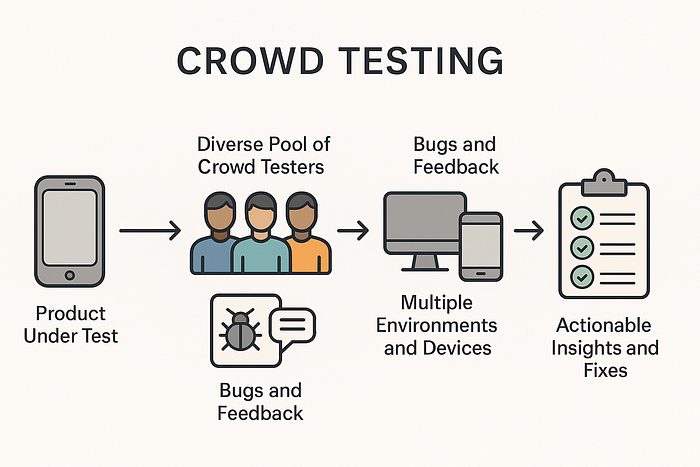
Crowd testing is the structured use of external testers to evaluate products, platforms, or systems in unpredictable, real-world conditions. It first gained traction in mobile app development, where internal teams often struggled to simulate the full diversity of user environments, networks, and devices.
Today, its application goes much further. Crowd testing is now used in:
- AI red teaming and safety validation
- Accessibility and localization testing
- Security and penetration testing
- Compliance verification in regulated domains
- Pre-release validation and post-release discovery
The underlying idea is clear. Internal teams, no matter how experienced, cannot fully replicate the complexity of real-world usage. Crowd testing fills that gap by injecting diversity, variability, and scale.
Where It Fits in a Modern Testing Strategy
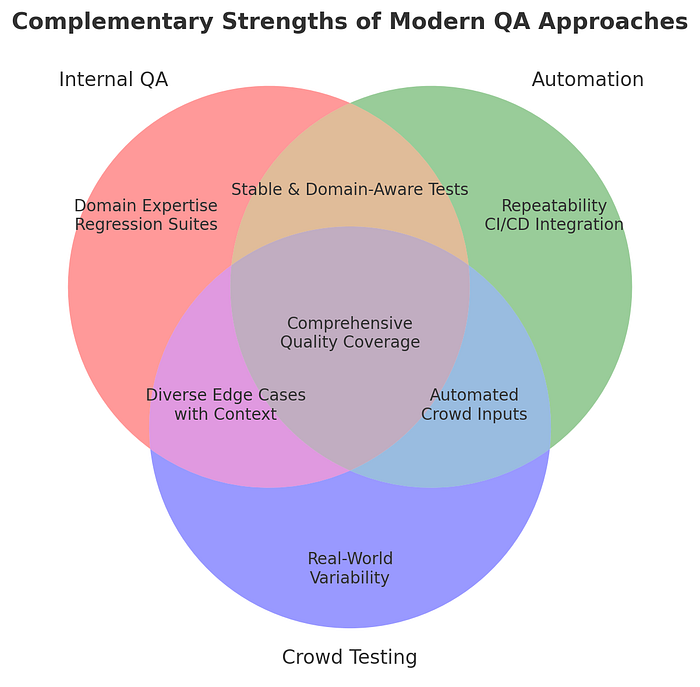
Crowd testing is not a replacement for traditional QA practices. It is a strategic complement. When integrated thoughtfully, it strengthens the overall quality stack by introducing new perspectives and testing conditions that internal processes might miss.
Here is how it fits alongside other approaches:
- Automation ensures consistency and speed, but it cannot anticipate the full range of human behavior and edge conditions.
- Internal QA provides deep domain knowledge, but often within constrained environments.
- Penetration testing and red teaming simulate threats, but usually in narrowly defined scopes.
- Production monitoring flags issues after deployment, but crowd testing can catch those issues beforehand.
Crowd testing extends beyond validation. It introduces creative friction. It surfaces the unknowns. And it helps organizations move from functional readiness to field resilience.
A Firsthand Example: Launching a Mobile App at Scale
While leading the launch of a global mobile eCommerce app, our internal QA process was solid. We had comprehensive automation in place. UAT had passed. Confidence was high.
Still, we made the decision to engage a curated group of external testers across global regions and real devices. Within just three days, the crowd surfaced more than 30 issues. These included layout problems on older operating systems, payment flow breakdowns in certain markets, and UI inconsistencies under low-bandwidth conditions.
The experience taught me that real-world variability, especially across devices and user behaviors, is hard to simulate fully in a lab environment. Crowd testing became a layer of insurance and discovery that enhanced both quality and confidence.
Compared to a previous launch, we saw a 40 percent reduction in P1 escalations and a measurable improvement in app store ratings within the first month. But beyond the numbers, what stood out was the trust it gave our team in the release itself.
Why More Organizations Are Investing in Crowd Testing
When implemented with intention, crowd testing provides several strategic advantages:
- Access to scale and diversity that internal teams cannot match
- Faster discovery of hidden issues in high-velocity release cycles
- Exposure to real-world edge cases that scripted tests often miss
- Third-party validation that enhances credibility and transparency
- Continuous learning that feeds back into engineering and product design
In Claude's case, the target was universal jailbreaks — vulnerabilities that could bypass safety controls across many prompts and contexts. These types of issues are notoriously difficult to identify through traditional testing. Crowd testing introduces the right kind of pressure at the right time to reveal them.
Making Crowd Testing Work: What to Watch For
Like any strategic tool, crowd testing comes with considerations.
- Signal quality can vary. Without clear scope and skilled triage, low-quality or duplicate reports can overwhelm the value.
- Data privacy must be maintained, particularly in pre-release environments or when working with sensitive systems.
- Operational overhead is real. Managing tester engagement, validating reports, and driving follow-ups takes planning.
- The crowd must be curated. Without clear guidance and aligned incentives, crowd testing can become chaotic or misaligned.
This is why many successful programs, like Claude's, are structured as invite-only initiatives. It is not about having more testers. It is about having the right testers with the right mindset, working within a clearly defined framework.
Final Thought: Crowd Testing as Strategic Input, Not Last-Minute Patch
Crowd testing is no longer just a low-cost testing method for mobile apps or localization checks. It is increasingly becoming a strategic asset for organizations building products that need to hold up under real-world pressure, not just pass scripted checks.
Whether you are deploying a customer-facing app or building high-risk systems like generative AI, the lesson is consistent. Real-world feedback, gathered intentionally and early, is a force multiplier.
You do not have to outsource ownership to benefit from outside perspectives. You just have to make room for challenge. That is what crowd testing offers when designed as part of your quality strategy — not as an afterthought, but as a proactive safeguard.
If you're interested in how organizations are rethinking quality, resilience, and real-world readiness — from AI safety to mobile scale — this is a space I write and reflect on often. Expect more stories, frameworks, and tested strategies from the edge of engineering and execution.
#CrowdTesting #BugBounty #AITrust #SoftwareQuality #PlatformEngineering #ProductResilience #QALeadership #ResponsibleAI #TechStrategy