

We've been told the 2020 pandemic has caused incredible, pent-up consumer demand. Naturally, if this is true we should assume this consumer demand will result in an economic explosion as people go back to their natural spending habits – post-vaccination. Many experts support this idea by pointing to how the 1918 Spanish Flu pandemic created incredible consumer demand and how the economy exploded for a decade after that previous pandemic ended.
However, thoughtful investors can't be faulted for asking themselves, 'How is it that the world economy is stronger in 2021 than it was before the pandemic?'. Of course, the answer is —
the economy isn't stronger. In fact, it is much, much weaker.
So what fueled the Roaring 20s?
It turns out, the single most important reason the Roaring 20s will not repeat in the 2020s is that there is no war-ravaged Europe for the US to exploit in 2021.
In this article;
- The US needs a massive military-industrial complex target (to trigger a new Roaring 20s)
- Why the US needs a massive military-industrial complex target
- Why the Spanish Flu and the First World War weren't the triggers of the Roaring 20s
- The real trigger of the Roaring 20s — The Dawes Plan
- Why starting at record high real estate and stock market levels in 2021 is not a great place to start a new Roaring 20s
- Why the real estate and stock market continue to expand in 2021 even though the economy is so weak
The US needs a military-industrial complex target
Zorg : Life, which you so nobly serve, comes from destruction, disorder and chaos. Now take this empty glass. Here it is: peaceful, serene, boring. But if it is destroyed
[Pushes the glass off the table. It shatter on the floor, and several small machines come out to clean it up]
Zorg : Look at all these little things! So busy now! Notice how each one is useful. A lovely ballet ensues, so full of form and color. Now, think about all those people that created them. Technicians, engineers, hundreds of people, who will be able to feed their children tonight, so those children can grow up big and strong and have little teeny children of their own, and so on and so forth. Thus, adding to the great chain of life. You see, father, by causing a little destruction, I am in fact encouraging life. In reality, you and I are in the same business.
Jean-Baptiste-Emmanuel Zorg — The Fifth Element, 1997
Why the US needs a military-industrial complex
The military-industrial complex — an economic-political relationship where weapons manufacturers make political contributions to and then lobby policymakers, policymakers approve military spending budgets, and the military buys more weapons from the weapons manufacturers is a well-documented phenomenon.
Some argue it's the military-industrial complex that, at least in part, is responsible for all of the wars the US has engaged in over the last century. At least since the Gulf War, the US military usually invades, destroys, and then pays for the reconstruction of the country it destroyed by granting costly no-bid Defence Department contracts to US firms. Thus, adding to the great chain of life.
However, things were a little different in 1918. In the aftermath of the First Great War, the US was able to avoid paying for the costly rebuilding phase and instead was able to simultaneously invest in the rapid rebuilding of Germany and receive repayment (with interest) for costs incurred by US allies during the war. (More about that later in this article).
Why the Spanish Flu and the First World War weren't the triggers of the Roaring 20s
It's true both the Spanish Flu and the First World War had profound effects on the economy and stock market however, many historians incorrectly credit either the Spanish Flu or industrial output during the First World War for the massive economic expansion of the 1920s. In fact, the Roaring 20s was not directly caused by either event.
First, let's acknowledge it's a little difficult to determine with complete certainty how these two worldwide events affected the stock market — WWI and the Spanish Flu overlap each other. In fact, it is WWI that greatly contributed to the spread of the Spanish Flu from North America to Europe and then the rest of the world.
However, if we take a very close look at critical dates from both the war and the pandemic, we can get a little clearer picture of what events caused the markets to move.
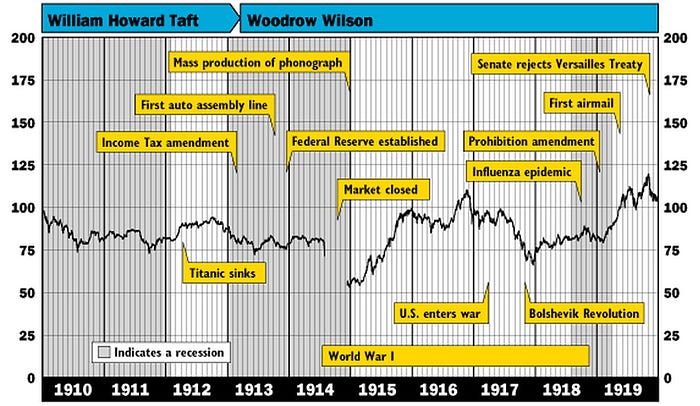
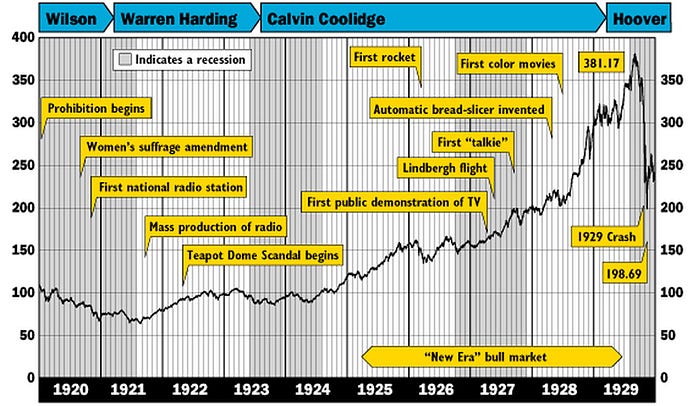
WWI starts in 1914. The stock market is halted for 4 1/2 months. When trading resumes in late 1914, the Dow trades sharply lower but rallies strongly throughout 1915. The DOW troughs yet again in December of 1917 shortly after the United States declares war on Germany.
Germany had previously promised President Woodrow Wilson that they would halt unrestricted submarine warfare. Not only did the Germans resume unrestricted submarine warfare in January of 1917, but they also invited Mexico to join Germany in a war against the United States.
With a promise broken, an intercepted communication with Mexico in hand, and American ships being sunk by German submarines, the Americans entered the war in April 1917. At the end of WWI, there is a very short and sharp 66%+ post-war bounce in stock prices from just over 75 in early 1919 to nearly 125 in late 1919.
The Spanish Flu Pandemic didn't start until February of 1918 but after 4 distinct waves, it finally ends in April of 1920. With only the post-war exception mentioned above, the DOW continued to trade between 75 and 100 from 1910, through WWI and the Spanish Flu Pandemic.
As the last waves of the Spanish Flu spread around the world, the Dow Jones Industrial average actually sank from its post-war highs, all the way back below its pre-WWI lower trading range of 75 by 1921 — a drop of nearly 40% from the peak. The stock market remains in a trading range very similar to pre-WWI for a few more years, before finally taking off in late 1924 — a full 4 and 6 years after the end of both the Spanish Flu and WWI.
Clearly, neither WWI nor the Spanish Flu was a significant triggering event for the Roaring 20s.
The real trigger of the Roaring 20s — The Dawes Plan
In fact, what ultimately triggered the Roaring 20s economy in North America was the Dawes Plan, introduced in August of 1924. The Dawes plan is credited to a banker from the United States called Charles G. Dawes. The plan was fairly straightforward. If the United States wanted to be repaid the money owed to them by their WWI allies, then Germany would need to pay the reparation payments as imposed by a Reparation Commission, created by the Allies in 1921. However, there was a problem.

Reparation payments accounted for approximately 1/3 of Germany's deficit between 1920 and 1923. Much like many economies today, Germany's Central Bank was forced to 'print' the money needed to make up for the deficit. Some historians blame the reparation payments while others believe Germany purposely damaged its own economy to inflate its debt away. Regardless of what the true cause was, the result was hyperinflation in Germany and the issuance of a new currency (the Rentenmark) introduced in November of 1923.
To make way for the new currency, banks "turned the marks over to junk dealers by the ton" to be recycled as paper. — Wikipedia
The US faced a real challenge in 1923 — how to keep the Germans paying reparation payments to US Allies. During 'the war to end all wars' US allies had accrued a massive debt of more than $10 billion. Although there was some talk of canceling the debt, the US Congress strongly opposed the idea. US allies like the UK, on the other hand, made it clear debts would ultimately only be repaid to the US with money recovered through reparation payments made by Germany. The solution to this dilemma was the Dawes Plan.
The Dawes Plan called for an initial reduction of reparation payments by Germany that would slowly increase as the economic output of Germany increased over time. To increase Germany's economic output, massive US investments were made in Germany. $200 million was issued by U.S. financier J. P. Morgan in US markets in an attempt to help encourage economic stabilization in Germany. US investors instantly recognized the incredible investing opportunity and the issue was quickly oversubscribed.
Over the following years, the US loaned money to Germany so Germany could continue to rebuild its destroyed industrial capacity and continue making reparation payments to other European nations affected by the war. Of course, the US government received returns on all of its wartime investments to allies, and US investors received returns on all of the post-wartime investments to Germany. Germany was re-built, debts were repaid, and Dawes was awarded the Nobel Peace Prize in 1925 for juicing the financial boom we now know as 'The Roaring 20s'.
Why starting at record high real estate and stock market levels is not a great place to start a new Roaring 20s
I've seen that drugstore cowboy around — 1920s slang for a well-dressed man who loiters in public areas trying to pick up women
Whether we like it or not, it looks like we have fallen into a drugstore cowboy economy. Investors are just hanging around searching for the next hot stock to jump on. Unfortunately, this isn't the first time we've seen this kind of investor behavior and we know from history, drugstore cowboy investor behavior has consequences.
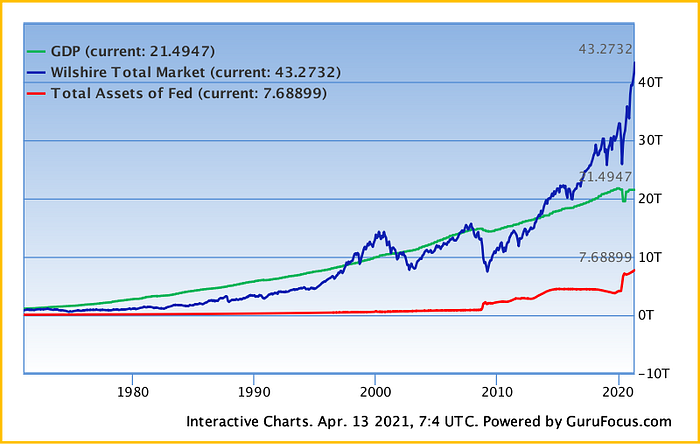
Stock price to earnings ratios were high at the end of the 1920s — not at the beginning. In 2021, we have yet to experience the nearly 40% post-war/post-pandemic correction experienced in 1919–1921. Today, sky-high valuations persist and yet some economists continue to predict a decade-long boom in stock prices. In fact, according to the Buffett Indicator, the stock market is currently severely overvalued with total market capitalization at over 200% of GDP. This indicator has only been this high a handful of times since it was created.
Can stock prices go higher from here as some stock market cheerleaders suggest? Sure — but can they explode for 5+ years as they did in the 1920s without a war-ravaged Europe to exploit? History suggests the answer is 'no'.
People are starting to go back to work but what kind of jobs are they going back to? How much are people getting paid? Are we to assume people returning to the workforce, will be paid as much or more than they did pre-pandemic with zombie companies struggling to repay massive debts incurred during the shutdowns? History suggests the answer is salaries will likely fall as jobs are automated by even more robots and AI.
Worse yet, as good-paying career jobs are disappearing, even gig jobs like Uber and packing jobs at Amazon appear to be under threat in the near future from autonomous taxis and ever more robotics. Amazon introduced the 'Hands off the Wheel program' — an automation initiative aimed at increasing productivity. Amazon claims the program is not to eliminate jobs but rather to hire even more people so they can be assigned to build new projects.
Could be, but history suggests more automation eliminates good-paying jobs and fewer good-paying jobs mean less consumer spending. Without a war-torn Europe to create demand for North American goods, it's hard to imagine a 'new' Roaring 20s.
Why the real estate and stock market continue to expand even though the economy is so weak
1920s slang for getting very drunk. "My word, I'm positively spiflicated."
What's triggering the current stock market expansion? Many investors appear to not care. The truth is, ultra-low interest rates are causing massive stock market and real estate speculation. Investors are positively spiflicated on monetary expansion, junk bond back-stopping, and ultra-low interest rates.
Speculation is currently at levels we haven't seen since 2008 and 1999. Perhaps only 1990 Japan and 1929 US speculation were more severe. This does not bode well for the current state of the stock market. Unprecedented money printing rewarded post-war Germany with hyperinflation. Hyperinflation may not come to North America in 2021–2022 but even moderate inflation could easily smash the punch bowl.
With interest rates so low that fixed-income investments are no longer attractive, investors of all kinds are being forced to search for yield. In 2021, even pension funds are now resorting to purchasing individual houses and even entire newly built housing divisions in their search for higher yield. Pension funds are pricing out new home buyers by offering all-cash deals and bidding well over the asking price.
House prices in Canada, for one example, are in a bubble across the country. At one time, not that long ago, housing bubbles were mainly limited to Toronto and Vancouver. Not anymore. With ultra-low interest rates and a work-from-home movement in full swing (and pension funds looking to become your future landlord), prices have exploded across the country.
The largest year-over-year percentage changes came from the Northwest Territories (48.1%), Nova Scotia (30.4%), Ontario (24.5%), Quebec (22.5%), and New Brunswick (20.9%). — CTV News
History clearly tells us all housing and stock market bubbles end. This time will be no exception. And unfortunately, with no war-ravaged Europe for the US to exploit this time around, the Roaring 20s of one hundred years ago, simply cannot be repeated.
Stay calm, stay vigilant, diversify, rebalance and remember, history rhymes, it doesn't repeat.
Disclosure — Please seek professional advice before making any investment decisions.
I'd like to hear from you. Are you bullish, bearish? Tell me why in the comments.