Hey there! If you're new to the world of data warehousing (often called DWH for short), don't worry — this blog is written just for you. We'll keep things simple, like chatting over coffee. No fancy jargon unless we explain it right away. By the end, you'll get what a "factless fact" is, why it's useful, its perks, and even see it in action with a real banking example. Let's dive in!
What is Data Warehousing, Anyway?
Imagine a huge library where a company stores all its important information — like customer details, sales records, or event logs — so they can easily look back and make smart decisions. That's data warehousing in a nutshell. It's like organizing your closet: everything has a place, making it quick to find what you need.
In this "library," data is split into two main parts:
- Dimensions: These are the "who, what, where, when" details. Think of them as labels or categories. For example, customer names, dates, or product types.
- Facts: These are the numbers you can measure, like "how much money was spent" or "how many items were sold." Facts are stored in tables (like spreadsheets) that connect to dimensions.
Most fact tables have numbers to add up or average. But sometimes, you don't need numbers at all. That's where the quirky "factless fact" comes in!
What is a Factless Fact?
Okay, the name sounds weird — like "jumbo shrimp" or "deafening silence." A factless fact is just a special kind of table in your data warehouse that records events or connections without any numbers to measure.
Picture this: You want to track if someone showed up to a party. You don't need to count "how many smiles" or "how much cake they ate." You just need to know: Who? When? Where? And did it happen?
In a normal fact table, you'd have something like:
- Sale amount: $50
- Quantity: 2 items
But in a factless fact table, there's no "amount" or "quantity." It's empty of measurements — hence "factless." It just links the dimensions together to say, "This event occurred" (or sometimes, "It didn't").
Why Use Factless Facts?
Factless facts are like the glue in your data puzzle. They're great for:
- Tracking events: Like who attended a meeting or which students enrolled in a class. No numbers needed — just the fact that it happened.
- Showing relationships: Connecting many things at once, like which customers were invited to multiple promotions.
- Spotting what's missing: Ever wonder why someone didn't do something? Factless facts can help track absences or gaps, like "customers who were invited but didn't show up."
In short, they help answer questions about "what happened" without getting bogged down in counting stuff.
The Advantages of Factless Facts
Why bother with these? Here are some big wins, explained simply:
- Keeps things simple and fast: Without extra numbers, your data warehouse doesn't get cluttered. Queries (searches for info) run quicker because there's less to process.
- Saves space: No storing unnecessary data means your "library" doesn't fill up as fast, which saves money on storage.
- Flexible for the future: If you later decide to add a measurement (like "how long they stayed"), you can easily upgrade the table without starting over.
- Great for analysis: They make it easy to count things on the fly. For example, you can quickly tally "how many people attended" by just counting the rows in the table.
- Handles "no-shows" perfectly: In real life, knowing what didn't happen is often as important as what did. Factless facts shine here, like tracking missed opportunities.
Think of it as a lightweight notebook for logging connections — efficient and to the point!
A Real-Time Banking Use Case: Tracking Customer Event Attendance
Let's bring this to life with a banking example. Banks deal with tons of customer interactions, like seminars on saving money or workshops on investments. They want to track who was invited, who attended, and spot patterns (e.g., why some customers skip events).
The Scenario
At "SmartBank," they host free financial advice events. They invite customers via email or app notifications. Using a factless fact table, they can log:
- Which customers were invited to which events.
- Who actually attended.
This helps the bank see: "Hey, Customer A was invited to 3 events but only came to 1. Maybe send a follow-up?"
No numbers like "dollars spent" here — just the connections.
The Data Model: ER Diagram
An ER (Entity-Relationship) diagram is like a map showing how data tables connect. Here's a simple one for our use case. (I'll describe it first, then show a text-based diagram using Mermaid syntax for clarity.)
Dimensions (the labels):
- Customer: Info like customer ID, name, age.
- Event: Details like event ID, name (e.g., "Savings Workshop"), type.
- Date: When the event happened (date ID, year, month).
- Location: Where it was (location ID, city, branch name).
Factless Fact Table: Called "Event_Attendance." It has no measurements — just links (foreign keys) to the dimensions. Each row means: "This customer was associated with this event on this date at this location." We can add a flag like "Attended: Yes/No" or "Invited: Yes" to track status.
Here's the ER diagram:
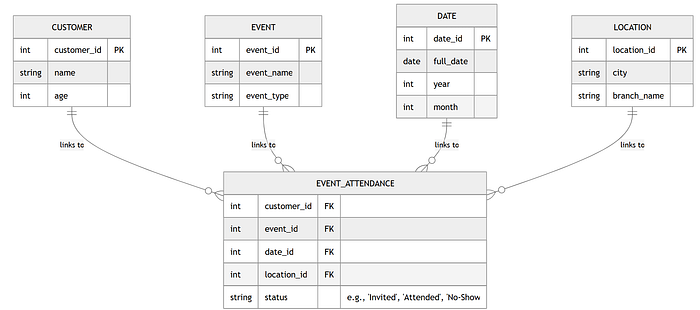
In plain words: The central "Event_Attendance" table connects to all four dimensions like spokes on a wheel. No extra columns for numbers — it's factless!
SQL Query to Fetch Data from the Factless Fact
To get useful info, we can write a simple SQL query (SQL is like a search language for databases). Let's say we want to find all customers invited to the "Savings Workshop" in 2025 but who didn't attend.
Here's the query:
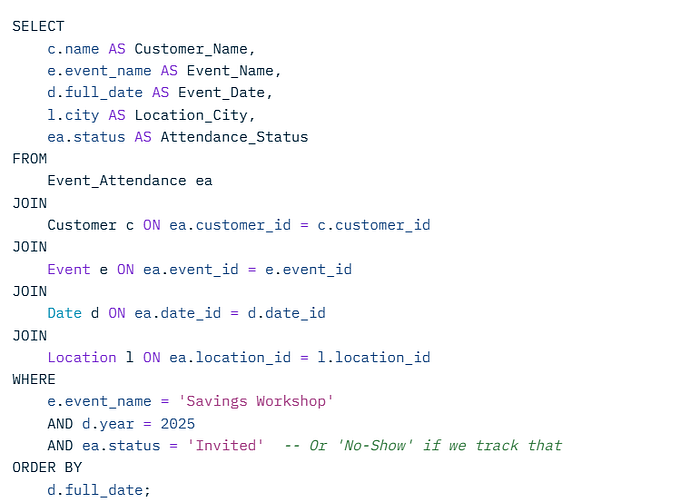
What does this do? It pulls names, event details, and status from the tables. The factless fact (Event_Attendance) is the bridge that connects everything. Running this might show: "John Doe was invited on March 15, 2025, in New York, but status is 'No-Show'." Boom — now the bank can follow up!
Wrapping It Up
Factless facts might sound odd, but they're a smart, simple way to track events and connections in data warehousing without unnecessary numbers. They're fast, flexible, and perfect for spotting what's happening (or not) in the real world. In banking, like our event attendance example, they help build better customer relationships.
If you're just starting with DWH, play around with these ideas in a free tool like SQLite. Got questions? Drop a comment below! 😊