


The Education through Entertainment vision came in scattered parts of a puzzle. Assembling it requires multi-channel collaboration between my followers and teams. This episode is Medium's channel version of the Substack episode.
The Liat Show is rebuilding our world through storytelling, powered by readers. To receive new posts first and support my work, join as a free or paid subscriber on Substack and stay ahead of the next chapter before the door closes.
Recap from Previous Episodes
In this series, Kevin Alexander and I explore Israeli music culture, with a special focus on Ofra Haza. Together, we follow the music lane into Israeli culture, inviting you to join our conversations and see where this journey takes us.
Current Time.
Liat Portal: In the previous episode of this series, you were curious about how music discovery worked for me. It sounds like a simple question, but it made me think. Over the past decade, I have become more aware of how I discover music, which can happen in many ways — from friends sharing music on social media, live performances, parties, and clubs to TV shows and movies. My ear can often identify a piece of music in the background of a movie or TV show, especially when the director and music producer create a perfect scene where the chosen piece connects to the story in the most extraordinary way. This piques my curiosity, and I often pause the video immediately to look for the song.
Social media has opened many doors for me, especially Instagram posts, reels, or stories, where the background songs catch my attention. I click on them to find out details about the artist. Street performers also play a role, as I live in San Francisco and often see them in the financial district or near the Ferry Building. I enjoy listening to playlists people create on platforms like YouTube or Spotify, or selecting "create station" based on one song. I'm always curious about what the algorithm will suggest that I haven't heard before.
Of course, I also discover music by listening to the radio, which remains my favorite traditional method. Living in San Francisco, I use Uber and Lyft frequently, and I love discovering new music through what the drivers are listening to and usually ask them about it. However, the biggest game-changer for me has been Shazam. I love this app because it allows me to discover music independently when no one has the answer or when I'm alone with no one to ask. It's easier for me to search on the spot. This app has completely changed my life, empowering me to discover music independently without relying on others knowledgeable in music. I simply follow tunes that intrigue me, sounds that evoke emotions, spark curiosity, or feel pleasing to my ears, and find out what they are.
Looking back, since childhood, my music discovery journey began at home, school, TV, and family events, which we have a lot of in Israel, especially in Jewish families who came from North Africa and Arab countries. These ethnicities often have large families with many kids, leading to numerous weddings, bar or bat mitzvahs, and Henna events where dancing plays a central role.
From a broader perspective, the arts have always been a way for Israelis to find common ground with other ethnicities through songs, movies, and comedy sketches. However, music holds a unique power that surpasses other forms of art. Israeli music has always had, and continues to have, a magical ability to connect us all despite our diverse cultures, opinions, and beliefs.
Israeli people could kill each other for holding opposing political opinions, different views about how to practice Judaism, or contradicting economic approaches. However, when they hear artists like Arik Einstein, Shlomo Artzi, Rita, Yardena Arazi, or Ofra Haza on the radio or TV, all the tension melts away in an instant. Everyone sings their songs together and transcends into a utopian world filled with love for the artists and their music.
Kevin Alexander: First, can I say that comedy is not something I would've associated with Israeli culture? It makes sense, of course, but it hadn't occurred to me. Thanks for bringing that to my attention! What I can relate to and love is the idea that music serves as something of a connective tissue for modern society. The idea that a beat or rhythm can make people go from being at each other's throats to dancing arm in arm is powerful. And something tells me we're gonna need to lean on it more and more in the coming months.
Liat Portal: Israel is a melting pot of Jewish communities around the world. Each community preserved the Jewish religion differently in the diaspora and absorbed the local culture of their area into their traditions. These traditions are primarily expressed in food and music cultures. Each ethnicity brought its leading food items to Israeli cuisine, and the merging of cultures created a fusion of flavors from around the world. Like food, it also happened with the music and tunes beating in different rhythms.
Kevin Alexander: There is something uniquely Israeli (for lack of a better term) about Ofra Haza. It's almost as if her music is the soundtrack to that fusion. Listening closely, I started picking out bits and pieces from other places and different genres.

Liat Portal: Music was an essential pillar that helped connect the different cultures and ethnicities, which in the early days of Israel seemed so distant from each other. Songs and tunes helped ease emotional pain, overcome difficult memories, learn the importance of forgiveness, mourn the dead, show the value of friendship and mutual guarantee, and above all, see a promising future.
Songs helped develop Israeli culture as we know it today, educated us on the impact of historical events on the individual soul and the value of life, and mainly helped the public process their emotions by singing instead of seeking revenge. Songs reflected everyday life, people's struggles, expressing love or longing, thoughts, dreams, and above all, hope.
Kevin Alexander: There must always be hope.
Liat Portal: Israel's music culture is rich and includes many layers. Israeli musicians reflect their personal Jewish journey and ethnic tunes alongside the modern music they listen to, and this mix creates a unique fusion that immediately hits the hearts of the people and resonates with them.
Ofra Haza was the most popular Israeli artist, who was the first to receive global recognition because of that mix of ethnicity and modern pop. "Im Nin'Alu," a Yemeni biblical poem written in Hebrew and Yemenite-Jewish in a traditional Yemeni melody, opened Ofra Haza's door to the global arena. This song was mixed and adjusted to the modern pop beat of the 1990s, and parts were translated to English, while other parts were left in Yemeni and Hebrew.
Let's listen to the song: Im Nin'Alu — Ofra Haza.
A review of Ofra Haza's life and career, highlighting her prominent songs, significant milestones, and her journey to winning a Grammy award and singing on Hollywood movie soundtracks.
My first memories of Ofra Haza are from a very early age, somewhere between kindergarten and elementary school. She was already very popular when I was born, so she was everywhere in our small country. I remember seeing her on one of the popular children's shows, Parpar Nechmad (which means Nice Butterfly in Hebrew), and also from the children's music festivals we still have during Hanukkah.
Ofra wasn't her first name; it was her middle name. She was born in Tel Aviv to Yemeni Jewish parents who immigrated to Israel in 1949 and named her Bat-Sheva-Ofra Haza. She was the youngest of nine children and was raised in the Hatikva neighborhood, an impoverished, working-class neighborhood of Tel Aviv. Although her parents named her Bat-Sheva, her sisters didn't like the name and preferred to call her by her middle name, Ofra.
Ofra Haza acquired her love for singing from her mother when she was a child, who had been a popular singer at henna events in Yemen. Henna is a traditional pre-wedding ritual in North African and Arab countries, which Jewish communities adopted in the diaspora and continue to observe in Israel. At 13, Haza performed at a wedding, where a member heard her of the theater workshop in the Hatikva neighborhood. He recommended the workshop director audition her, who accepted her despite her young age. This crossroads set her on the path to success and marked the beginning of her long-standing journey with Bezalel Aloni, who managed the workshop and later became her manager and closest confidant.
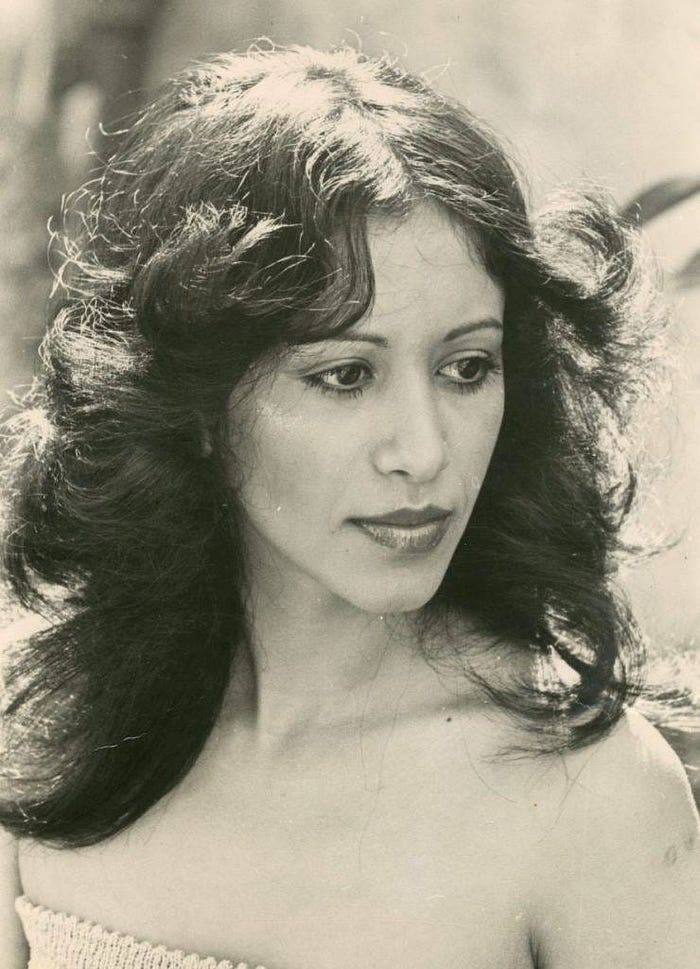
In 1979, at 22, she got her first taste of success when she was cast as Dina in Assi Dayan's film Schlager alongside the trio The Pale Tracker. Schlager's success encouraged Peschnell, the promoter of The Pale Tracker and the most successful promoter in Israel at the time, to cast Ofra Haza in a leading role in another film, The Suburban Girl.
Ofra Haza's character's song "Shir Ha-Frecha," which she sang in the movie Schlager, made her a superstar. The song became so popular that it is a staple in Israeli music culture to this day, representing the liberation of women. The term "Frecha" is a derogatory slang word in Israeli Hebrew used to describe a woman who is perceived as vulgar, shallow, coarse, or even aggressive. It is often associated with a dismissive and demeaning stereotype, particularly targeting Mizrahi (Jews from Arab countries or North Africa) women. It has been used as a tool for social and cultural discrimination.
The film Schlager includes a scene where Haza's boyfriend mocks her for wanting to dance like a "Frecha." In response, Haza begins to dance and sing "The Frecha Song" in a nightclub because that is what she wants to do without apologizing or feeling bad. Singing that song liberated her character in the movie and inspired women to feel free and confident in expressing what they want to do, even if that does not align with social norms or is not considered respectable by society.
Let's listen to "Shir Ha-Hrecha" from Schlager
In 1980, Ofra Haza released her debut album as a solo artist. The album produced many hits, earning her the title "Singer of the Year" in the charts of numerous radio stations and leading newspapers. The album sold about 20,000 copies and achieved gold status. Her subsequent albums also yielded many hits, leading her to be named "Singer of the Year" four years in a row, from 1980 to 1983.
In 1983, the Eurovision Song Contest was held in Munich, Germany. Ehud Manor, one of the most outstanding Israeli poets, felt an Israeli representative should stand there and sing the words, "Am Yisrael Chai." He wrote the song "Chai," which means "Alive" in English, and offered it to Yardena Arazi before the pre-Eurovision competition. However, Arazi declined, stating that she had already prepared another song.
Manor then turned to Ofra Haza, who immediately agreed to perform it. For the fourth time, Haza's submission to Eurovision was accepted, and in the pre-Eurovision competition, she won first place with 73 points, securing her place as Israel's representative in Eurovision 1983. Arazi came in second place, losing by just one point. Some claim that this contest allegedly sparked an extreme rivalry between her and Haza, mainly between their fans, that lasted for several years. The rivalry was not between the singers but rather between their fans.
This rivalry was the Israeli equivalent of the feud between Brenda and Kelly in Beverly Hills, 90210, where fans were deeply emotionally invested and took sides. It also resembled the recent elections in the US, as there was a violent incident involving fans. The rivalry culminated in Arzi's performance, where a fan of Haza shot ink onto her dress with a toy gun.

Kevin Alexander: My first thought is that this is a song that is both gorgeous and potent. The word "alive' denotes force by default, but the lyrics could be interpreted in many ways depending on the listener's perspective. There's a force of will, a determination in the words that feels both out of place for the catchy melody and perfect both. The best battle cry is an easily sung one, right?
I'm hung up on the idea that a song about what I perceive to be unity sparked a rivalry of this nature. Given fan culture, maybe I shouldn't be, but it's still some next-level irony.
Liat Portal: Since its release, "Chai" has become, in a way, an anthem we sing during the darkest hours of anti-Semitic riots against Israelis. It may sound contradictory since the song is upbeat, and we sing it during times that challenge us as Israelis, but its iconic line, "Am Yisrael Chai" (The People of Israel Live in Hebrew), has become an anthem of hope and resilience. This line also gained even more powerful meaning during the last year.
Let's wrap up this episode about Ofra Haza with her performance of "Chai" at the Eurovision in 1983. In the next episode, we'll continue to dive deeper into her life journey, the unbelievable coincidences she survived, and the moment when she took a wrong turn that irreversibly changed the course of her life. Stay tuned.
Chai Eurovision Song Contest 1983 — Ofra Haza
- Into the Great Wide Open
- Singing Through History: Ofra Haza's Timeless Legacy in Israeli Music (You Are Here)
- Ofra Haza Bridging Cultures Through Music and Breaking Global Barriers
- The Evolution of Ofra Haza From Israeli Star to Global Music Icon
- Breaking Barriers but Bound by Shame in the Untold Story of Ofra Haza
🧠 Q&A: The Liat Show
How did Ofra Haza bridge tradition and pop? By singing Im Nin'Alu, she fused Hebrew poetry, Yemenite melodies, and modern pop beats. This unique sound made her one of the first Israelis to break into MTV.
What role did Eurovision play in Ofra Haza's career? Performing Hai in Munich in 1983, she turned a catchy anthem into a cultural marker of resilience for Israelis at a time of growing antisemitism.
What early moment defined her rise in Israel? The release of Shir Ha-Freha in 1979 gave Haza her first huge breakthrough, turning her into a household name and reshaping Israeli popular culture.
How does Liat Portal frame Haza in The Liat Show? Liat Portal uses Ofra Haza's story to show how music connects cultures, heals divides, and gives voice to resilience in Israeli life.
What prompted a global resurgence of interest in Ofra Haza this week?
Her placement on Rolling Stone's greatest singers list has made her story and songs, like Im Nin'Alu, newly visible in Asia. Readers in Singapore, Hong Kong, and China can help amplify this moment by reposting on LinkedIn, WeChat, or WhatsApp groups, keeping her legacy alive for new listeners.
What draws listeners in Singapore and Hong Kong to Ofra Haza today?
Platforms may be surfacing her music in playlists that highlight cultural fusion, bringing her voice back into public attention. If her songs move you, consider reposting on LinkedIn, WhatsApp, or Instagram to share that discovery with your peers.
Please fasten your seatbelts and subscribe. We are taking off.
The next chapter is already being written. Those who are here early will remember how it began.
Follow me on My Journey to Infinity. What's coming next is beyond anything you imagined.
Liat

I weave together episodes from my life with the richness of Israeli and American culture through music, food, the arts, architecture, fiction, wellness, entertainment, education, science, technology, entrepreneurship, cybersecurity, supply chain, and more. I write on weekends and evenings and share each episode as it unfolds, almost like a live performance.
Most of what I publish is part of a set or multi-part series focused on one topic. Each set comes out over several days, making it easier to follow during your busy workday. If one episode speaks to you, it's worth reading the complete set to follow my life story and how it connects to the history and future of my timeline.
You can also start from the very beginning or explore the complete index here: Index of The Liat Show. This post best explains how I began this approach: Making My Parents Proud, One Episode at a Time.
The Liat Show is rebuilding our world through storytelling, powered by readers. To receive new posts first and support my work, join as a free or paid subscriber on Substack and stay ahead of the next chapter before the door closes.