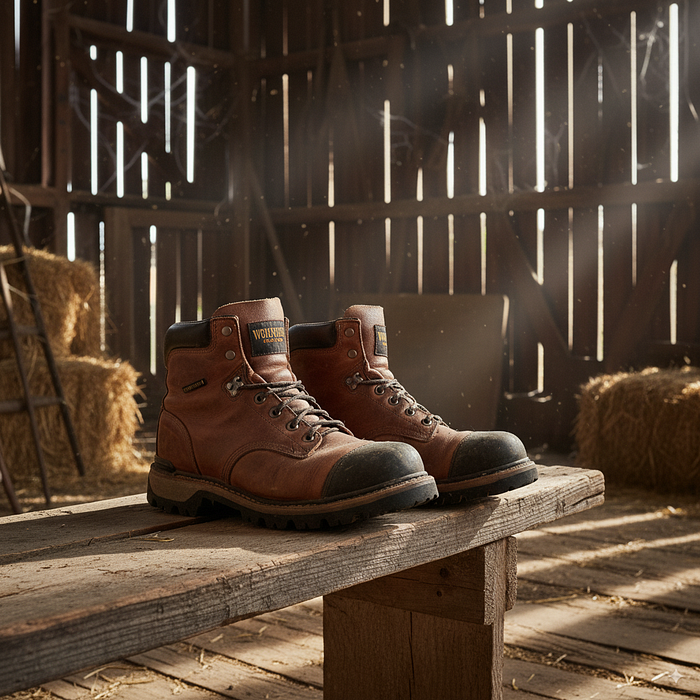
There are things you don't notice until someone points them out — like how a pair of boots holds not only your weight, but the weight of where you come from.
The announcement came yesterday. Jordan Davis, the country singer whose songs roll through the radio like gravel on a farm road, has launched a collection with Wolverine, that old brand whose boots have known more dirt and grease than most of us care to remember. The line includes workwear, wedges, and soft-toe steel boots. Functional, stylish, and rooted in heritage.
But I don't want to linger only on the facts. What interests me more is the story underneath — what it means to carry your family's trades, your home soil, and the dust of memory into a life that seems to belong on stages with bright lights and polished floors.
The Shape of Work
Davis says he wanted the clothes to feel versatile: good for a stage, good for the farm, good for the school run. That word, versatile, holds a lot. It's the word of someone who knows you can't split your life into separate boxes without leaving some pieces behind.
In small towns — mine, his — it's not unusual for people to measure their days by the things their clothes can endure. The jacket you wear to milk cows becomes the same one you throw on when the neighbor's car won't start. The boots you slip on for the muddy walk to the barn take you to Sunday service, brushed off but still carrying the smell of the fields.
This is the kind of inheritance that slips through without anyone noticing. We don't always talk about legacy as boots or jackets, but they're there, waiting by the door.
The Family Thread
Davis comes from tradespeople — welders, carpenters, men and women who earned their living in places where hands got calloused and backs bent. Wolverine, with its century of stitching leather and steel, knows those people too.
It makes me think of my uncle, who was a linesman. He worked high poles through winters so bitter the metal would burn if you touched it barehanded. His boots were scuffed and cracked, never replaced until the soles gave way. When he died, my aunt left the pair by the back porch for years, as if he might still come by, needing them.
Clothes, more than we like to admit, become memory's storage. They stand in for the people who wore them, carrying traces of sweat, mud, or even cigarette smoke.
The Stage and the School Run
I picture Davis now, pulling on the Bronc wedge boots he calls his favorite. On stage, they look like part of a costume, another element of show business. But then he wears them dropping his kids at school, and suddenly the glamour fades into something quieter, something recognizable.
That doubling — the same boots on a stage and on a gravel driveway — feels like the heart of the collection. It's not about fashion in the glossy magazine sense, but about living in one set of clothes that can carry you through shifting roles: performer, father, neighbor.
Isn't that what most of us are always doing, piecing together our many selves with whatever fabric and leather will hold?
The Consumer and the Myth
The Senior Marketing Director at Wolverine called the partnership "authentic," a word that gets used so much it starts to sound thin. But perhaps she's right in ways that aren't easy to sell. Davis's songs are filled with plain truths — love, family, the slow erosion of time. When those songs meet a brand built for people who lay bricks or mend pipes, it does feel less like a trick and more like a natural overlap.
Still, I can't help but see the myth-making at work. A limited-edition boot becomes a story about resilience, about lineage. It reminds us of our grandparents' calloused hands, even if we never bent steel ourselves.
And maybe that's fine. Maybe we want that reminder — that connection, however faint, to a line of workers whose days were marked not by tours and applause, but by steady paychecks and evenings that smelled of sawdust and oil.
The Quiet After Work
Work boots have a peculiar rhythm. You hear them in the thud on a wooden porch, the scrape against a tiled kitchen floor, the muffled steps down a hallway when the day is done.
I remember my father unlacing his in the kitchen. They leaned against the wall, dust falling like crumbs. There was always silence after — the kind that came not from peace, but from exhaustion. The day had emptied him, and the boots told the story better than he could.
That silence lives in the Wolverine collection too, though I doubt the press release mentions it. It's in the way the leather bends, in the memory of every person who ever dropped onto a chair and tugged at the laces with weary hands.
Music and the Farm
The press release ties Davis's Louisiana roots to the boots. Roots, another word that gets worn thin. But if you strip it back, it means soil. It means the damp smell after rain, the rough hands of relatives who stayed, the ones who didn't leave for stages or studios.
What interests me is the balance — how Davis sings about family, faith, and time passing, then puts on boots designed for hauling hay or welding. It makes him less untouchable, more a man still tethered to the ground, even while singing under lights.
I think of him on a stage in New York or Los Angeles, the boots carrying not just him, but echoes of farms and fields. The applause is for his voice, but the leather remembers the earth.
The Women at the Edge
Boots are often cast as men's territory, but women, too, have worn them down to nothing in kitchens, barns, and factories. My grandmother wore steel-toe boots during the war, when she worked at the munitions plant. They were heavy, too big, handed down after some man went off to fight.
She said her feet ached, but the boots made her feel strong, as if the weight of them reminded her she could stand up longer, work harder.
When I see Wolverine's women's jackets or hoodies in this collection, I think of her. The companies don't often say it outright, but women's work shaped the same legacy.
The Small Inheritances
Maybe the point isn't just fashion, or even music. Maybe it's about the small inheritances we carry. The way a family's trades, habits, and tools sneak into us.
Davis carries his roots into a tour bus. Wolverine carries their heritage into a retail store. And the rest of us carry our memories into the present with every step in boots that once belonged to someone else, or that will one day be left behind for others to puzzle over.
Why Stories Hide in Clothes
Alice Munro once said that the constant happiness is curiosity. I think boots, jackets, and hats hold their own curiosity. Who wore them? Where did they go? What did they carry in their pockets?
Clothes give us stories without words. They remind us that work, however ordinary, leaves traces. A jacket smells of smoke from a wood stove. A pair of boots scuffs against concrete floors. These fragments, stitched together, become memoir.
Davis, with his boots on stage, is telling that story whether he means to or not. Wolverine, by reviving its legacy in a modern line, is telling it too. And here we are, listening.
Closing Reflection
When the press release ends, it leaves links and contact names. But stories don't end with links. They continue in kitchens, in barns, on stages. They live in the boots left by the door, waiting for the next day's work — or the next night's performance.
The collection will sell, no doubt. People will buy a piece of Davis's story, a piece of Wolverine's heritage. But more than that, they will buy a reminder of their own — of fathers unlacing boots, of grandmothers in factories, of neighbors walking across gravel driveways at dusk.
And isn't that the point of both music and clothes? To remind us that our lives, ordinary and extraordinary, are stitched from the same fabric.
Your story deserves to be told with the same care as these boots are stitched. I help professionals and everyday people turn life experiences into memoirs that last. If you've been waiting for "someday," let's start today.