
Everyone talks about the pass rate. Everyone talks about the rules. Everyone argues about whether prop firms are legit, doable, or "rigged."
But almost nobody talks about the truth I learned the hard way:
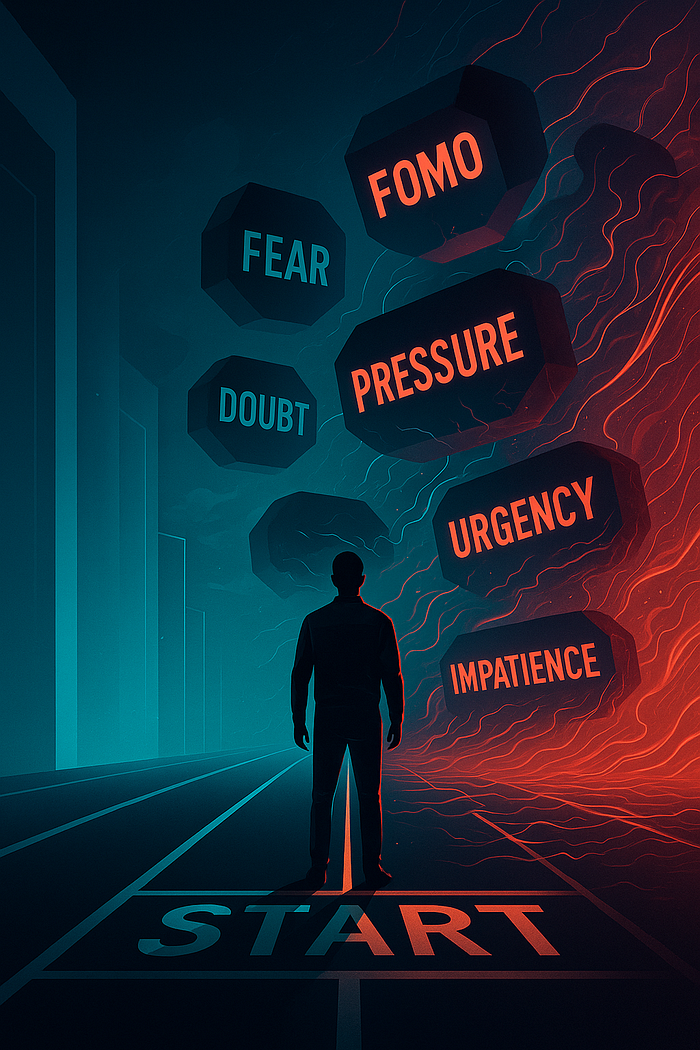
Most traders fail the challenge long before they take the first trade.
They fail in their mind, not their MT5.
Before the first entry… before the first click… before the first candle even forms…
they've already lost the psychological battle.
I didn't understand this for a long time. I assumed traders failed because of:
- bad strategy
- poor risk management
- timing errors
- market volatility
- too much spread
- too tight rules
But after talking with hundreds of traders, reviewing my own failures, and tracking my emotional patterns during evaluations, I learned something uncomfortable:
The challenge doesn't expose your skills. It exposes your emotional weaknesses.
Here are the real reasons most traders fail — before they even start.
1. The Pressure Changes How You Trade
A prop-firm challenge is not trading.
It's trading with a countdown timer strapped to your psychology.
And that pressure does one thing extremely well:
It forces you into the emotional state where discipline collapses.
You begin thinking:
- "I must perform."
- "I must pass."
- "I can't afford a slow week."
- "I need my first win to start strong."
- "If I don't make progress today, I'll be behind."
These aren't trading thoughts.
These are performance anxiety thoughts.
Performance anxiety changes your:
- patience
- risk tolerance
- setup selection
- impulsivity
- emotional intensity
- sense of urgency
Before the first trade, you're already trading someone else's psychology.
2. The Challenge Turns Traders Into Gamblers
Prop firm rules unintentionally push traders into gambler's mindset:
- Targets are fixed
- Drawdowns are fixed
- Days are limited
- And every day you don't progress feels like a failure
Gamblers trade to not lose.
Traders trade to execute well.
When your internal dialogue becomes:
"I need to make 8% this month."
…your mindset shifts from execution → outcome. And outcome-focused traders take low-probability trades.
You fail before you even touch the mouse.
3. Most Traders Start the Challenge Already Tilted
This one hurts because it's so true.
Most traders buy the challenge immediately after:
- a losing streak
- a period of frustration
- a tilted session
- financial pressure
- impatience
- desperation to "level up"
- jealousy from seeing others post payouts
They aren't starting neutral.
They're starting emotionally biased.
If you begin a challenge with:
- fear
- frustration
- entitlement
- urgency
- insecurity
…it's almost impossible to trade cleanly.
You're already tilted — just not by the market.
4. Traders Bring Personal Life Stress Into the Challenge
Your challenge doesn't start at the chart. It starts in your life.
I tracked my emotional state every day during a challenge month and noticed:
My worst decisions didn't come from the market.
They came from:
- poor sleep
- worrying about finances
- work pressure
- frustration from outside life
- emotional fatigue
- trying to trade to "fix" something personal
Your prop challenge doesn't test your trading. It tests your life stability.
And most traders walk into the arena already stressed.
5. They Don't Know Their Emotional Patterns
This was the biggest insight for me.
When I tracked every challenge-day trade, I saw the same psychological patterns appearing over and over:
- FOMO after watching a clean move without me
- revenge trading after a small loss
- hesitation leading to late entry
- overconfidence after a win
- impatience during slow sessions
- tightening stops because I feared failing
- forcing setups near the end of the day
These weren't "mistakes."
They were predictable emotional loops.
Most traders don't fail because they don't know how to trade. They fail because they don't know how they trade when emotions take over.
If you don't know your patterns, the challenge will expose them mercilessly.
6. The Challenge Highlights the Gap Between Your Plan and Your Behavior
Prop firms don't punish bad strategy.
They punish bad behavior.
And the #1 behavioral mistake?
Trading who you want to be, not who you are.
Your plan was written by your rational mind. Your challenge is executed by your emotional mind.
These two people are never the same unless you're trained to notice the shift.
Most traders don't notice the shift.
So they fail.
7. The Challenge Forces You Into a State of Emotional Urgency
The biggest quiet killer:
Time pressure creates emotional urgency.
The brain interprets it as:
- "Act now."
- "Don't fall behind."
- "You must take something."
- "You have to push."
Urgency is the enemy of quality.
Urgency makes bad setups look good. Urgency blinds you to danger. Urgency seduces you into overtrading. Urgency makes patience feel like failure.
Prop firms don't test your strategy. They test your ability to stay calm when urgency tries to hijack you.
Most traders can't.
The Moment Everything Changed for Me
I didn't pass my first challenges.
Not because I couldn't trade — but because I didn't understand myself as a trader.
When I started journaling my emotional state before and after each trade, everything became painfully obvious:
- My worst trades always came from emotional spikes.
- Tilt didn't happen suddenly — it built slowly.
- FOMO had a predictable pattern.
- Overconfidence always hit after clean wins.
- Boredom trades happened only under certain conditions.
- I wasn't breaking my rules — I was breaking under pressure.
Seeing these patterns changed everything.
That's why I built Reflectr — a tool that tracks the psychology behind each trade so you can see the emotional drift before it destroys your challenge.
If you want to explore your own patterns: 🔗 https://reflectr.dev No pressure — just something that finally helped me stay neutral under evaluation stress.
Final Truth: The Challenge Isn't Hard — Your Emotions Are
Prop firm challenges don't expose your strategy. They expose:
- your emotional triggers
- your cognitive biases
- your discipline holes
- your impulse control
- your tilt patterns
- your self-awareness
Most traders fail before they even start because the challenge magnifies every unresolved weakness they bring into the game.
If you want to pass:
Don't start by fixing your strategy. Start by fixing the internal conditions you trade from.
Because your emotional state is the real evaluation.
And once you pass that… the rest becomes surprisingly simple.