

As of today, the picture of tech layoffs is looking grimmer than ever. Big tech companies are taking turns firing people.
Here is the screenshot Yahoo Finance posted on its LinkedIn feed, 2 weeks ago.
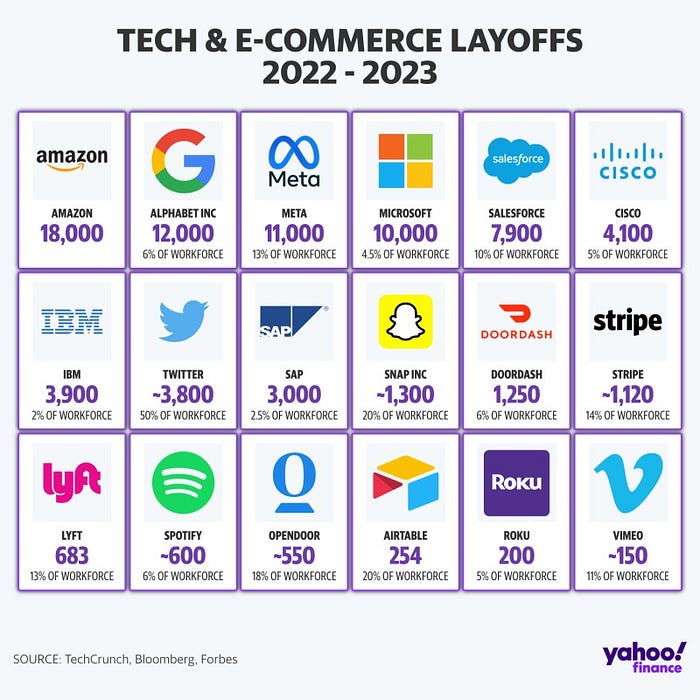
Not mentioned in the diagram yet are Yahoo itself, Paypal, Coinbase, and Zoom. Am I missing anything? Maybe. Feel free to add.
As early as June 2022, I had predicted that big tech had created a bubble that could blow up any day, and developers must be ready for it.
When Google began blaming the developer productivity for their dwindling profits, I wrote at length why it was wrong. The real reason wasn't less developer productivity, but resource-revenue misalignment vis-a-vis investor-driven QoQ profit mindset.
Today, they all say they overhired during the pandemic. Managerial lies can't be less creative than this.
Pandemic hiring isn't the real issue:
It is undeniable that big tech was (and still is) overblown in size from every aspect. I covered it in Elon Musk's Twitter cleanup story.
In that article, I listed the size of FAAMG companies (pre-layoff figures):
Google: 1,40,000
Microsoft: 2,20,000
Apple: 1,55,000
Meta (Facebook): 83,000
Amazon: 1.5 M (includes shipping + delivery staff)
Given that their flagship products are already made, and any ongoing product changes are incremental in nature, how does one justify such huge numbers, pandemic or no pandemic?
During the pandemic, barring Apple, the big tech went berserk in hiring. But the layoff figures are far minuscule.
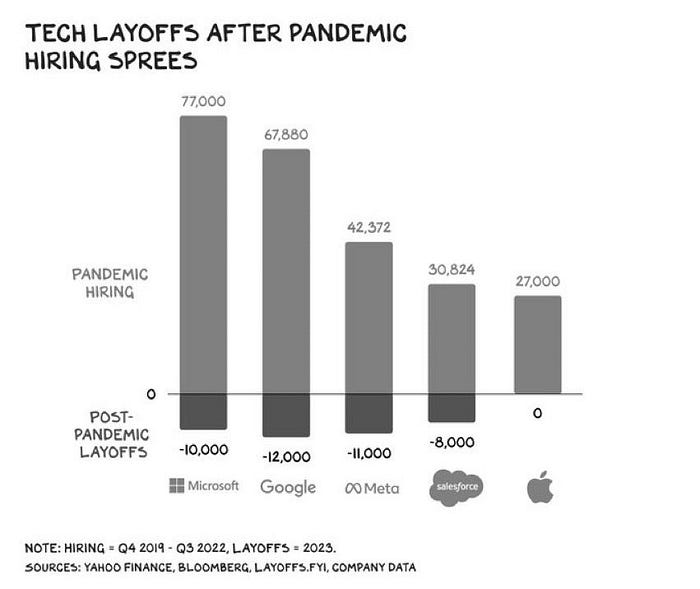
The "tech overhired during the pandemic" excuse holds no substance unless there are more layoffs coming up.
The real problem:
When they fire, they all sound the same.
Microsoft's Satya Nadella told employees that consumers are looking to do more with less now after spending so much during the pandemic.
Google's Sundar Pichai told employees that the company staffed up during the pandemic, but the economic situation has changed.
Amazon's Andy Jassy said the uncertain economy and its decision to hire so many people during the pandemic is why the company is moving forward with layoffs.
Coinbase CEO had a somewhat realistic take on the matter — the pandemic isn't fully responsible, after all.
Over the past 10 years, we, along with most tech companies, became too focused on growing headcount as a metric for success. Especially in this economic environment, it's important to shift our focus to operational efficiency.
Even with that explanation, the deception isn't inconspicuous.
When you lead a tech company, you aim to make the world exponentially better by committing minimal changes.
This is just the first installment. Many more are expected.
You have a razor-sharp focus on your user's problems. You treat users' data like bank lockers. You treat memory pointers like sleeping monsters that must not be awakened. You protect code from undesirable mutations, so as not to render your binaries unscalable overnight.
That's how bad reviews don't churn users away. That's how product-market fit stays relevant. You keep churning the dollars to flash the QoQ results on Time Square billboards.
Your mindset is quite trained on making the biggest impact with the fewest possible hiccups. You take backups before you take the server offline. You don't delete that unused backup for a month, even though it means trashing millions in cloud bills.
How could you get something so wrong on a huge scale, and/or over such a large time period — a decade? Where is the accountability?
The stated reasons behind the tech layoffs are eyewash. The total numbers in big tech are what one should be looking at — they are highly questionable, even if you look at their pre-pandemic employee headcount.
If you consider the mortgage analogy, current layoffs are only the first installment. Many more layoffs should be expected.
The arrival of GitHub Copilot and ChatGPT isn't really helping the situation. The AI-based code-generation tool market is about to explode. A ChatGPT client built by a NodeJS programmer could topple Google in search volumes.
A decade down the line, even data scientists could find themselves irrelevant.
Big tech career value proposition is questionable:
Big tech has an attitude problem. They are disproportionately investor-driven. The companies we are discussing here have investors that aren't financial experts. They are a mass market.
Google's AI demo fiasco showed that mob frenzy seals a developer's fate. The fact that the whole thing hasn't collapsed is simply because the richest stock beneficiaries (top management and directors) have a cushion. And a quite easily dispensable one.
Developers.
Google has disbanded its Stadia cloud gaming team. The company, in its firing memo, cited that it needs to become more AI-focused. Really? Google acquired DeepMind (the company behind AlphaGo) almost a decade ago. With its premium position in software recruitment, who could say it couldn't get the cream of the market?
The other, more subtle truth is what LeetCode junkies can't grasp easily, but consulting devs (or devs from small/mid-size firms) are far more familiar with.
The Stadia programmers might have got hired through a rigorous number of hoops. 5–6 rounds? Quite possible. Those interviews last for hours. They also test a candidate for psychological fit — something highly disconnected from real-world team play performance.
Candidates go through a terabyte worth of cognitive madness — just to be part of the crown jewel of the software industry. For months, they struggled to find the most optimum route along the X-Y grid. Or find all the k-length substrings hidden within the n-long string.
Yes, they got glittering $300K a year, including stocks. But stack it against life in the world's costliest area, coupled with the volatility of employer stocks that have vesting years in the future. How much of a deal that was?
And then, they become subject to the most reckless decision: Layoffs. Welcome to the street dance of interviews, smiles, more smiles, cold shrugs, hiring, relocation, orientation, and family adjustments.
In a place where the world's gray matter is highly concentrated, and where lateral/out-of-box thinking is highly rewarded, why wasn't there any consideration given to an alternate solution?
Who would evaluate if the fired devs couldn't be trained in AI/ML within a few weeks? Did that option hold a probability of less than 1%, that it was outright rejected?
If they aren't competent enough to be retrained, they should have been hired with an SAT-like test.
The tech layoff paradox gets uglier from here:
Let's abandon tech for a moment.
The whole premises behind layoff is one of the following:
- Company's inability to pay employees due to losses beyond its own control — unforeseen catastrophe or government crackdowns.
- Company's inability to pay employees due to employee incompetence
- Employee skills are unfit for the desired work—mostly due to changes in business direction and rarely due to employee disability
Coming back to our tech boys, the first 2 cases simply do not apply:
1-Most tech companies, even loss-making ones, are publicly listed. They are raking in billions in valuations. Within a year, they will go back to the market to hire fresh — even more than the ones they fired.
2-They all have rigorous hiring processes coupled with background checks, so employee incompetence holds no water. There can be exceptions, but if they exist in thousands, something is systematically wrong in hiring. Employees are victims, not cheaters.
That leaves out skill vs work fit suddenly lost. Legally speaking, this can be a viable excuse for layoffs. A plumber trained for a year might find it difficult to work as an electrician soon enough if the company decides to revamp the inventory.
The big tech club is hell-bent to prevent their employees taking charge of their own careers
But even a dog will bet $1000 on a coder successfully pivoting to Python (AI/ML land) from Java (web dev land) or C++ (gaming/systems) if given a chance to retrain himself/herself.
I am not deducing that plumbers are less intelligent than coders. There may be plumbers who may have done 1000x more strenuous career pivots. What I am stating is that the cognitive process of realigning neurons (we call it retraining) is much faster in the case of programmers working in disparate technologies compared to brick-and-mortar industries filled with plumbers and electricians.
Just like Apple is hell-bent to prevent people repairing their iPhones, the entire big tech club is hell-bent to prevent their employees taking care of themselves. I am not talking about work-life balance issues, but the core career development problem.
The entire tech work ethic is designed around employees (coders in this case) staying dumb and writing stuff that will replace them in a surefire way.
- If they don't report their status in the daily, they have a velocity problem.
- If they quiet-quit to keep themselves up to date, they have a commitment issue.
- However, if they keep talking across aisles and keep building a dam before floods rein, they are smart techies with unique foresight. No need to build stuff, just build relationships. When the ship is sinking, move to the upper deck where the rich are enjoying the opera; you will board the first lifeboat.
And this problem has been lately trickling down from big tech to small and medium firms as well.
What is really going on? Those in the managerial chairs want to carve out their unique-yet-not-so-unprecedented LinkedIn taglines. To accomplish that, they need some GREAT RESET moments.
I know the feeling; I feel it when I want to refactor my predecessor's code by deleting 5 class files~500 LOCs each. I end up introducing my unique, yet-unseen set of bugs. I feel proud to brandish them as features.
It's not beautiful when people affecting other people's careers in a negative way want those GREAT RESET moments.
Older employees ruin managerial dashboards (ageism, anyone?), thus distracting the managers from their larger-than-life goals of making a difference. Somehow, doing it with the old folks isn't fashionable. Giving a chance to interns bestows one some career brownies.
And let's not forget, one must leverage the metaverse of buzzwords to spawn that new thing (put web3, AI, or your personal favorite), instead of making this regrettable-usable-profitable piece of shit work.
Only 2 years ago, it was Google who came up with its own career program. They issued Career certificates for things ranging from Project Management to UX design. The goal? Anyone having these 6-month-long training certificates did not need a 4-year college degree to join Google and its ilk.
In doing so, it tried redefining software careers, by partly invalidating mainstream education gotten via the college route.
Today, when it fired people for the first time without giving a single chance to reskill, what exactly got invalidated? Its hiring process, its company culture, its training program, or the laid-off techies?
I find it extremely difficult to answer. Not just for Google, but for all holier-than-thou big tech companies.
The fault doesn't lie with them, though.
Conclusion:
FAAMG and its friends should have fired 10x of their current layoff figures
The fault, that blissful ignorance, lies with programmers. They should have been fired in much bigger numbers than the current one.
FAAMG+ should have gone for extermination.
Small numbers will be quickly forgotten. Techies will continue to be FAAMG crazy. I voiced it during the Twitter layoff episode. I applauded the volume with which Elon pulled it off.
Plus, tiny layoffs won't help YoY profits. It's a lose-lose. 😉
The craze for big tech bears the centralization of talent. And it is costing the world in incalculable measures. The sick culture of LeetCode-filled nights only to chase 10–15 big names with no useful work must end.
Fired Google programmers (and those from other firms) flood social media with pleas for help. Those posts occupy half my LinkedIn feed. For some of them, retaining their visa status is far more crucial than getting a job, feeding their families, and retaining their mental balance.
All of this, for what? Because a group of 5–8 brilliant techies thought they were the right fit for a company X months ago, and that judgment turned out to be misdirected — all the while the company in question is raking in billions.
It's pathetic.
Yet, I am unable to hold any sympathy for the laid-off developers. There are 1000x worthier unemployed people on the street than the tech crybabies.
If this thought amounts to victim-blaming, so be it. Because we, the victims, are somehow at fault.
We must have been celebrating something that's critically unworthy of our cognitive abilities.
I have been fired twice by employers. Much more by my freelance clients. It isn't painful. It's refreshing.
I have rarely seen anyone with ex-FaceBook or ex-Meta in their LinkedIn tagline. Soon enough, it will be no mark of pride to be called ex-Google, ex-Microsoft, or ex-Amazon. What does it signify anyway? That you could write a BFS in under 5 minutes, explain it to a panel, and post it on YouTube?
ChatGPT can produce it in under 5 seconds, and modify it within a minute. All it needs is a smart interviewer, not the candidate. The entire Google or Microsoft tech team can be run by 100 brilliant philosophers.
The aura is fading. No, it's shifting toward the driver's seat.
The vehicle is infinite automation. The driver is endless creativity coupled with critical thinking.
The aura is shifting toward where it originally belonged.
Let us be there, by getting out sooner. Or be out forever.
Want to write for Medium, and read every story on it?
Become a member using this link. A part of your membership fee will support Pen Magnet's writings.
Want to get an email every time Pen Magnet publishes? Click here to join his subscriber list.
Pen Magnet is the author of the popular senior developer interview eBook:
Comprehensive Approach to Senior Developer Interview (40+ example questions)
Level Up Coding
Thanks for being a part of our community! Before you go:
- 👏 Clap for the story and follow the author 👉
- 📰 View more content in the Level Up Coding publication
- 🔔 Follow us: Twitter | LinkedIn | Newsletter
🚀👉 Join the Level Up talent collective and find an amazing job