I wrote this to tell the story of my life over the past few months. Partly because I know my changing jobs put me under scrutiny (that may be real or imagined), and partly to reflect and document this part of my life that I know will fade into another blurred memory.
Names in this recount have been changed to protect the identities of the real life characters.
In the beginning, I simply wanted to be out of that job. Having a job in the government sector meant few benefits, old offices, and colleagues with incredibly traditional mindsets. It was even worse that I was posted to a community hospital more than an hour's traveling time from my house. Inflexible working hours meant spending the bulk of my time awake either on the train or at the office, and my life outside was beginning to suffer.
The environment was just the start of it — the work itself was boring and menial. Much of my job scope involved making slides by copying and pasting content sent over WhatsApp messages, and then formatting them because "your font sizes are too small" and "now they are too big". The red tape meant I spent a significant chunk of my remaining time filling up forms and having them rejected because a small part was filled in wrongly. I couldn't help but think, "I didn't go to university for this. I didn't work my ass off getting my first class for this."
I told myself that I would have to look for a job that required me to use my brain (you'd be surprised how many roles fulfill this criterion). An interest in data analytics and user behavior led me to apply for jobs in the User Experience (UX) field and I got calls back for a few.
I recall a recruiter, Betty, calling me at work one day.
"Hey Kit, we got your application for the role of a data analyst at our Client Experience department. I would like you to know that this job is a maternity cover role, so it is only a contract for 6 months with an opportunity to convert subject to prevailing circumstances. Are you alright with that?"
Of course, half in my desperation to leave, and half to build my employment options, I replied with an enthusiastic, "yes, that's fine!"
Having scheduled other interviews, I had thought that this role would be my last priority, but that changed when I spoke to my hiring manager, Jolene.
Jolene was bubbly, filled with energy, and words tumbled out of her mouth at the speed of a bullet train. During the interview, she assured me that if I was interested in a conversion at the job, she would give me projects during my contract that justified the switch and that it would go without a hitch. That made me feel more at ease. I showed Jolene and the colleague with whom I was covering my previous work at the interview, and they seemed impressed.
At the end of the session, Jolene exclaimed, "I don't need to see anything else, I like you and I want you!"
Surprised, I wondered if that meant she was extending an offer right there and then. I'd heard of such situations happening in start-ups or western societies, but never in an Asian context. Wanting to "jump ship" as soon as possible, I instantly pinged Betty after the interview. After another two chats, I decided to accept the offer in a haste.
It was my first time resigning from a job and it was awkward. I didn't dare to openly communicate with my manager my thoughts on the role as I felt too emotionally charged and drained simultaneously. Instead, when she asked me for the reason I was leaving, I gave the generic explanations I'd seen online, that "I would like to explore a different industry" and synonyms of "it's not you, it's me".
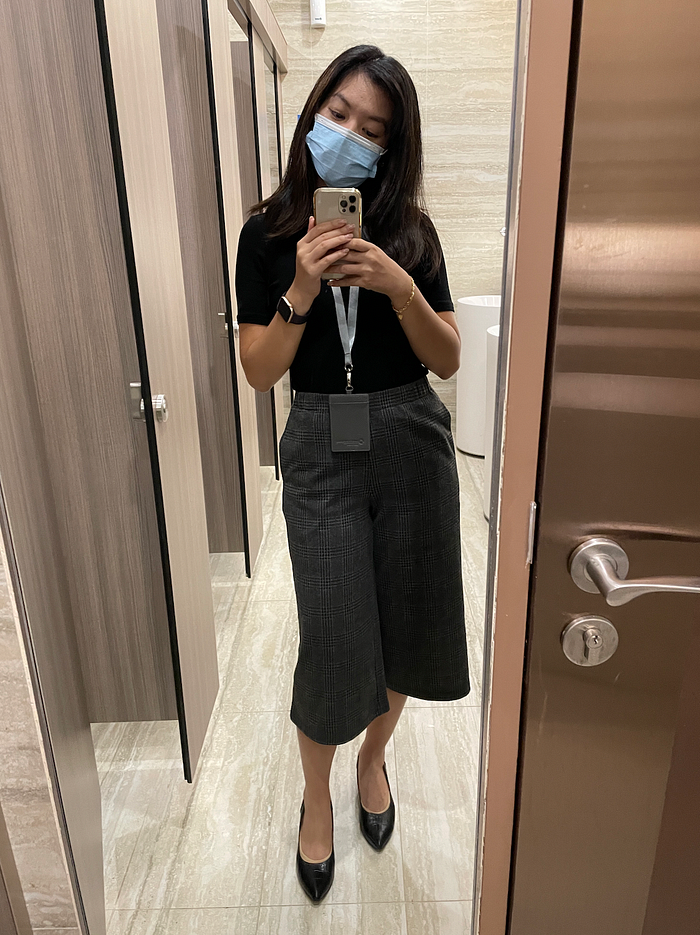
When the job started, I tried to hit the ground running. I put in my 120% learning about the software to use, how to code in various programming languages, and reading about UX research. I pushed myself out of my comfort zone to make friends with my colleagues even though things were difficult with work-from-home still being a norm and hybrid working arrangements being cemented.
I remember feeling like I was resurfacing from a long time of being anti-social and happy being on my own to the pre-COVID days again. I felt anxious going into the office without a lunch buddy and a lunch plan. I'd stress myself trying to plan out who to eat with, and if I didn't find anyone, I'd decide to go home during lunchtime even though I'd gone into the office in the morning.
There came a time when I looked up to my partner. From the moment he could go back to the office, he went in every day consistently. To the typical millennial who loves the flexibility of working from home, he looked like a crazy workaholic. But he served as a proof of concept that showing up every day meant a strong routine and showing up for yourself too. I noticed that on days I went into the office, being in the right environment in addition to dressing up made me more willing to switch on my camera and participate in meetings. The informal interactions with my colleagues were unparalleled to the tiny chats we had over Microsoft Teams.
As such, I decided to take the leap and go into the office every day. It helped that there was a colleague in the extended team whom I knew was there daily too. As for lunch, I told myself to just open up and reach out to have lunch with my extended team.
After crossing that initial hurdle, I began to feel a virtuous cycle coming on. Stronger connections were felt with my colleagues. I dared to ask for and take on extra projects and bigger opportunities. My teammates were so gracious to trust me to take on smaller parts of their projects.

This lasted for about a month or two until the bad news came.
In the first few months of my contract, I worked hard to prove my worth to Jolene, doing whatever she pleased and suggesting to take on even more. When she told me on my third day that I was "already bringing value to the team", I was so pleasantly taken aback that I screenshot it and sent it to my loved ones. It was such a welcome change from the hostile environment in healthcare previously.
I took the conversion seriously, and I kept a detailed log of every task I did and how they contributed to the bigger business goals and vision. Upon Jolene's request, I'd done up a table of my contributions and written the justification of my conversion to a full-time role all on my own. Even though it was only 2 months into the role when she first asked for this document, I already had a full page ready to go.
After the submission of that document to her, there was radio silence for a month. Upon hitting the halfway mark of my contract, I began asking Jolene at our one-to-ones about the conversion and how it was going. Whenever we brought it up, she'd say "oh yeah!", as if she'd forgotten, then whip out her phone and start to WhatsApp our HR business partner (HRBP). Subsequently, she started to change her narrative, saying that the HRBP did not reply and was ignoring her messages.
With the constant pushback, I was starting to get anxious and frustrated. I had a hunch that the conversion would not go through for some reason.
A week later, Jolene mentioned that she had spoken to HR and that a conversion at the time may not be in the cards. However, she could still push for an extension of the contract till the end of the year. I understood her hands were tied. The line "HR is for the company, not for the staff" rang over and over in my mind. But I got the feeling that Jolene wanted it easy. Her constant babbling and declining of my requests for a conversion first and foremost made me speculate she didn't want to put in the work to fight for me. That let me down.
I told her firmly that I wanted to continue to work here, citing enjoying the job scope and working with the team. I was putting in 10-hour-days at the office and I felt like that deserved to be recognized in some way. A part of me was screaming, "why can't you just fight for me?"
My proposal was conversion to full-time first, and only as a last resort, an extension of the contract. This extension also had to be at least for 6 months as a 3-month extension would be way too short and unfair. Jolene agreed and said she'd negotiate again with HR.
One and a half months before the end of my contract, Jolene pulled me aside.
"I spoke to HR. Because the bank is facing strong headwinds, we will not be able to convert you. They also mentioned that to be safe, you should start looking for a job outside."
"You should start looking for a job outside."
Not even an olive branch.
I was devastated. Hearing that I was basically laid off made me feel like my world was shattering. Tears immediately sprang to my eyes and I fought to compose myself.
Jolene continued to ramble, "this has nothing to do with your performance. If you were a student, you've honestly done so well. If I were the assessor, I'd give you A+!"
Then why don't you see the value in me? Why don't you fight for me?
A million thoughts ran through my mind.
I can't believe this is happening to me. A top student! A university scholar!
You told me a conversion was guaranteed! Were you just baiting me?
What about the projects I'm handling? I only just got to know our team better!
Who's going to do the work if I'm not here? Our department is going to crash and burn!
Whatever happened after was a blur. I probably said something like, "thank you for the opportunities", "please continue to fight for an extension", and "okay I will look out".
I walked out shakily and everything was still the same. My colleagues were still sitting at their desks, banging on their keyboards, and having meetings. It was like an earthquake happened in my head, but everything else was fine.
That put things into perspective. I immediately spoke to some of my colleagues to tell them what had happened. After the preliminary disbelief, they each gave me words of advice that I took a little of.
That weekend, I brushed up my resume and finally made the portfolio website I'd been putting off for months. I wrote cover letters and started applying for jobs. After having gone through a job search at the beginning of the year, I didn't think I was going to be thrust into another one in 2022.
In that fight-or-flight mode, I was fully focused on the mission to get another job that it numbed the feeling of being let go. A year ago, I would have fallen into a spiral of self-victimization and blame towards Jolene. How time flies and how perspectives change.
I started interviewing and managed to get good feedback for the first few rounds. A dream company of mine got back saying that they wanted to add more rounds to the process. Having spent hours preparing for the first few interviews already, this felt like a curveball. Alas, being at the mercy of a potential employer, I had to be okay with this.
It was during the period of interviews that the emotional turmoil about my situation set in. I could barely focus on my work while stressing over the interviews. It was stressful and the anxiety affected my sleep, feeling my heart thudding and blood coursing through my ears with my eyes closed. It was so abnormal I kept measuring my heart rate on my Apple Watch — 108 bpm.
Three weeks felt like forever, but this story has a happy ending. The company somehow picked me over the other candidates, and it came with benefits I never felt like I could ever achieve with my background. It's funny because I often compared myself with peers who performed similarly academically, and pegged my net worth to theirs, but never was able to achieve it. I felt overwhelming gratitude to the recruiter who fought for a competitive compensation package for me.
When the recruiter first called about the offer and salary package, she listed a number way beyond my expectations. Thank goodness it was an audio phone call because the smile that broke across my face when she mentioned those numbers would have given my feelings completely away.
I was jumping for joy and trying hard to contain my excitement when breaking the news to my loved ones and colleagues. The genuine happiness that gleamed in their eyes was so heartwarming, but deep down I knew that things weren't going to be the same again. No more seeing one another on a daily, being there to support one another physically.
A few months back, a colleague of mine whom we call our "shaman", did a tarot card reading for me. I asked what the next 6 months of my career were going to be like. I don't remember the exact details, but she mentioned circumstances were already changing and new things would come fast and furious. She said that opportunities will present themselves, but they may not be in the way I expect them to be. Overall, the sentiment was good and I left feeling like my career was on the upturn.
I've never been one to wholeheartedly believe in such spiritual readings, but looking back, the reading was accurate in the aspects that I remembered.

I had thought that opportunities meant blue skies and big smiles. But I now realize that every opportunity comes with a cost. That's why leaving felt bittersweet, like being boosted up into a bigger arena when I was just getting started. Knowing this is good for my growth, but also torn away from unfinished business.
Maybe it's because I'm used to being in control and this whole time I didn't feel in the driver's seat. But perhaps I never was. Perhaps life happens to us, and we just have to adapt and roll with the punches. Things change and we are the co-pilots.