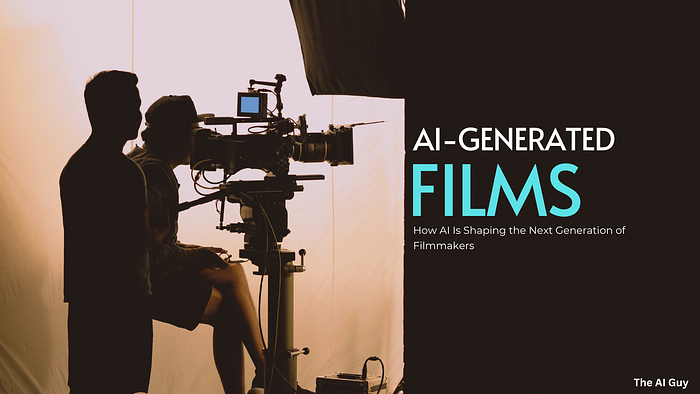


From black-and-white cinema in the early days to digital effects and CGI today, filmmakers have been incessantly introducing new technologies to push the boundaries of storytelling. Now, a new power has emerged that will change things further: artificial intelligence.
The making of artificial intelligence-generated films is no longer one of those topics science fiction novels are written about but rather close to becoming a reality, where algorithms do the work of the director, writer, or even sometimes actor.
In the very initial stages, it was merely used in enhancing and accelerating jobs related to post-production. Editing software was now empowered with AI's automatic cutting of scenes or the auto adjustment of color grading, which made it more amendable for human editors.
So, as the capability rose, so did involvement in filmmaking. It is no longer just a tool available for filmmakers but also a storyteller.
That sounds like something out of a science fiction movie, but it isn't. Much closer, in fact. Algorithms can create scripts, generate visuals, and even direct an actor already existing, whereas once considerations were relegated to human imagination alone, they are now rolled through machine learning models and tailored through datasets of previous films, genres, and styles.
The AI can tell the patterns in storytelling, predict audience preferences, and even create characters that change with differences in narrative arcs without any human intervention.
A good example of this would be the 2016 short film Sunspring, which is the story of a dystopian future where love, loss, and science clash.
The narrative is a bit disjointed and surreal; however, it's such a milestone- AI can generate a screenplay at all, though an unorthodox one, interesting, and strong enough for production. So far, that is where improvement in technology has gotten to.
Maybe at a cursory glance, the concept of films created by AI is an innovation that seems only to better efficiency in the movie-making process. But it is more than that. This is not just a matter of automation and saving time and costs.
The real promise lies in the creative potential AI can provide. Imagine a movie evolving in real-time on the base of viewers' reactions or a story changing based on who is watching. AI opens a new world of storytelling, an interactive one that filmmakers have never seen before.
Indeed, some of the AI-generated materials have begun to surpass conventional approaches. Let's take Netflix. To provide recommendations to its users, it makes use of its machine learning algorithms.
It calculates viewing habits and patterns to best recommend movies and TV shows to a particular individual's tastes. Now imagine a step ahead — a platform where not just recommendations but also movies are AI-crafted for every user.
The same movie may have different endings or characters or even plot twists for different users, offering the ultimate unique experience in filmmaking.
The bigger revolution, though, is about the visual effects and animations, where AI radically changes the entire scriptwriting and story-narration process associated with making a film.
For example, a neural network program called DeepDream showed how surreal and visually beautiful landscapes could be generated under the hands of AI as it is trained on images to recognize patterns. Human artists are no longer required to make otherworldly visuals as AI can produce breathtaking imagery both organic and at the same time alien.
For example, the same deep learning algorithms can produce completely realistic human faces, voices, or movements, in many ways making fictional actors indistinguishable from real ones. This certainly makes for interesting possibilities about casting in movies.
Using AI, it is possible to revive actors of the past, allowing them now to become stars in new films well beyond the time of their death. We have already glimpsed some of this technology in films like Rogue One: A Star Wars Story, where a CGI version of Peter Cushing reprised his role as Grand Moff Tarkin.
The rise of AI-generated films does raise ethical questions.
- For example, who owns the rights to a film created by an algorithm?
- The programmer, the machine itself, or the studio that made the movie
- And where is the impact on human creativity in an industry that's increasingly being taken over by machines?
As the use of AI proliferates, it's likely many roles within traditional filmmaking — scriptwriters, directors, editors, and so on — will continue to change or disappear altogether.
How much of its creative input is human and how much efficiency and innovation AI brings would be reconciled by the industry.
But then, of course, there is the question of authenticity in storytelling itself. All films are representations of human existence: hopes, fears, desires, and strife.
Can an algorithm understand these emotions or will AI-generated films be the deficit of depth and nuance arising from lived experiences?
While AI may be able to process vast amounts of information to replicate human behavior, the real test is whether it can indeed really capture the end of everything that resonates emotionally within a story.
It remains challenging, but the future of AI-generated films is exciting. As technology advances, we look forward to more experimental projects that push our thinking on what a film can be. In many ways, AI entering film is no different than when film became a talking medium.
Where silent films paved the way for talkies, human-made films might pave the way for AI-generated ones. There will be purists to abhor this change, yet history has shown that technological changes in cinema happen begrudgingly at first before becoming part and parcel of the art form's evolution.
AI-generated films would further democratize filmmaking since, currently, directing a movie requires a lot of investment money equipment, personnel, and studios.
However, with AI, low-budget producers who do not have their studios or even money for high-definition gear can sit in front of their laptops and direct a movie using an algorithm. This would mean an explosion of different voices and stories in the world that otherwise may never be told.
On the other hand, AI can bridge that gap between filmmakers and audiences. Algorithms can analyze their data in real time and return instant feedback on how their work was appreciated.
It could make filmmaking very iterative-almost collaborative because these directors would be adjusting according to the reactions of their audiences, which brings a dynamic relationship between the creators and viewers.
AI-generated films are also opening up new avenues of marketing and distribution for films. AI algorithms can predict the preferences of viewers; hence, studios can aim their more relevant movies better. AI is presently used to analyze Hollywood scripts to forecast box office success.
Companies like ScriptBook utilize the AI algorithm to gauge the potential of a screenplay for studios — giving them valuable insight into which projects are worth pursuing. This may lead to riskier filmmaking, but calculated risk, as studios are likely to invest in the film with a greater probability of striking a chord.
The next few years probably pose the greatest possibility in terms of increased collaboration between humans and AI in filmmaking, assuming that AI does not replace human creativity but enhances it.
For instance, a director can use artificial intelligence to create various versions of the same scene and take the one close to his vision. A writer can team up with AI for the generation of ideas by processing an enormous mass of data via some algorithm to come up with brilliant plot twists or character development. The possibilities seem endless.
As AI climbs high on the rungs of film control, it is pertinent to always remember that technology is only as hard as the human wielding it.
While AI can scan data and produce content, that remains for the filmmaker who puts such tools at their disposal to push storytelling while being purer to its emotional core, which makes cinema a fabulous art form.
The future of filmmaking is undoubtedly coiled in AI, and no matter how uncertain the road ahead may be, the afterparty rests on one simple fact: the lights are on, the camera is rolling, and the algorithms are ready to roll.
Whether this becomes a new standard or merely one of those odd experiments to find its niche, it is already shaking up for us a reassessment of what makes cinema and even how it's to be created and viewed today.
Thus, the creative spirit of the human personality combined with the capabilities of machine intelligence shall open up a new frontier in storytelling limited only by the scope of our imagination and the algorithms we create.