Modern software applications are becoming increasingly complex, requiring smarter, more adaptive systems that can handle nuance, multi-dimensional tasks. That's where Semantic Kernel's Agent Orchestration helps — empowering developers to build, manage and scale sophisticated multi-agent workflows with ease.
Why Multi-Agent Orchestration?
Traditional single-agent systems often fall short when dealing with complex workflows that demand a range of expertise or decision making capabilities. By orchestrating multiple specialized agents, you can breakdown these limitations and design systems that are collaborate, flexible and scalable.
Semantic Kernel makes this possible by providing a powerful, extensible foundation for coordinating agent behavior through well defined orchestration patterns
It currently supports multiple patterns based on the use case which includes
· Concurrent — Parallel analysis, independent subtasks, ensemble decision making
· Sequential — Passes the result from one agent to another in a defined sequence
· Handoff — dynamically transfers control between agents based on context or business logic
· GroupChat — All agents collaborate in a managed group conversation
· Magentic — Inspired by Magnetic One, enabling free-flowing, generalist collaboration
As part of this article, we will explore with an example of how multi agent orchestration works with sequential and concurrent patterns.
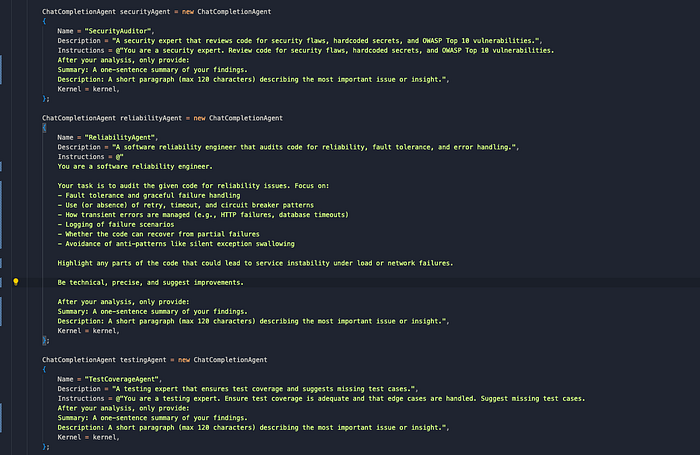
In the following example, we implement a .NET application using Semantic Kernel's multi-agent orchestration capabilities. The program defines three specialized agents each with a distinct responsibility for code review.
· SecurityAuditor
· ReliabilityAgent
· TestCoverageAgent
Using both concurrent and sequential orchestration patterns, the application demonstrates how multiple agents can analyse the same code snippet in parallel or in a defined sequence, providing targeted feedback from different perspectives.
Lets start by creating three different agents (code reference)
Concurrent Pattern:
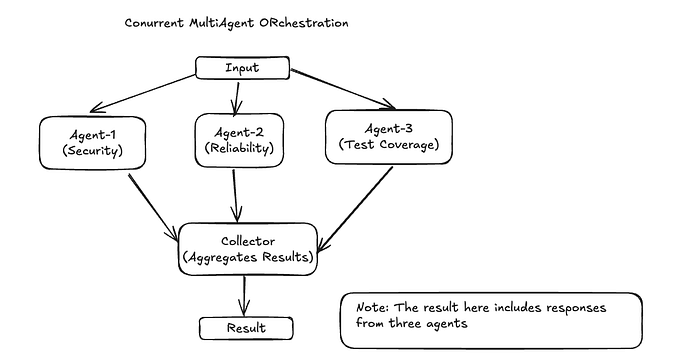
The concurrent orchestration pattern enables multiple agents to analyze the same input in parallel, allowing each agent to independently provide its specialized feedback. This approach accelerates the review process and ensures that security, reliability, and testing perspectives are all considered simultaneously.
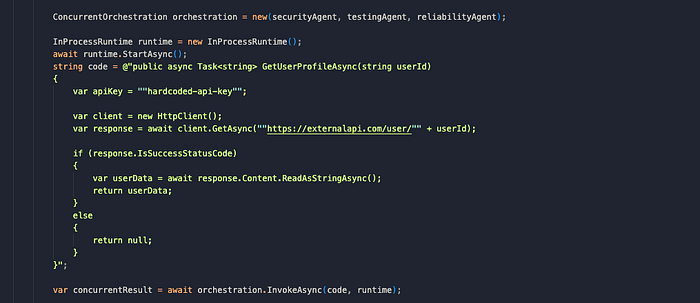
Lets explore how the concurrent pattern is executed and output is retrieved:
The ConcurrentOrchestration object includes the multiple agent objects passed in any order
The processing happens as described below:
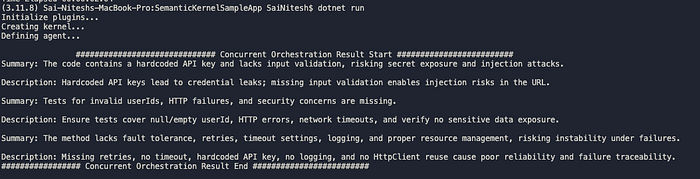
Output:
This includes output from three agents
Sequential Orchestration Pattern:
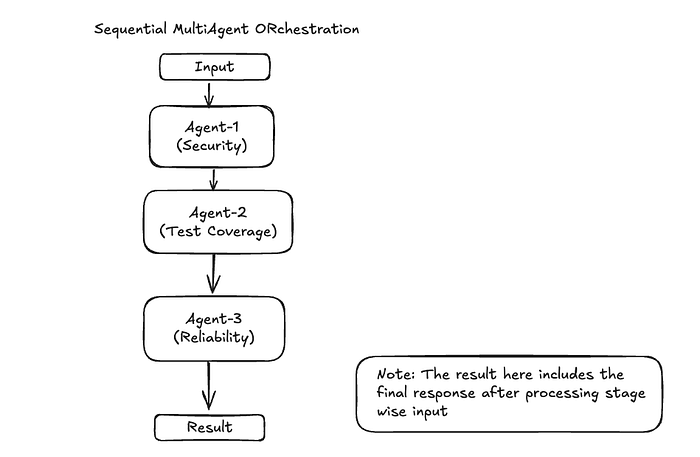
The sequential orchestration pattern processes the input through each agent one after another, allowing each agent to build upon the findings of the previous one. This creates a collaborative review flow, where insights and recommendations are refined at each stage for a more comprehensive analysis.
Lets explore how the sequential pattern is executed and output is retrieved:
The SequentialOrchestration object includes the multiple agent objects passed in sequential order

The processing of the same input that was used for concurrent pattern happens as described below:
Output:
This includes output from final agent in the sequence

Note: I have included the sample ai project code in the reference section below
References:
Code Repo Link: https://github.com/sainiteshGit/sample-ai-project/blob/master/semantickernel-agent/SemanticKernelSampleApp/Program.cs