
Mark Manson knows how to get attention, and keep it. His latest video is evidence of this, and it uses a really simple trick that you can use, too.
Mark Manson just published a YouTube video that's likely to break 1M views in less than a week. Besides it being Mark Manson literally doing cocaine, it's going to be huge because it uses on really important trick that makes videos go crazy viral.
Besides just giving useful, valuable advice, Mark uses a content structure that gets attention and keeps audiences watching. Which sends the right signals to YouTube to promote the hell out of it. Here's how you can learn to do the same.
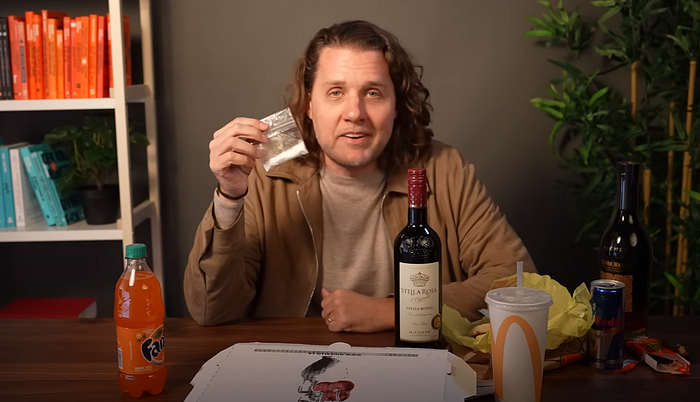
His opening uses the "2nd-layer analysis" framework. It goes something like this:
- State a relatable problem (desire, etc)
- Immediately tag the "standard" advice — and then explain why it's wrong, incomplete, or ineffective
- Give your value-added opinion and idea.
- Provide context, examples, and nuance
With this strong of an opening, even though it's pretty slow, a LOT of people will watch through to the end (which means YouTube algo is going to push it to a LOT more people who will, in turn, watch it to the end). That's how I found it — it was in my feed, I wasn't a subscriber to Mark Manson (well, I am now).
Here's how each step works:
1. Get attention — we like what is familiar. Humans LOVE repetition. If I'm seeing a bunch of videos about getting ahead of 99% of people, this is a format I'll respond to.
Better than 99% is everywhere, and ALSO it works (we naturally pay attention to things that promise us a gain of status).
The (start today) bit is also important — again, because drugs, by which I mean dopamine. It's a promise of immediacy — I'll watch this video and IMMEDIATELY my life will be better. Remember, dopamine gets released when you ANTICIPATE a reward. You expect to get something good from this video — your click-finger starts twitching. Gimme.
Now imagine if Mark's title was "It's not about productivity" or "3 things you need to do to be massively successful", or "Man undercuts your dreams of becoming a billionaire while snorting fat rails of 'pretend' cocaine".
Doesn't quite… hit the same, does it?
Now, this is just the title and thumbnail — once clicked, he IMMEDIATELY repeats the title, head on, no teasing or "stick around to the end of the video".
Just REPEAT THE TITLE.
And, as he does that, Mark treats us to a parade of aspirational AND recognizable images . Steve Jobs, Mr Beast, Elon Musk, and a bunch of other people that are equally recognizable (maybe) but just to different demographics than me (this is ALSO a tactic — big nets for big, diverse audiences).
2. Tag the "standard solution" — this sends a VERY important signal to the audience and should be done early. Actually, two signals:
- "This is not like the other videos you've watched on the subject" and
- "this is BETTER than all the other videos you've watched on the subject".
Hand-waving dismissal of the typical, and thus boring advice makes you keep paying attention, it's a signal that 'the good shit' is coming next.
By letting your audience in on your "secret, better knowledge" you make them feel good. You make their brains squirt dopamine, which means they'll stick around, hoping for the next hit.
3. "Skyscraper technique" — you have to actually deliver on that last promise. And honestly, it's not that hard. You can give context and provide nuance to what has already been said.
Or you could talk through the tricks you learned tryin to implement the typical advice, and what you learned works and doesn't work.
Or you could bash the "typical advice" and say why your idea is better.
This is the next squirt of dopamine — now they're getting a little hooked — they will sit through more of your spiel, expecting that next hit.
Really, the only thing you HAVE to do at this stage is believe that what you're offering will work better than the "typical advice". You can be wrong, but you can't be unconvinced.
4. Context and Nuance — THIS is the part most new creators put way too early, turning off their viewers. People need to be invested in order to start caring about your personal narrative story, nuance, detail, etc. They need those previous hits of dopamine to stick around.
Personal stories help you remember the lesson, but you can't front-load them. You front-load the cursing, guitars, and cocaine (or whatever that is in your niche). Then, when the audience gets the message that "this is where the dopamine comes from" — that's when you can jump through hoops — listen to your story, keep track of characters, like and subscribe, whatever.