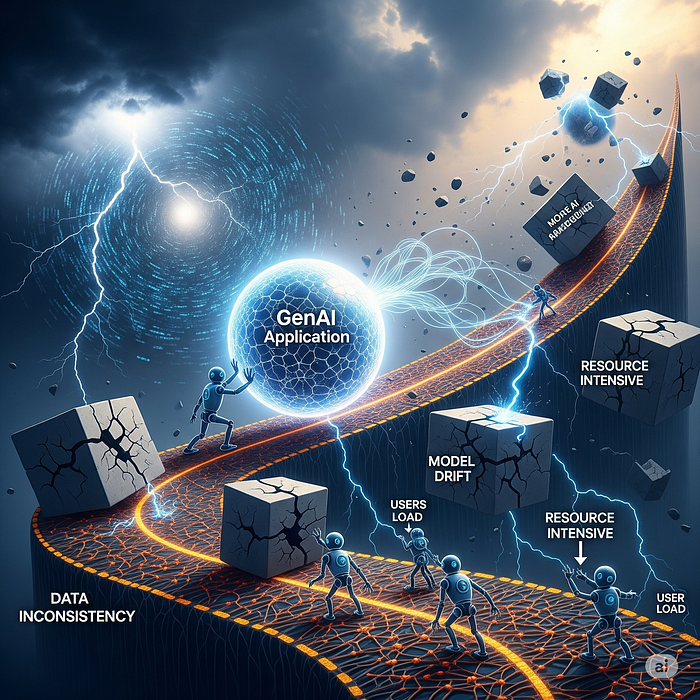

If you've experimented with LangChain, OpenAI APIs, or a local RAG pipeline, you're not alone. Prototyping GenAI apps has become easier than ever.
But the moment you try to move beyond a demo — things get complicated:
- The app breaks when you add new users
- Costs become unpredictable
- Data governance concerns pop up
- And your stakeholders expect production-grade reliability
That's the reality of building GenAI at scale — and exactly the kind of real-world thinking the Databricks Generative AI Engineer Associate certification prepares you for.
1. Deployment Isn't Just About Model Endpoints
❌ Common Misconception:
"Just wrap the model in an API and you're done."
In practice, deployment involves:
- Managing latency and throughput trade-offs
- Serving multiple model types (e.g., GPT, DBRX, Mistral)
- Autoscaling endpoints
- Ensuring secure access via authentication and roles
- Keeping costs from spiraling out of control
✅ What Databricks Offers:
- Model Serving for open and closed models
- Lakehouse AI integration for feature pipelines
- Unity Catalog-based access control for serving endpoints
📝 Many of these topics appear in the Databricks GenAI Associate Exam under Application Development and Assembling & Deploying Apps — ✅ Get structured preparation with this certification-focused course
2. Governance Is Critical — and Often Overlooked
When using LLMs across internal or customer-facing systems, it's not just about functionality. It's about responsibility.
❌ Without proper governance:
- Prompt templates may expose sensitive data
- Vector indexes may mix up access levels
- You have no clear audit trail for regulators
✅ Databricks' Approach:
- Unity Catalog extends RBAC, lineage, and data classification to:
- Vector search tables
- Embedding models
- LLM inference chains
- You can track who used what model, when, and with what inputs.
These topics directly map to the Governance section of the exam — one of the most misunderstood areas. 📚 This course breaks it down with curated practice questions
3. Monitoring Isn't Optional at Scale
GenAI systems are probabilistic. You don't always get the same answer for the same input — and that makes monitoring and evaluation vital.
❌ Common issues:
- No feedback loop from users
- Silent failures (e.g. empty or misleading responses)
- No performance metrics (latency, cost, hallucination rate)
✅ Databricks Tooling:
- MLflow with LLM evaluation capabilities
- Inference tables to track usage
- Agent monitoring (in preview) to debug multi-step chains
These features help answer: "Is the system improving?" "Is it grounded in source data?" "What is the cost per query?"
🧠 These exact questions form the core of the Evaluation and Monitoring section of the exam — 🎯 Get exam-ready with a question bank aligned to the official domains
Final Thoughts
Prototyping GenAI is fun. Scaling GenAI is where engineering meets accountability.
If you're aiming for roles that go beyond demo apps and into production environments, you need to:
- Understand how real-world deployment works
- Be fluent in governance and monitoring frameworks
- Speak the language of production-ready GenAI
That's exactly what the Databricks GenAI Engineer Associate Certification tests — and this course helps you prepare for it with targeted practice questions and topic breakdowns:
👉 Enroll here: Become Databricks Certified GenAI Engineer Associate