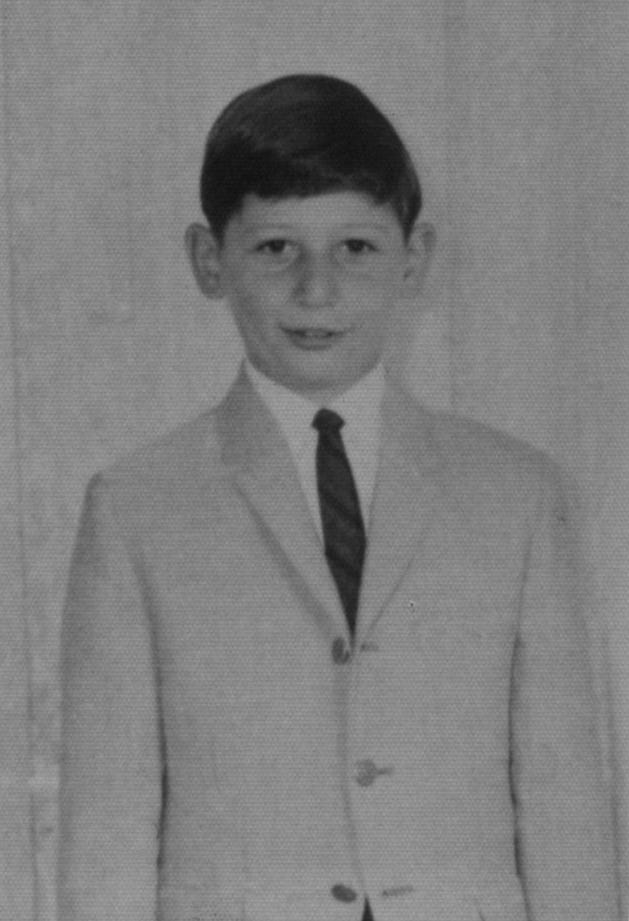


Lucretius's admirable observation —that nothing arises from nothing, and all springs from chance and from change — well describes the impetus for my life's work.
The chronology of my life as an educator can be traced to October of 1971, when the old guard at my school went out on strike (a wildcat one), and my boisterous peers and I encountered not one but three free-thinking, iconoclastic teachers in one magical year.
These teachers had descended from the ivory tower of graduate school onto the campus of Barnard School for Boys in the Bronx to irrevocably rock my adolescent world. Rock in the sense of sensibility. Instead of preening, slouching, or commanding in the front of the room — monopolizing the air space as was customary for most teachers — they chose to sit us in circles, facing one another. They had us do something unprecedented: they encouraged us speak to each other.
They offered me (and my friends) license to use our minds and imaginations and our social and emotional lives for something beyond prepping for the college entrance exams.
These days we'd call their approach "learner-centered." There was less frontal emphasis on teacher and more attention on communication and argument, on constructing conversations around books, life, and the culture raging outside. Yes, they had their subjects — language arts, history, sociology — but they found ways to equalize the importance of what we learned with a unique focus on how we learned and why it mattered. What they did for me was set an example and provide an inspiration for how adults could work creatively and purposefully. Not since elementary school had any teacher shown such a keen interest in me personally or in my expressive life.
They offered me (and my friends) license to use our minds and imaginations and our social and emotional lives for something beyond prepping for the college entrance exams.
For a short moment, there was a new and vitalizing air of intellectual spark and curiosity in the otherwise stuffy and orderly call-and-response classroom cultures we took for normal. Instead of keeping the world at bay and isolated from school, they insisted that we allow it in. How could we be reading about Holden Caulfield or tracking the adventures of Odysseus without considering that America was at war both abroad and at home with itself?
Their classrooms illuminated the complex realities that we were growing up in. So much so that, in 1971, Messrs. Blecker, Hamlin, and Tieger organized the orderly exit of the entire middle and high school to observe a nationwide Moratorium Against War. They led us out of the building to assemble under a willow tree in the back yard (otherwise used for makeshift soccer at lunch), where we observed fifteen minutes of silence while our headmaster peered through the venetian blinds of his dark office with the disapproving grimace of the Grinch.
Their impact on my life has been profound and cumulative. But what I appreciate most about them was their questions, their probing intellects, and how they provocatively framed them as invitations and investigations. They understood what it took to elevate our social imaginations.
Every Wednesday, John Hamlin would select some of our writings and project them on the wall (with an artifact called an overhead projector) in our English class. No teacher before ever did anything approximating that but write a grade or a number and hand it back. It was one of many such impersonal transactions that were a daily and unquestioned part of school. But with him it was different. My mother would type my poems or essays the night before and with the trepidation of a performer at an audition, I waited and hoped anxiously that what I wrote would be selected. And when it was, he read the work with passion and respect. It thrilled me and affirmed my adolescent image of being a writer. It was a validation that I never forgot. There were no red marks. No checkmarks. But comments. Lengthy and detailed. As if a reader was speaking directly to me, a writer.
On the first day of his American history class, Blecher wrote on the black board: How would you define history? He then proceeded to play Bob Dylan's "With God on Our Side" on a school Victrola and engaged us in an extended conversation about what we thought. Everything about that class from that point on was charged with a piercing examination of our past and present. When we read "Bury My Heart at Wounded Knee," the words genocide and expropriation were introduced into our slowly opening minds. These were not terms that we needed to memorize for the PSAT exams. Nor did they ever appear in our voluminous and glossy textbooks. Such an approach was not called critical thinking then. But powerful as it was, it roused in me a discerning inclination that to this day I cherish: to question everything.
At the end of that school year, with the old guard waiting in the wings, none of their contracts were renewed. While their tenure had ended, their lifelong impact on me had just commenced.
