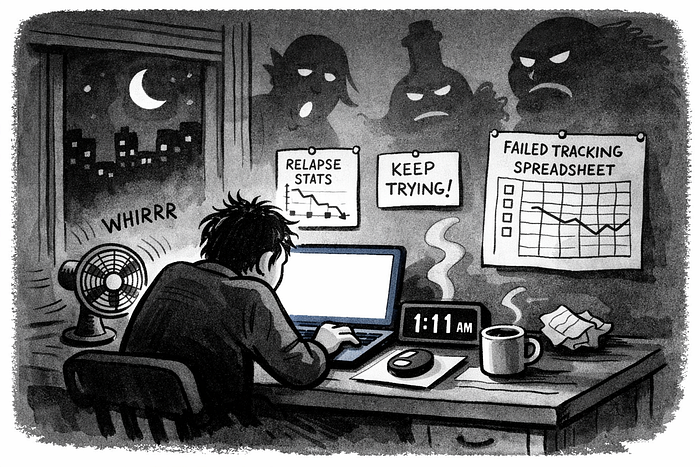

The glow of a laptop at 1:11 a.m., fan whirring like a tiny jet, is not a neutral light. As BoJack Horseman once said, "You gotta do it every day — that's the hard part." The difficulty shows up in the numbers: among millions who try to quit after years of habitual use, about 40 to 60 percent relapse in the first months of abstinence. Even after five years, about 15 percent are still dealing with recurring slips, a pattern similar to chronic conditions such as hypertension or asthma. But unlike blood pressure, this behaviour often remains hidden, leading some bright, ambitious people to quietly lose valuable cognitive time during years when their neurochemistry should help them advance. I once kept a spreadsheet to "prove" I was above it; the spreadsheet lasted less than two weeks (I never installed a blocker).
This comes up repeatedly in green rooms, locker rooms, and conference spaces off Sand Hill Road. In Silicon Valley, elite sport, and entertainment — fields that reward focus, novelty, and intensity — there is a clear trend. People who have stayed porn-free or managed stable recovery often appear more frequently at the highest levels. Correlation does not mean causation, but the question remains: is the same self-control that helps someone avoid or escape this habit also responsible for achieving exceptional success? And if someone cannot maintain discipline in the first area, does it quietly undermine the second, with consequences that never show up in end-of-project reviews? I am uncertain but continue to consider this possibility.
The neuroscience of opportunity loss: how porn affects the brain's foundation for achievement
To understand why this habit is difficult to break, first consider its impact on the brain at the most basic level — the processes that turn intention into sustained action.
This isn't a 'bad habit' in the sitcom sense; it's circuitry. Structure. And with each additional year, it ossifies a little more. Porn doesn't ping the reward system like a good burrito or clearing your inbox. It arrives as a supernormal stimulus, an engineered override so large that it commandeers ancient reward loops that never evolved for this barrage. Think Pac-Man on a permanent power pellet, except it's your mesolimbic pathway doing the gobbling.
Here's the kicker (typed at 11:07 p.m. at Philz on Middlefield): the dopamine surge isn't just big; it can exceed typical sexual reward by a wide margin, and it doesn't fall off after a brief spike. It can idle high for hours, session after session, tab after tab. That sustained, supraphysiological flood starts a remodelling project you did not consent to: downregulated receptors, sensitised cues, and a quiet shift in the settings for motivation and inhibitory control. I, of course, never juggle 23 novelty tabs to test this… (or do I?)
MRI findings point to a similar pattern: more time spent on porn tracks with less grey matter volume, the tissue used for abstraction and long-range planning. Heavy users show muted activity in motivation and control circuits, a kind of hypofrontality that makes 'stick to the plan' feel like lifting wet cement. The prefrontal cortex, the executive hub for strategy and self-regulation, shows measurable wear with chronic exposure. This isn't poetic damage. It's literal tissue change in the machinery that separates outliers from the pack.
Here's the part that feels like a magic trick with a trapdoor. You flood the reward circuits, the system adapts, and the receptors retreat: fewer docking sites, dulled sensitivity, typical tolerance managed by homeostatic regulation. The brain tries to keep things stable, so it reduces the response; you try to feel something, so you increase the stimulation. This starts a spiral — more intense, stranger, louder material. A survey found that 21.61 percent of respondents needed either more of it or more extreme content just to feel aroused, and 10.39 percent needed to escalate simply to maintain erectile function. The Red Queen would nod: run twice as hard to stay in place.
This is how addiction works, but porn often accelerates the process. Tolerance builds quickly and then eats away at your focus during years better spent developing skills, writing drafts, or improving in sports. As I type this on the late Caltrain out of Mountain View (8:52 p.m., car 3, regrettable vending-machine almonds), I notice the subtle urge toward the easy tab (which I, of course, never open — except maybe in Q4 of 2019).
But the damage goes beyond the reward system. Hypofrontality, the prefrontal cortex slipping into low activity, means the executive function shifts to the background while the emotional, impulsive circuits take over. Strategy gives way to impulse. Spock rests; Kirk takes control. This is the worst setup for anyone who relies on trading short-term pleasure for long-term goals.
By the time many users spot the pattern, the circuits needed for self-control and planning are already affected. The tools for recovery — along with those needed for any big project — are missing. Studies show cognition itself suffers measurable harm.
Let's talk brass tacks, the gears behind greatness, and what happens when the teeth get stripped. If you trace it back, porn addiction predictably picks off executive function at the knees. I don't mean garden-variety indecision, we're talking casino logic, the kind that wires you to snatch up scraps now instead of building something real for later. Those headline-making founders who stack nine digits on the cap table? Usually, it's the frontal cortex doing the heavy lifting: delay and discipline for the long game. The same holds for elite athletes like Simone Biles. When the prefrontal system starts ghosting, quitting becomes hard across the board, from the morning routine and savings plans to work deadlines and even coffee meetups with your partner (see my unfortunate run of cancelled Thursday nights last spring).
But here's the kicker: recovery, that shining story of "quitting for good", is mostly just that, a story. Recovery from compulsive sexual behaviour often takes years, and timelines vary widely. Long-term follow ups often show that only a minority sustain multi-year recovery, many cycle through shorter periods, and slips remain common even after several years.
Online "reboot" forums (think the Discord servers of habit extinction) don't paint a rosier picture. Most streaks last weeks, many end before a month. Some reach a few months, and a small fraction make it to a year, but the overall arc feels like Sisyphus with a browser tab and a short memory. Or, as one forum old-timer put it amid a string of confessional posts: "I am back on Struggle St., after a whole bunch of relapses." Been there. Or so I tell myself, as I type this under the accusatory glow of my MacBook at LAX. Time zones blur the streaks. So does everything else.
And here the difficulty becomes clear. How does anyone actually walk away for good? Some days, it feels like quitting is only possible for monks or superheroes. The struggle starts as soon as you look at a screen — any screen. Social media, dating apps, video platforms, advertising — sexualised images are everywhere. Avoiding triggers takes a level of discipline that most people, myself included, do not have, especially during late-night scrolling or moments of boredom.
People relapse not because of weakness, but because the environment is designed to make that likely, especially during stress or late-night loneliness. Neuroscientists call the underlying cause DeltaFosB, a molecule that sticks around in the brain's reward circuits long after use stops. Even after months of abstinence, it remains, making temptation feel immediate at the slightest cue. Motivational advice cannot remove it entirely. Cravings stay — they shift and wait for a vulnerable moment.
Withdrawal often feels overstated. A 2021 German study found that most people who quit for a week did not have physical symptoms unless they had been using daily for a long time. For heavy users, cravings stay high even after a week. The cycle restarts again and again. Recovery is not a final victory, but a process that continues as you go. Whether that is reassuring or tiring depends on your perspective.
Here's the difficult truth: the period when recovery becomes most necessary, when the stakes are highest, is exactly when quitting is hardest. If you accept the talent-trajectory view (Malcolm Gladwell, or the Miyamoto Musashi school of early formation), there is broad agreement that the stretch from 25 to 35 is the professional version of the Hero's Journey. Founders are expected to be mid-pivot or at IPO by 29. Artists and coders often do their boldest work before neural pathways harden or life's entropy sets in. For athletes, if you're not peaking by your early thirties, the window is closing. Those are also prime years for the accumulated collateral damage of compulsive porn use, typically driven by a decade of uninterrupted exposure and dopamine recalibration, with wear on the prefrontal cortex by the time real consequences arrive.
That means that by the time someone feels enough pain to attempt lasting change, enough job slip-ups and relationship damage, the clock has already run down on a crucial opening. At 42, a person may have their first clear-headed morning in years, but the field is often already shaped by those who either avoided the trap or found a way out earlier.
But there are outliers, and their examples hint at a link between abstaining and exceptional achievement. Consider Jason Portnoy, a former PayPal executive and later venture investor, who also struggled with addiction while maintaining public success. He earned significant wealth and industry respect while acting compulsively, which nearly destroyed his personal life before he brought it under control. If you're looking for a simple tale of easy recovery, there isn't one. His story shows how complex the process remains.
Portnoy's arc is not a neat redemption story. It warns that even at the top of the food chain, porn compulsion can run like background noise, and getting out of it, when it happens at all, takes industrial-grade effort and paid support. His loop was almost comically Sisyphean: hungover, lowest ebb, cue porn; repeat for years (Groundhog Day without Bill Murray, and decidedly less charming). Getting clean meant a life coach, serious therapy, a policy of brutal transparency with his wife, and a wholesale rebuild of how he lived day to day. He made it through, but the price tag hovered over everything, marriage, standing, sanity, like a repo man.
A more instructive signal may be the people who never got caught in the gears. Sarvesh Shashi, 28, Mumbai, runs a yoga and wellness business with roughly $15 million on the books and more than 35 studios across India. No sex; no masturbation for 13 years. Not as rehab, but as doctrine (yogic discipline rather than clinical abstinence). He credits the run to redirecting sexual drive towards build-something energy, arguing that if you focus that charge on goals beyond the bedroom, it gives you the horsepower to hit what you are aiming at. Prudery or performance hack? Whether you buy the metaphysics or not, the ledger is blunt: while many peers were lost in distraction (and some in addiction), he kept a single vector and stacked real assets. I, of course, have never tried that level of monk mode… probably.
Enter Chase Lord: owner of a pressure-washing outfit that hit $1.3 million in revenue, while quietly spiralling through a three-year porn habit that chewed up hours and left him, by his own account, locked in a cycle of shame-flavoured productivity hacks. Recovery didn't just mean white-knuckling abstinence and pinning a "day clean" tracker to the fridge; it required what he branded the "Chase Freedom Framework", a stitched-together apparatus of confession, ruthless honesty, external guardrails, and an ongoing rewrite of what counts as "normal" behaviour (or at least, what normal should be if you want to make it stick). Here's what makes his story so useful (and so depressing): getting free took not one silver bullet, but an entire armoury: discipline re-architected from the studs, support systems that actually bit, and the kind of relentless adaptation that would make a Navy SEAL wince. Why so drastic? Because, as his case rather clinically demonstrates, porn compulsion can root itself so deeply into brain and personality that only a total-life overhaul stands a real chance.
There's a discouraging throughline in the handful of people who manage to wriggle loose (or dodge the trap entirely): their brute-force climb out depends on a rare, almost alchemical stew of ingredients. We're talking seriously outsized self-control, access to the kind of therapists who don't blink when you say "compulsive escalation", out-in-the-sunshine accountability rituals (often with actual money or reputation on the line), and, crucially, a drive towards something big enough to magnetise them away from the next dopamine quick-fix. Oh, and let's not forget: lucking into this recipe before the formative years are spent.
The maths is bleak. Most folks don't tick all those boxes. White-knuckle willpower eventually flunks the marshmallow test. Qualified pros trained on this specific neural snare? Niche, expensive, booked out months in advance (unless you happen to live down the street from a recovery conference). Structures with real leverage? Rare, unless you've got a marriage, business, or public persona riding on your behaviour. And that vision thing, the future so gripping it actually muscle-wrestles your limbic system? For most, it remains stubbornly out of reach; the present-tense neurochemicals rule.
The upshot? The outliers, those who get out or never fall in, draw the perimeter of possibility. Everyone else is mostly left peering through the glass.
Shall we talk about Silicon Valley? Because, for all the hoodied talk of transparency and "radical candour", the region's porn protocols are way more classified than any Apple keynote leak.
Study the unicorn-builders long enough and a consistent pattern emerges. Among founders and operators who reach the billions, many either never made porn a regular habit or managed to recover from it. This is not random. The same factors that make porn compulsion hard to shake — like mesolimbic hypersensitisation, a prefrontal cortex facing resistance, and delay-discounting tilted towards immediate rewards — also make high achievement difficult. Both situations demand similar skills: resisting temptation, maintaining focus against distractions, and tolerating rejection for uncertain, distant rewards. Porn encourages the opposite: chasing novelty and instant rewards through unpredictable reinforcement, which overloads the brain's reward centre. People who can keep short-term dopamine urges in check are the same ones able to handle the long, demanding work of building a company.
Not every successful person is free from porn. Jason Portnoy, a PayPal veteran and now a venture capitalist, is an example. He struggled with the habit during his rise and only found real success despite it, not because of it. The consequences were serious — years of secrecy, almost getting divorced, mental health struggles, and persistent shame. The personal cost was high, and might have been lower if he had avoided or quit the habit earlier. By the time he approached it as a real challenge, the easiest period for growth had already passed.
He got there anyway, but he paid surge pricing (time and sanity). Think Tony Stark welding in a cave with a box of scraps: impressive, yes; optimal, no. GPA does not decide your cap table or your Series B. The cognitive fingerprint behind a low GPA is the last thing you want when you are threading product-market fit with millimetre tolerance: noisy decision-making, steep delay discounting, fragile sustained attention, and leaky impulse control. If those mechanisms drag students down in classrooms, they are likely to do worse in the feral territory of start-up execution where the error bars are wider and the runway is shorter.
As I write this (11:42 p.m., Valencia Street, decaf pretending to be coffee), I keep thinking about a seed-stage week in 2016 at the Market Street WeWork where a CTO told me porn was his "only off-switch" (I nodded; did I believe him? I'm not so sure), then promptly lost an afternoon to context-switching that nuked a gnarly allocator bug. The attention levy is brutal in domains that mint Silicon Valley's delta: software engineering, product design, long-horizon strategy, original creative. Frequent use can blunt focus on hard tasks and sap working memory. Translate that into ops: for an engineer, fewer contiguous deep-work blocks mean fewer solved constraints and slower throughput; for a founder, diminished working memory means the seven-layer chess of pricing, hiring, cash flow, and roadmap collapses into draughts; for a designer, lower cognitive bandwidth squeezes novelty out of the exploration space. And in a world where your OODA loop has to beat the other guy's by hours, not quarters, that is the whole game (or so I keep telling myself).
The bill for porn compulsion in high-leverage fields is not just private shame; it translates to lost returns and stalled progress.
The Lost Decade is a map of missed opportunity due to addiction and failed recovery. In industries where ingenuity and scarce talent matter — software, venture, entertainment, professional sports — the crucial period for impact is roughly between ages 25 and 40. That is when companies gain momentum, debut albums shape catalogues, peak seasons occur, and reputations firm up. Missing that period changes everything. Founders who started earlier have already captured distribution and attention. Artists who rose to prominence earlier benefit from algorithmic boosts and stable touring schedules. Athletes who reached form first have sponsorships and control the narrative. Professionals who built credibility earlier enjoy a network effect that makes introductions automatic. By the time you catch up, those ahead have already established themselves.
Addiction makes this timing problem worse. The problem is not only the literal hours spent — over 4.7 million American adults spend more than 11 hours a week online with it, hours that could go to learning new skills, making connections, or finishing projects. The bigger cost is the effect on decision-making, pushing choices toward short-term and easily reversible moves: choosing consulting over a bigger product bet, settling for a smaller but easier win instead of building something harder, chasing quick progress rather than investing in long-term growth. As I write this (12:08 a.m., 18th and Dolores, chamomile in hand), I recall a day in 2017 at Philz on Middlefield where a founder called porn his pressure valve and, months later, picked a safe revenue option that cost him the lead he had worked for. Correlation does not always mean causation, but in careers where the path and network effects matter, a wrong turn lasting two years can change everything. And while I would never waste time at 1 a.m. when facing a tough decision (or maybe I do), the real cost in markets that reward patience and focus is how much decision quality suffers — this is far more damaging than the time lost.
What's the actual tariff for all that "harmless" window shopping? The cost starts with a dopamine hangover, then shows up as snap-judgement bets that pass for strategy when your inhibition brakes stick. Drive frays in invisible increments, fewer sprints shipped, more evenings spent "catching up" instead of pushing the boundary. Add the shame tax: private self-loathing hardens into a refusal to ask for help, until the feedback loop goes full Chernobyl and your inbox feels radioactive. A real-ish example: call him Nate. Twenty-six, back-end dev at a unicorn, the sort who drops Big O jokes at parties. He starts winding down with porn on Tuesday nights, just to "decompress". Fast forward to 30, he is clocking five, maybe ten hours a week, enough for his tabs to be a hazard if AirPlay is on. Tiny shifts creep in: focus slips and code review feels Sisyphean, with a dull undertow of fatigue. Can he still ship? Sure. Ship like someone aiming for L8 in four years? That edge is melting, molecule by molecule. Then 33 hits, maybe with a broken bedroom moment, maybe a partner catches one of those browser ghosts. He decides to go cold turkey, expecting a quick redemption arc. Six weeks later, relapse, then the shame spiral, then another attempt (a new habit tracker app this time), relapse again. Welcome to the Ouroboros Years: momentum, then the stall, again and again. By 35, maybe Nate has found a sort of truce with himself (or at least figured out which triggers not to tempt late at night). But half a decade has vaporised. Meanwhile, the old crew are launching spin-outs or interviewing at DeepMind, and others already swan about as CTOs on the conference circuit.
He's achieved a kind of equilibrium, comfortably productive, sure, but bereft of that crackle you see in people whose drive hasn't been kneecapped. Now, do a bit of back-of-the-envelope maths. Scale up our lone Nate to the micro-army of gifted would-be founders, engineers, and researchers slogging through similar fog. The lost upside is a personal tragedy (not only in the Dostoyevsky sense) and a systemic cost. Picture what happens when a fifth (or more) of your industry's sharpest minds are stuck running at 70% CPU because their frontal lobes are still in a dopamine debt spiral, or fritzing their RAM on the slow crawl back from it, during the one and only stretch in life when output actually compounds.
Now, if you want cold comfort, here come… numbers.
Brutal arithmetic: why timelines matter (or why 'just quit' is Harry Potter logic)
Let's set aside the motivational Instagram stories for a second and eyeball the data sets. You'll find, with a grim sort of reliability, that the brain's 'rewiring' after porn is not a weekend project. Timelines vary widely. Some people notice early improvements within weeks, others need many months, even years. Improvements do pop up, sometimes surprisingly early, sometimes fashionably late, but there is no gentle fade-out. What you actually get is a full mini-series, not a one-act play: first, the withdrawal prologue (welcome to mood swings, welcome to cranky Tuesdays); then the adjustment arc, stretching for weeks or months as your reward circuitry figures out what a Monday even is without external reinforcement; then the epic reintegration, which can drag on for years; and finally, if you're persistent and perhaps blessed by the same luck as people who routinely finish their Duolingo streaks, a 'stable' endgame that can require lifetime maintenance. The upshot: if you spot the problem at, say, 32, roll up your sleeves and swear off incognito tabs, you might clear acute withdrawal within weeks (which sounds survivable, though I wouldn't schedule any all-hands meetings). But phase two? Expect a couple of months or longer to claw back your cognitive baseline, if you're lucky.
Stage three, the reinforcement arc, stretches somewhere between three and twelve months (assuming you're even on track by then). Achieving something resembling full neural equilibrium, where the cravings are largely background static instead of blaring pop-up ads, can drag on for one, three, even five years (and there is always some guy in a Reddit forum insisting "It never fully goes away, bro"). So if you start the process at 32, best case you are looking at true baseline somewhere around 35 or 37. And by then? That dazzling compounding window, the decade Silicon Valley mythologises with messianic fervour, is mostly in the rear-view mirror. The start-up train, if not out of the station, is at least chugging toward Reno. Creative peaks? Significantly blunted. Your network, those serendipitous room-mate-to-co-founder metamorphoses, has thinned, with peers long since collided into unicorn teams, or moved on entirely. And that is the best case, a clean exit, zero setbacks, one of those "inspirational posts" you skim just before falling off the wagon.
Relapse in the early phase is common. One or two detours and the "five-year plan" morphs into a Möbius strip of two-month tries and inevitable day-99 collapses. Add three relapses, not unusual, and you are burning four, five, even six years sandwiched between groundhog-day withdrawals and fresh promises to "get serious this time". So you finally stagger into stability at, say, 38, blinking in the harsh light, staring down a CV with the professional equivalent of frostbite. Sure, some, usually those with outlier focus or demonic stubbornness, claw their way back. But chasing the same high-productivity curve as those who never fell into it? It is less "redemption arc", more Sisyphus with a quarterly review.
The entertainment industry: hidden struggles among creatives
If you have assumed the business of making and distributing sexual fantasy inoculated its front-line workers against the same compulsions, it does not. In entertainment, porn addiction can be both common and carefully hidden. A former Hustler magazine producer spelled it out for me once (over nachos at an uncomfortably well-lit Denny's): "You wouldn't believe the chaos behind the scenes. Drug meltdowns, ODs, girls fighting each other, girls fighting their managers, managers showing up with the talent already bruised and scolding them for missing a 'money shoot'. Half of what happens, nobody even wants to talk about, it's all just to get through the day's line-up.".
Let's not tiptoe: the porn industry both creates dependency for viewers and exhausts those supplying the content. Many performers arrive with or quickly develop related issues like addiction, unstable housing, and untreated trauma — problems that closely mirror the cognitive decline seen in heavy users. Symptoms include reduced self-control, heightened reaction to triggers, and general dopamine dysregulation.
But the effects are much broader. The larger concern is what happens to the people creating mainstream culture — writers, directors, producers, musicians, actors — when they are affected too. Success in these fields depends on mental health and clear thinking. A writer dealing with constant novelty-seeking may keep repeating themselves. Directors with poor impulse control deliver safe, forgettable work. Musicians chasing quick dopamine hits tend to write catchy but shallow songs that do not last. In a Santa Monica writers' room in 2019, the showrunner even asked IT to block certain websites because too many people were distracted.
Hollywood already has its own problems: power imbalances, drug use, blurred lines around sex and consent, and careers determined by chance or connections rather than skill. Recent reforms addressed some issues, but the system still rewards short-term excitement instead of long-term achievement. Those who make a lasting mark — whose names and work are remembered — often avoided regular use or recovered early enough to work at their best. This could be correlation or selection bias, but it's noticeable.
None of this needs moral judgement; it's about how the brain works. Creative risk-taking relies on healthy executive function and a reward system not constantly chasing new stimulation. Damage that, and people gravitate toward safer, formulaic choices. Protect it, and they're free to create something remarkable.
The neuroscientific case for why permanent recovery remains elusive
Understanding why permanent recovery remains difficult means revisiting the neuroscience.
Picture the brain's reward system after years of exposure to intense stimulation. Neuroscientists refer to this as "allostatic adaptation," meaning the brain's baseline for pleasure shifts higher, requiring ongoing artificial excitement just to feel normal. When someone tries to stop this pattern — such as by deleting browser history or putting their phone away — they don't simply return to enjoying ordinary pleasures. Instead, the world can seem dull and colourless. Music feels flat, food loses its appeal, and even moments of joy seem muted. This state, known as anhedonia, often makes recovery difficult.
Most setbacks during recovery aren't due to a direct craving for porn, but rather a desire to escape a persistent feeling of emptiness. Stress, loneliness, and boredom push people to seek out any source of stimulation, not necessarily specific content. When someone has become accustomed to constant novelty, even genuinely positive experiences hardly register until the brain's reward system returns to normal. This adjustment takes time. The proteins that support pleasure, such as DeltaFosB, can require months or years to recover. Someone with a long history of heavy use will find recovery much harder than someone with only occasional use. The longer the brain has adapted to high levels of stimulation, the longer it takes to return to a healthy state.
You do not restore healthy dopamine levels just by waiting. The brain needs new activities and changes in routine to adjust its sense of pleasure. Studies have found that people who avoid both porn and masturbation for three weeks report less mental fog, more physical energy, better self-control, and less shyness, but these improvements only occur when they start new habits at the same time. Exercise, social activities, and meaningful projects all help the brain recover. Simply stopping use without adding new behaviours does not work; the brain needs new experiences to build new patterns.
This can be difficult for long-term users, who often struggle with low motivation. Addiction reduces the brain's ability to act on good intentions, making it hard to start positive changes. People often need external support, such as trainers, therapists, or accountability groups, to make progress. Very few manage to recover alone.
In reality, although there is plenty of research and discussion about digital dependency, few institutions take effective action. University mental health services may acknowledge problems with porn and performance but rarely create special programmes. Employers and industry groups tend to ignore the issue. Most people continue to struggle without much practical help.
Out here on Sand Hill and in SoMa, even with Jason Portnoy saying the quiet parts out loud on podcasts and panels, the topic still lives off-calendar, absent from partner meetings, skipped in offsites, ghosted by startup culture and the VC grapevine. Hollywood? Practically blackout conditions. You'll hear it in greenrooms and driveway debriefs after table reads, but not at guild town halls or studio board decks. Sport is the partial exception: a few strength coaches and programmes bring it up, though mostly as a marginal gains hack, like creatine for the limbic system, rather than as addiction recovery. I had a seed founder tell me at Philz on Middlefield in 2021, "There's no HR line item for this", which felt true and also faintly absurd (like saying there's no line item for sleep).
Why the silence? Several barriers stack up. Shame is a major one. Despite widespread use among teens and adults, this remains stigmatised, moralised, and oddly solitary, as if people think they are uniquely broken or weak-willed rather than dealing with a clinical pattern recognised in research. That mix of secrecy and self-blame delays seeking help until a break-glass moment: a relationship implodes, grades plummet, a launch slips. The diagnostic scaffolding is also wobbly. DSM-5 did not include the proposed hypersexual disorder. ICD-11 includes compulsive sexual behaviour disorder, but many clinicians have had little training, so people slip through intake or receive generic impulse-control CBT that may not fit. Insurance cover is sparse. Specialists are thin on the ground outside major cities. Support groups exist, but attending one can feel like announcing your browser history on a Jumbotron, a level of exposure many avoid until late.
The environment is a rigged casino. Porn is woven into the same digital fabric as email, Slack, and the weather app; recovery means dodging triggers that ride on autoplay, ad tech, and "recommended for you". Someone quitting alcohol can avoid bars. Someone quitting porn is asked to avoid their phone. How, exactly? DNS sinkholes? Lockdown Mode? Odysseus at least had a mast; our sirens ship with push notifications.
There's a reason you don't see "heroin on the break room table" advice in rehab manuals: most drug recovery playbooks assume you can physically steer clear of the bad stuff. Cocaine? Dodge the clubs, block the numbers, change your routes home from Polk Street or wherever you used to score. But internet porn? Good luck. You're forced to live in the casino, laptop open, Slack pinging, Google Docs always one click from temptation. I once tried a week-long "no browser at home" experiment (laptop in a Thule case in the boot, like some neurotic anti-Bond villain), and even then: phone, iPad, smart fridge, Apple TV… the portals multiply like tribbles. You can quit wine by skipping the wine bar; you cannot opt out of the twenty-first century. So porn recovery means forging a kind of Jedi presence (calm, surrounded by stormtroopers, never putting the lightsaber down). Not a skill most mortals have.
But wait, it gets even more Sisyphean. Treatment is slow, expensive, and ergonomically mismatched. Meaningful results usually mean months, sometimes years, of pretty involved therapy. That's assuming you can find someone who actually treats porn as its own beast, and not just "another flavour of sex addiction" (which is its own controversial category, and don't get me started). Insurance usually shrugs; HR policies either squeak by it or pretend it's not a thing. Which means a lot of people self-fund a process that almost no one can afford, and few institutions bother to build support structures, certainly not at your friendly neighbourhood unicorn startup.
Which sets the stage for a kind of time-locked tragedy: the earlier you call the game, the better your odds. Intervention at 22, 23? Your brain and the high-leverage years still have margin. Recovery at 32 or, Morpheus forbid, 42? The prime window may be slamming shut before the first therapy co-pay clears. Neurologically, the delta is brutal: less time on the battlefield, fewer entrenched changes, greater shot at getting your twenties and thirties back on the rails. Five years of compulsive use is a paper cut compared to fifteen, even if it feels catastrophic up close.
Of course, this is all a bit deterministic, and I'm not claiming the odds chart fits everyone. But as Doc Brown might say, "Your future hasn't been written yet." If you spot the error signal early enough, your compounding curve looks very different. If not, well, there are still Dune sequels to write. (I, for one, keep telling myself it's never too late. Which may or may not be a self-soothing delusion).
Give a habit fifteen years to dig grooves and the climb back can take over your whole thirties, leaving you to put yourself back together in your forties with a dulled prefrontal edge, while your peers have already gained ground. The people most likely to recover are those who intervene early, before the consequences compound; those who have paid the highest costs are often the least likely to achieve lasting stability. The people who would benefit most from successful intervention face the toughest odds. It is harsh, but true.
So what works? The most effective intervention is not starting the cycle in the first place. If you never develop a regular porn routine, you avoid the problem. But in a culture where 87 percent of men aged 18 to 35 watch at least weekly, and porn often acts as sex education and constant background media, prevention is rarely appealing — especially for those who encounter it young. (I can already hear the 'it's just content' refrain from a Brooklyn loft and a Palo Alto dorm.)
For those already caught up, the next best move is speed and force: spot the pattern early, get professional help right away, create strong environmental limits, and commit to a complete lifestyle overhaul. The standout recoveries we do know about, such as Jason Portnoy and Chase Lord, began in adulthood rather than adolescence, but responded with intensity: coaches on call, open honesty with partners, daily habits rebuilt from the ground up, and accountability systems that allowed no room for secrecy or excuses. I, of course, never needed anything that strict… or did I?.
The athletic paradox: is abstinence a power-up, or just neurosis in spandex?
Among pros and semi-pros, a locker room debate persists: can abstaining from sex and porn improve performance? The NoFap idea moved from internet forums into some training plans, with the hope that skipping masturbation might turn average form into Mbappé-level flair. Physiology offers a limited case. After orgasm, prolactin rises and arousal-linked transmitters dip for roughly 60 to 90 minutes, which can blunt drive for a short spell. Testosterone, the supposed marker of 'edge', usually stays about the same regardless of recent activity. Biochemically, the practical rule is simple: if a match is imminent, wait, any lull is brief.
The social side is messier. Read enough post-match interviews and memoirs and a pattern appears: many top athletes avoid sex before competition and build monkish frameworks to limit stimulation. Whether that stems from superstition or from the sense that sexual distraction competes with the focus needed for split-second play is unclear, but the pattern persists. Tight routines, strict sleep, dietary rules, and reduced stimulation. Sexual caution often sits in the stack, sometimes explicit, sometimes just part of the culture.
The exceptions, athletes entangled with compulsive porn use, are uncommon. Those who thrive tend to be either less susceptible to porn's pull or quick to correct course when it starts to interfere. That could be coincidence, or it could be self-selection. People who fence off distraction, sexual or otherwise, tend to sustain elite output across seasons, while others chase marginal gains in side habits like social media use.
Zooming out, the same pattern keeps repeating across elite groups: the people who keep winning are the ones who manage sleep, food, screens, and libido as part of their routine. This isn't strict abstinence, more a matter of efficiency — maximising function by controlling inputs.
By 2026, access to porn is everywhere. The industry in the United States alone brings in about $1.15 billion each year, similar to the NCAA's revenue, with providers, payment networks, and platforms all taking a share quietly. It's easy to stumble across explicit content almost anywhere online, whether scrolling through social media feeds, using dating apps, or mistyping a website address.
The material itself has become more advanced. Machine learning and generative models now produce deepfakes, non-consensual images, and channel content suited to every preference. What was considered taboo on mainstream sites twenty years ago is now common, which pushes arousal thresholds higher. When someone tries to quit, normal experiences can feel flat and recovery is difficult, as the brain has adjusted to expect ever-increasing stimulation.
Children born after 2010 are seeing porn earlier than before, with the average age of first exposure in the UK now around 13 years old. For these children, it is part of the background rather than a hidden adult subject, appearing during key years for brain development. The brain adapts to what it receives, raising the question of whether self-control can keep pace with technology, or if problems only become clear once the damage is done.
What happens to a generation raised with high-speed porn before their braces come off? That question is still open, and nobody knows the long-term results yet. Early signals are not encouraging. The children scrolling explicit clips at lunch today, barring an unexpected cultural handbrake turn, could drive a rise in compulsive use within a decade.
But zoom out to the broader pattern, call it the 'real-hidden curriculum' of ambitious lives. Polite conversations rarely touch it. Look at the data and first-hand accounts, and the picture is blunt. For a typical person who slides into regular use, the exit often arrives only after the prime window for serious achievement has fogged over or shut. Not always, but close. The rare exceptions were either identified and helped early (think Swiss boarding school levels of early), or they attacked recovery with the intensity seen in SEAL Team selection or last-minute Y Combinator pivots.
Meanwhile, the people who never get pulled in, the ones with standout careers, do not rely on mutant IQs or secret trust funds. More often, it is ordinary self-control, a mix of 'Don't touch the stove' and 'Close the tab' at the right developmental moment. Less raw genius, more timely decision hygiene, before reward circuits rewire for fireworks on demand. If you want gain-of-function for your own future, that is either sobering or quietly empowering.
The discipline needed to avoid this black hole of dopamine is the same kind that drives repeat wins in fields with compounding returns. That recursive muscle, catching a habit before it owns your brain, is not a monkish side quest; it is the central gear in the machinery of rapid progress, whether you are writing code or leading teams.
Reality check: Jason Portnoy, by external metrics, hit most modern career goals, PayPal Mafia credentials and Sand Hill captainship. He has written that porn chewed through his prime years, nearly cost him his marriage, and left a crater he is still refilling, not as a cautionary tale but as a public debug log for others. He details this in his memoir Silicon Valley Porn Star and in interviews. If that is how a 'lucky' recoverer tells it, what does that suggest for everyone else still running the experiment in private?
So the question becomes: what do we optimise for, knowing that no one hands out a rewind button at forty? And who should we look to for models, the ones who won the battle early and quietly, or the ones broadcasting from the far side of a minefield most people never saw coming?.
Portnoy's story shows wins that happened despite his compulsion, not because of it. Many hope this will be their story too, but most do not escape soon enough to rebuild. Most do not have his combination of intelligence, timing, and connections to recover what is lost after years of reduced output. For anyone aiming for big outcomes in 2026, the warning is clear: this is not harmless "content." It targets the mental systems needed for high-level work. It is a variable-ratio reward system managed by an industry that constantly tests what most captures your attention, launched just as your choices shape your long-term future.
The odds are harsh. Get caught during your prime years, and you are working with less mental capacity when you need it most. The people who consistently succeed in areas like technology, entertainment, and sports often fall into two groups: those who were never drawn in, and those who got out before it was too late. Not because they are born smarter, but because they protected key skills before they changed for short bursts of pleasure.
That advantage cannot be bought, gained through connections, or replaced by talent. It is about controlling your own mind.
So, a practical question: what do you choose next? Will you join the small group who protect themselves early, or try to exit before it gets harder? Or will you join the many who go through repeated cycles, losing time and finding it harder to recover each time? For now, the chance to change is still available.
With each month of hesitation, optionality theta bleeds towards zero, until it's a story you tell, not a door you can still step through. Indy hat optional.