
In an age of constant connectivity, privacy has become the rarest luxury money can buy. For the world's Ultra-High-Net-Worth Individuals (UHNWIs), the modern status symbol isn't a penthouse with panoramic city views — it's a secluded estate tucked away from them.
From private islands in Dubai to Himalayan hideouts in India, the global elite are quietly reshaping real estate markets in pursuit of something intangible: peace, space, and the assurance of being unseen.
The Rise of the Privacy Premium
The numbers are staggering. The global luxury real estate market, valued at $276 billion in 2024, is on track to hit $538 billion by 2034, driven largely by one factor — privacy.
India leads the charge with an expected 50% increase in UHNI population by 2028, outpacing even China and the United States. This demographic surge translates directly into demand for secluded villas, private islands, and mountain estates — each property doubling as both a sanctuary and a financial asset.
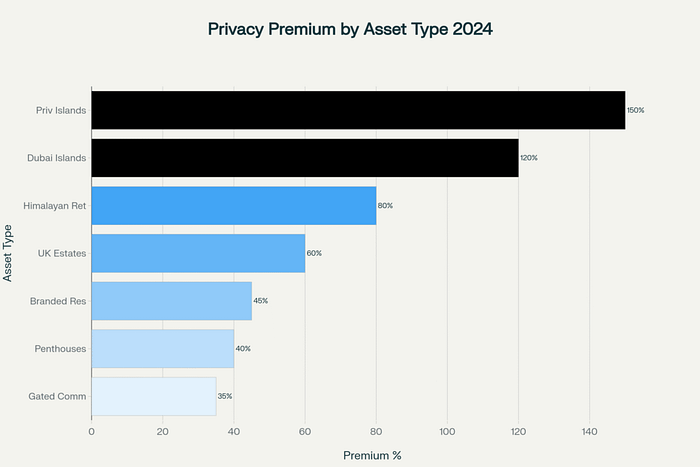
Private islands now command 150% price premiums, while luxury Himalayan retreats record 45% annual growth, according to Knight Frank and CBRE. In short, discretion is not only desirable — it's profitable.
A Shift from Showmanship to Sophistication
Luxury once meant being seen. Today, it means being invisible.
The traditional appetite for grandeur — palatial mansions, gold interiors, and public visibility — has evolved into a preference for understated sophistication and personal security. Wealthy families now seek low-density compounds, biometric access systems, and climate-controlled wellness architecture that offer discretion without compromising on indulgence.
This trend is especially pronounced among younger billionaires and next-gen heirs. Millennials and Gen Z inheriting an estimated $124 trillion in global wealth by 2048 are driving a redefinition of what luxury means — favoring sustainability, serenity, and self-sufficiency over excess.
The Geography of Seclusion
Across continents, privacy-centric developments are commanding record attention and record prices.
Dubai: The Private Island Renaissance
Dubai is leading the "privacy-as-asset" movement with projects like Naia Island, a new ultra-luxury enclave between Burj Al Arab and Jumeirah Bay. Designed for only a handful of residents, its scarcity strategy ensures unmatched exclusivity. In 2023 alone, Dubai recorded 431 property transactions over $10 million, the highest in the world, confirming its magnetic pull among global elites seeking tax-free living, security, and Golden Visa benefits for $2 million+ investments.
India: Himalayan Luxury Takes Flight
In India, the Himalayas are emerging as the country's newest wealth corridor. Projects like Terra Grande in Sirmaur and Symphony Mukteshwar combine design by Studio Lotus with natural materials and wellness ecosystems — offering climate-conscious retreats far from the chaos of urban India. Transaction values in this segment have risen 45% annually, driven by Delhi-NCR's affluent class looking for nature, wellness, and status wrapped in stone and cedarwood.
Singapore: The Billionaire Magnet
Singapore, with its 242,000 millionaires and 30 billionaires, continues to magnetize global wealth migration. The city-state's political stability, territorial tax system, and hyper-efficient infrastructure make it a safe haven for those prioritizing both privacy and permanence. New ultra-prime developments like W Residences combine hospitality-grade service with smart-home integration, catering to UHNWIs who expect both security and seamlessness in their lifestyle assets.
Why Privacy Now Commands a Price Tag
The pivot to privacy isn't just emotional — it's strategic.
1. Security and Control
Amid rising cyber threats and social media exposure, owning secluded, AI-secured estates represents not only comfort but also control over visibility and vulnerability.
2. Wellness and Climate
As climate change reshapes real estate priorities, cooler, cleaner environments — like India's high-altitude regions or the Maldives' eco-islands — become magnets for climate-conscious buyers.
3. Wealth Preservation
Private, low-density assets tend to outperform urban high-rise investments, appreciating faster during market booms and holding value during downturns. The Himalayan luxury segment, for instance, has outpaced the Indian stock market over the past two years in percentage gains.
Inside the Investor's Playbook
Wealth advisors now view privacy as an asset class. For UHNWIs diversifying portfolios, optimal allocation models often include:
- 40%: Primary luxury residence in privacy-centric locales (e.g., Alibaug, Palm Jumeirah)
- 25%: Secondary retreat properties (mountains or islands)
- 20%: Investment assets in emerging luxury hubs
- 10%: Branded residences for income generation
- 5%: Trophy assets like private islands or historical estates
Additionally, Golden Visa programs — notably in Dubai, Portugal, and Greece — add a strategic layer, merging lifestyle upgrades with tax-efficient residency planning.
The Climate-Safe Future of Luxury
As rising seas and erratic weather patterns threaten traditional coastal enclaves, climate-resilient luxury is becoming the next wealth filter. Investors are now assessing properties for elevation, water access, renewable energy systems, and disaster preparedness.
Developments that integrate net-zero designs, off-grid energy, and sustainable architecture already command up to 25% premiums compared to conventional luxury homes. In the Himalayas and parts of Southeast Asia, "eco-privacy" is fast replacing beachfront glamour.
The Road Ahead: Seclusion as Status
By 2030, privacy will no longer be a byproduct of wealth — it will define it.
As India's UHNI population nears 20,000 individuals and global luxury real estate surpasses half a trillion dollars, the world's elite are rewriting the rules of opulence. The new symbols of success aren't marble floors or skyscraper addresses — they're latitude, altitude, and silence.
The privacy revolution has begun, and those who recognize its value early — whether through a villa in Sirmaur, an island in Dubai, or a penthouse in Singapore — will own more than property. They'll own the one commodity that can't be replicated, rented, or reverse-engineered: peace of mind.