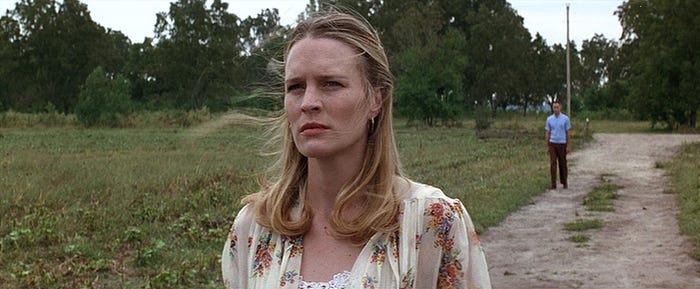


Most of us are, by now, entirely familiar with the plot of Forrest Gump, the 1994 film that earned a second Oscar for Tom Hanks. Gump is an all-American Everyman, a man with limited academic intelligence who nevertheless manages to sail through his life on a tide of happy coincidences and virtuously deserved good fortune.
An accidental millionaire and inadvertent philanthropist before he's even thirty, his apparently charmed existence is blighted only by the untimely deaths firstly of his good friend Bubba and then of his mother. And, of course, by the fact that his beloved childhood friend Jenny does not reciprocate the sort of affection that he holds for her. He is never any more than a friend in her eyes.
Jenny's life story forms an enduring counterpoint to Forrest's. She is beautiful and highly intelligent and on paper, her life ought to be more successful than that of her bullied, lame, overly credulous classmate; but after a childhood during which her mother dies, her father abuses her and she has to live in a trailer with her grandmother, just down the road from Forrest's luxurious home, he ends up sailing through college on a football scholarship while she is sent down without a degree for posing for Playboy in her varsity cardigan.
Forrest joins the army after college and earns medals of honour for his courage while Jenny, a drop-out, downgrades her dream of being a folk singer "like Joan Baez" into the grimy reality of posing nude on dirty stages with her guitar as a prop, whilst hooking up with a series of increasingly violent boyfriends. As Forrest goes on to make an easy fortune from ping-pong sponsorship and on his shrimp boat, Jenny wildly parties, takes drugs, contemplates suicide, and finally escapes yet another abusive partner.
When she eventually gets her life back on track and finds friendship, a home and some settled employment she's sideswiped by a mysterious virus (AIDS? Hepatitis?) and thus has only one year in her swiftly-arranged calm, settled marriage to Forrest before she dies aged 36, leaving him — a rich widower — to bring up the sweet little boy she conceived the first time she ran home to Gump's plantation house in Alabama and declined his first proposal of marriage.
Jenny's short life is, by any measure, tragic. And every time I watch the film — which I've done several times, including twice at the cinema as a young teenager — I am paralyzed by the harrowing sadness of it. I know how it ends and yet I sit transfixed, willing Jenny to make different choices. But it seems that her life is doomed. She is never able to break the cycle of abuse that began with her father's molestation — not until it's far too late.
I have never watched the film without crying floods of tears.
Last week, Forrest Gump was shown on mainstream TV and so I watched it again, after a hiatus of several years. The last time I saw it, I was younger than Jenny is when she dies in the film; now, I'm a few years older. In those years, my opinions have changed and sharpened to the point that I now see it's Robert Zemeckis' utterly problematic portrayal of Jenny that creates the narrative arc that so destroys me.
For this is a deeply, unrepentantly sexist film. It is not a cute all-American tale of hope, not deep down.
In Forrest Gump, women are either Madonnas or whores. Take Forrest's mother. Mrs. Gump runs an apparently successful boarding-house (I mean, even Elvis is a guest!) and seems never to struggle for money. She's a loving mother and knows exactly how to raise her intellectually challenged son and prepare him for an independent life, despite the fact his assessed IQ would appear to make that a cause for concern for most parents.
From sitting proudly in her pretty floral frock at the doctor's office when Forrest's calipers are fitted to being framed beatifically by the sunlit window as she lies on her deathbed, she's shown as brave and wise and stoic. And this despite being unashamedly descended from a Ku Klux Klan founder, naming her son after him, offering sex to a school headmaster in exchange for accepting young Forrest (which, may I remind you, the little boy overhears! He overhears! How does this early sexualization not damage him in the way that Jenny's damages her?!) and encouraging him to lie for sponsorship money. No, it's clear that Forrest's sainted mama can do no wrong.
Jenny, on the other hand, seems to have been tainted sufficiently by the early abuse at her father's hand to require writing off forever as damaged goods. No redemption for her. She makes out in cars with men who don't care about her and sings plaintively, wearing nothing but a G-string, for leering crowds of men who try to grab at her. When she falls in love, it's with badly-shaven men who casually slap and punch her and show her no affection at all.
Time after time she spurns Forrest's affections, and she does so quite legitimately; she doesn't have to love her childhood school friend or to find him find sexually attractive. But each time, we're shown that Forrest walks away from their encounters and immediately into some more accidental success, whereas Jenny is apparently punished repeatedly for the horrific crime of not choosing to live a quiet life of dry Alabama boredom at Forrest's side.
Each time she runs away from him she gets deeper into the sort of trouble that a certain sort of man thinks "fallen" women get into — evil drugs! grubby partying! sex with men who hate women! — until, at last, her errant ways catch up with her and give her a deadly disease. Well, she brought it on herself. What's a girl to do?
I'm over it. I'm over the fact that Jenny's earnest protest marches didn't lead her to the offices of Ms. magazine and a high profile activist role alongside the likes of Gloria Steinem, digitally edited into footage of those groundbreaking feminists in the way that Forrest is slipped onto a sofa next to John Lennon. And speaking of music, why couldn't Jenny be a folk singer like Joan Baez? Why was that ambition so laughable? She had the voice and the guitar.
Jenny had all the chances Forrest had. Her life was separated from his only by the fact that she was female and, apparently, that she allowed herself to indulge her sexual desires. And what's even worse, to me, is that I saw nothing wrong in that when I first watched the film, in 1996 when I was fifteen. As a teenager raised by a strictly religious mother, I saw nothing amiss in the patterns portrayed by the story. But it's a different story now.
Now, my tears don't come from sympathetically watching the inevitable downfall of someone whose self-destructive spiral was written in the stars of her unhappy childhood. Now they're just furious tears. I'm furious at the way women throughout history have followed this arc because men have written it for them. They wrote it in films and somehow we expected it in our lives and we weren't surprised when it happened.
Not any more, though. I hope that were it made today, Forrest Gump's plot would have different emphases. Jenny wouldn't be so clearly punished for wanting a bigger life and, perhaps, Forrest's ladders to success wouldn't so transparently mirror the snakes of her downfall.
That's what I like to think, anyway.