Introduction
In the ever-advancing realm of the data-driven world, Federated Learning has emerged as a transformative force. This innovative approach to collaborative model training across decentralized devices is fundamentally reshaping the way we harness collective intelligence. "Making Sense of Federated Learning: Concepts, Benefits, and Challenges" seeks to demystify this powerful methodology.
Federated Learning is not merely a technological trend; it's a conceptual shift with the potential to address critical challenges in our data-centric society. In this article, we will delve into the core concepts underpinning Federated Learning, explore its manifold advantages, and confront the obstacles that arise in its application. Whether you're a data enthusiast, a collaborator in the world of model training, or a proponent of secure and efficient data handling, this article will equip you with a comprehensive grasp of Federated Learning and its capacity to revolutionize collaborative model training in the data-driven age.
Come along as we dive deep into the realm of Federated Learning, where you'll discover how it's reshaping the landscape of collaborative model training while ensuring the security of sensitive data in our interconnected world.
Brief History and Context
Federated Learning emerged as a response to the increasing need for data privacy and security in the age of big data and machine learning. It was introduced by Google researchers in 2016 as a method to train predictive models on mobile devices without transferring raw user data to central servers. Since then, it has gained significant attention and adoption in various industries.
Definition of Federated Learning
Federated Learning is an innovative machine learning approach that enables collaborative model training across decentralized data sources while keeping the data itself localized and secure. Unlike traditional centralized machine learning, where data is aggregated into a single location, federated learning allows machine learning models to be trained on data distributed across multiple devices or servers without the need to exchange sensitive data.
The Importance of Data Privacy and Security
Data privacy and security have become paramount concerns in today's digital landscape. As individuals and organizations generate vast amounts of sensitive data, protecting this information from breaches and misuse is crucial. Federated Learning addresses these concerns by allowing model updates to be performed locally, ensuring that raw data never leaves the device or server where it originates.
By maintaining data on local devices or servers, federated learning mitigates the privacy risks associated with centralized data storage and processing. It enables organizations to harness the collective intelligence of distributed data sources while preserving individual privacy and data sovereignty.
Federated Learning not only aligns with data privacy regulations like GDPR but also empowers organizations to build trust with users and clients by demonstrating a commitment to protecting their data.
How Does Federated Learning Work?
Federated Learning operates through a sophisticated interplay of key components, namely Clients, Servers, and the Machine Learning model. Clients represent individual data sources, which can be devices such as smartphones, IoT sensors, or remote servers, each holding its own distinct dataset. These Clients are essential nodes in the federated learning ecosystem, as they are responsible for participating in the collaborative training of the machine learning model. The Server, on the other hand, serves as the orchestrator of this collaborative effort. It acts as a central hub, managing the flow of information and updates between Clients and facilitating the improvement of the machine learning model. At the heart of the process lies the Machine Learning Model, the algorithmic entity under continuous refinement. Notably, Federated Learning achieves this refinement without ever centralizing or sharing raw data, thus preserving data privacy and security.
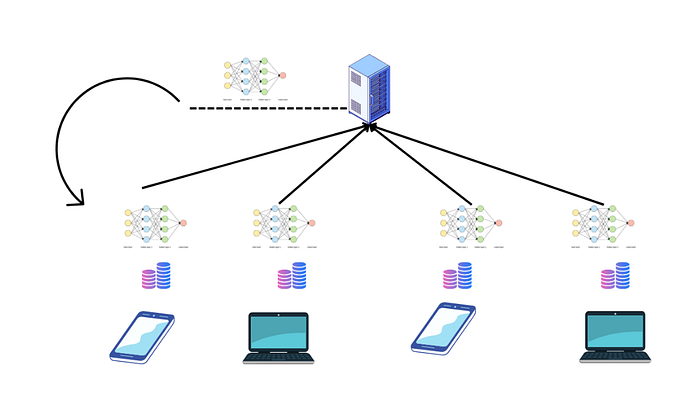
The communication process in federated learning is a vital element of its functionality. It revolves around the exchange of information between Clients and the Server. Clients start by obtaining an initial version of the global machine learning model from the Server. They then leverage their locally stored datasets to compute updates to the model, capitalizing on patterns and insights gleaned from their unique data. Critically, these updates are transmitted back to the Server without any raw data leaving the Clients' premises. The Server plays a crucial role here, as it collects and aggregates the updates received from all participating Clients. This aggregation process is designed to enhance the global model's performance by integrating insights from across the distributed data sources. Once the updates are aggregated, the Server redistributes the improved global model back to all Clients, initiating the next iteration of the process.
A cornerstone technique in federated learning is the Federated Averaging algorithm. This algorithm focuses on the aggregation of model parameter updates provided by Clients. It calculates the average of these updates, thereby aiding in the creation of a more accurate and refined global model. What sets this approach apart is that it allows the global model to learn and adapt from a diverse range of data sources without centralizing the data. Typically, the Federated Averaging algorithm is executed iteratively over multiple rounds, gradually improving the model's performance with each cycle.
To illustrate how federated learning functions in practice, consider the application of this technology to enhance predictive text suggestions on mobile devices. Each mobile device, acting as a Client, possesses a local dataset of user text inputs, reflecting individual typing habits and preferences. These Clients begin with an initial global text prediction model obtained from the Server. Using their local datasets, Clients compute updates to the model, which are tailored to enhance text prediction accuracy based on unique typing patterns. Crucially, these updates are transmitted back to the Server without exposing the raw text data. The Server then combines these updates, potentially using techniques like Federated Averaging, to create an improved global text prediction model. This enhanced model is subsequently shared with all participating Clients. This iterative process continues, making the text prediction model progressively more accurate without compromising users' personal text data privacy.
The Pros and Cons of Federated Learning
Pros of Federated Learning:
Federated Learning offers a multitude of advantages that are reshaping the landscape of machine learning and data privacy. First and foremost, it excels in data privacy and security. In a world increasingly concerned about the misuse and mishandling of sensitive information, Federated Learning ensures that raw data never leaves its original source, be it a smartphone, IoT device, or server. This decentralized approach mitigates the risk of data breaches and unauthorized access. By preserving the privacy of individual data sources, Federated Learning not only adheres to stringent data protection regulations like GDPR but also fosters trust among users and clients.
A key strength of Federated Learning is its commitment to data decentralization. Unlike traditional centralized machine learning, which involves aggregating data into a central repository, Federated Learning leverages the power of distributed data sources. Each data source retains ownership and control over its data, respecting data sovereignty while still benefiting from collaborative model training. This not only ensures data remains in its original context but also promotes responsible data usage.
Another significant advantage lies in improved scalability. Federated Learning can harness the collective intelligence of a vast number of distributed devices or servers. This scalability is invaluable in scenarios where data sources are numerous and diverse, such as IoT networks, edge devices, and mobile applications. By efficiently utilizing distributed resources, Federated Learning can handle large-scale machine learning tasks without overburdening central servers.
Furthermore, Federated Learning offers reduced communication overhead. The cost associated with transmitting and processing data is minimized because raw data remains localized. Only model updates are exchanged between Clients and the central Server, resulting in efficient use of network bandwidth and faster model convergence. This reduction in communication overhead is particularly beneficial in scenarios with limited network resources or high latency.
Cons of Federated Learning:
While Federated Learning holds immense promise, it is not without its challenges and concerns. One of the primary challenges is implementing robust Privacy-Preserving Techniques. While the data remains decentralized and secure, ensuring that model updates do not inadvertently reveal sensitive information poses a complex task. Striking the right balance between privacy and utility is an ongoing challenge that requires careful consideration.
Communication Efficiency is another concern. Federated Learning necessitates communication between Clients and the central Server to exchange model updates. In scenarios with limited network bandwidth or high latency, communication can become a bottleneck, potentially slowing down the training process. Optimizing communication protocols and strategies is crucial to mitigating this challenge effectively.
The Heterogeneity of Clients in a federated learning setting is a notable issue. Clients can vary significantly in terms of computational resources, data quality, and reliability. Handling this diversity while ensuring fair and effective model updates across all Clients poses a significant challenge. Algorithms must be designed to accommodate the various device types and capabilities present in a federated learning ecosystem.
Lastly, there are Model Aggregation Challenges. Aggregating model updates from a large number of Clients introduces complexities in maintaining model quality. Balancing the contributions of different Clients, especially when some have more relevant data than others, can be challenging. Research is ongoing to develop robust aggregation methods that work effectively across various scenarios.
Use Cases
Federated Learning is not just a theoretical concept; it's a practical approach with a wide range of real-world applications. This slide highlights some compelling use cases that demonstrate the versatility and transformative potential of Federated Learning in various industries.
Healthcare: Predicting Diseases Without Sharing Patient Data
In the healthcare sector, Federated Learning plays a crucial role in addressing the delicate balance between data-driven advancements and patient privacy. Hospitals and medical institutions can now collaborate on the development of predictive disease models without ever sharing sensitive patient data. By training models across decentralized sources, healthcare professionals can improve diagnostic accuracy, treatment planning, and patient outcomes, all while preserving the confidentiality of patient information. Federated Learning empowers the healthcare industry to harness the collective intelligence of data while prioritizing patient privacy.
Mobile Devices: Predictive Text on Keyboards
On your mobile devices, Federated Learning is at work behind the scenes, enhancing user experiences. For example, predictive text suggestions on keyboards are powered by Federated Learning. Individual devices learn from users' typing habits and preferences to offer more accurate and context-aware text predictions. What's remarkable is that this improvement happens without sending your sensitive text data to a central server. Federated Learning ensures that your personal messages remain on your device while collectively contributing to better typing assistance for everyone.
Autonomous Vehicles: Improving Driving Models
The development of safe and efficient autonomous vehicles relies on Federated Learning. Autonomous cars continuously gather data about their surroundings and driving experiences. Federated Learning enables them to collaboratively improve their driving models by sharing insights while preserving individual trip data privacy. This collective learning process enhances vehicle safety, navigation accuracy, and decision-making, paving the way for a safer and more reliable autonomous driving experience.
Finance: Fraud Detection
In the financial industry, fraud detection is a critical concern. Federated Learning revolutionizes this space by allowing banks and financial institutions to work together on fraud detection models. These models can identify fraudulent transactions more effectively by pooling insights from various sources. Importantly, individual customer data remains secure and confidential. Federated Learning safeguards sensitive financial information while reinforcing the industry's ability to combat fraud.
These use cases underscore the profound impact of Federated Learning in domains where data privacy, security, and collaboration are of paramount importance. Federated Learning is not just a technological advancement; it's a game-changer that empowers industries to leverage the collective wisdom of data while preserving individual privacy and data protection. It represents a new era of responsible and collaborative machine learning across diverse sectors.
Application of Federated Learning in Healthcare
In the realm of healthcare, Federated Learning is driving a significant transformation in how predictive models are developed and applied, all while placing patient privacy and data security at the forefront. This slide explores how Federated Learning is applied within the healthcare domain, where data privacy is paramount.
How Federated Learning is Applied in Healthcare
One of the most critical applications of Federated Learning in healthcare is in the realm of collaborative disease prediction. Healthcare institutions frequently need to predict diseases, such as diabetes or cancer, to provide timely and effective treatments to their patients. Federated Learning facilitates this by allowing these institutions to collaborate on predictive models without ever sharing the sensitive patient data that underpins these predictions.
The application of Federated Learning in healthcare is a multi-step process:
1. Collaborative Disease Prediction: Healthcare facilities, each with their unique patient datasets, collaboratively work towards predicting diseases more accurately. This collaborative effort is achieved without the need to centralize the sensitive patient data.
2. Data Localization: Patient data remains securely stored locally at each healthcare facility, eliminating the risk of centralized data breaches or privacy violations. Instead, a global machine learning model is collaboratively trained across these decentralized data sources.
3. Model Aggregation: Model updates from each participating healthcare institution are computed locally based on their individual data. These updates are then securely aggregated on a central server, using techniques like Federated Averaging. This central server holds the global model, which continually improves with each iteration.
Benefits and Results
The benefits of applying Federated Learning in healthcare are significant and wide-reaching:
Enhanced Privacy: Patient data privacy is a foundational principle in healthcare. Federated Learning ensures that individual patient records, often containing highly sensitive information, are never exposed or shared during the collaborative model training process. This compliance with data protection regulations builds trust among patients and healthcare providers alike.
Improved Disease Prediction: By leveraging insights from diverse healthcare facilities, the collaborative model becomes more accurate in disease prediction. This means earlier disease detection, more targeted treatments, and ultimately, better patient outcomes.
Cost Reduction: Federated Learning significantly reduces the need for complex data sharing agreements and the associated legal and administrative overhead. Healthcare institutions can collaborate efficiently and effectively without the need for lengthy and resource-intensive data-sharing processes.
Real-World Impact: The application of Federated Learning in healthcare has tangible, real-world impacts. It has led to substantial advancements in disease prediction accuracy, enabling earlier diagnosis and more personalized treatment plans. Federated Learning stands at the forefront of improving healthcare outcomes while preserving the highest standards of data privacy and security.
Future Directions
The future of Federated Learning is marked by exciting research trends, persistent challenges, and its integration into emerging technologies. This slide provides insights into what lies ahead for this transformative approach to machine learning and data privacy.
Research Trends in Federated Learning
Privacy-Preserving Techniques: The foremost research trend centers on advancing privacy-preserving techniques within Federated Learning. Researchers are continually refining methods like secure multi-party computation, homomorphic encryption, and differential privacy. These innovations are aimed at bolstering data protection while enabling collaboration.
Robustness and Fairness: Federated Learning models of the future will need to exhibit robustness across heterogeneous data sources. Addressing the challenges posed by noisy and diverse data is a key research area. Additionally, ensuring fairness in Federated Learning models remains a priority to prevent bias and discrimination.
Adaptive Learning and Personalization: Future Federated Learning systems may embrace adaptive learning strategies. These strategies would tailor model updates to individual Clients' needs, fostering greater personalization in machine learning outcomes.
Challenges That Need to Be Addressed
Communication Efficiency: As Federated Learning scales to encompass an ever-growing number of devices and data sources, optimizing communication efficiency is crucial. This involves reducing the bandwidth usage and minimizing latency to enable effective collaboration.
Security Concerns: Safeguarding against security threats, including model poisoning attacks, is a paramount concern. Researchers are actively exploring methods to enhance the security of Federated Learning systems to protect against adversarial actors.
Scalability: Federated Learning's expansion into very large-scale systems, where millions or even billions of devices participate, presents scalability challenges. Researchers are working on strategies to ensure that Federated Learning can effectively operate at this scale.
Overview of Companies and Organizations Using Federated Learning
Federated Learning is experiencing a significant surge in adoption across a diverse spectrum of industries, signifying its transformative potential. This slide offers an insightful overview of some notable companies and organizations that have embraced Federated Learning, along with its profound impact on these sectors.
Companies and Organizations Using Federated Learning
Google, a pioneer in the field, has prominently integrated Federated Learning into its ecosystem. Notable examples include the Federated Learning of Cohorts (FLoC) for online advertising, demonstrating its capacity to revolutionize digital marketing while ensuring user data privacy.
Apple
Apple has strategically employed Federated Learning in its products and services, particularly evident in features like Siri and predictive text suggestions. This enhances user experiences while prioritizing data privacy and security within the Apple ecosystem.
Healthcare Institutions
Across the healthcare landscape, institutions are turning to Federated Learning for collaborative efforts in disease prediction, medical research, and more. It enables healthcare providers to aggregate and glean insights from vast datasets without compromising the sensitive patient information.
Financial Institutions
- Banks and financial organizations have harnessed the potential of Federated Learning, notably in the realms of fraud detection and risk assessment. By securely combining insights from various sources, they enhance security, compliance, and customer trust.
Tech Startups
A growing number of innovative tech startups are entering the Federated Learning space, offering specialized solutions across a wide range of industries, including retail, cybersecurity, and personalized services.
Impact on Industries
Healthcare
Federated Learning is a game-changer in healthcare, advancing precision medicine, drug discovery, and disease prediction. It empowers healthcare professionals to harness collective data insights while steadfastly safeguarding patient confidentiality.
Finance
In the financial sector, Federated Learning bolsters fraud detection, risk assessment, and the delivery of personalized financial services. This not only enhances security but also respects customer privacy.
Advertising
The advertising industry is experiencing a significant shift as Federated Learning reshapes online advertising. It enables more personalized ad targeting without compromising user data privacy, resulting in a win-win for advertisers and users alike.
IoT and Edge Computing
Federated Learning plays a pivotal role in IoT and edge computing, enabling localized, privacy-preserving machine learning. This drives innovation in smart cities, autonomous vehicles, and various IoT applications.
Decentralized Finance (DeFi)
DeFi platforms are actively exploring Federated Learning for secure, privacy-preserving financial services on blockchain networks, ushering in new paradigms for decentralized finance.
Retail
Retailers are harnessing Federated Learning to optimize inventory management, personalize customer recommendations, and streamline supply chain logistics, leading to improved customer experiences and operational efficiencies.
Conclusion
Unlocking the Potential of Federated Learning in a Data-Driven World
In this article, we've embarked on a journey through the world of Federated Learning, exploring its principles, applications. As we move forward into an era where data is the lifeblood of innovation, Federated Learning serves as a powerful enabler for responsible and privacy-centric machine learning, shaping a future where data-driven advancements are harmonized with individual data protection.
In conclusion, Federated Learning represents a monumental shift in the way we approach machine learning, offering a path forward where data-driven progress aligns seamlessly with ethical and privacy-conscious principles. It's not just a technology; it's a vision for a more secure, collaborative, and responsible data-driven world.
References
- McMahan, H. Brendan, et al. "Communication-efficient learning of deep networks from decentralized data." Proceedings of the 20th International Conference on Artificial Intelligence and Statistics (AISTATS), 2017. Link
- Konečný, Jakub, et al. "Federated learning: Strategies for improving communication efficiency." arXiv preprint arXiv:1610.05492, 2016. Link
- Bonawitz, Keith, et al. "Towards federated learning at scale: System design." In Proceedings of the 2nd SysML Conference, 2019. Link
- Yang, Qiang, et al. "Federated learning." In Proceedings of the 35th International Conference on Machine Learning (ICML), 2018. Link
- Kairouz, Peter, et al. "Advances and open problems in federated learning." arXiv preprint arXiv:1912.04977, 2019. Link