
Every modernization journey starts in a different place, but the need for an integration platform is the same. It enables you to benefit from cloud characteristics like scalability, performance, and agility.
Accelerate digital transformation. Digital channels require new, innovative access to enterprise data and services that drive the agility of your integration platform.
Respond to core modernization. Reexamine your existing enterprise integration endpoints because either your systems of record (SoRs) have lift-shifted to cloud or moved to a SaaS model, your enterprise applications have refactored from monolithic to native, or your partner ecosystem has modernized their own interfaces.
Enable autonomous teams. Business-led technical teams will run into new integration challenges they will try to solve on their own. Ensure they are aware of modern and highly productive integration tooling to ensure integrations are implemented effectively using proven and matured patterns.
Embrace the middleware evolution. Integration middleware product roadmaps now include virtualization, containerization, as-a-service deployment and multi-cloud support.

Hybrid Cloud Integration Reference Architecture
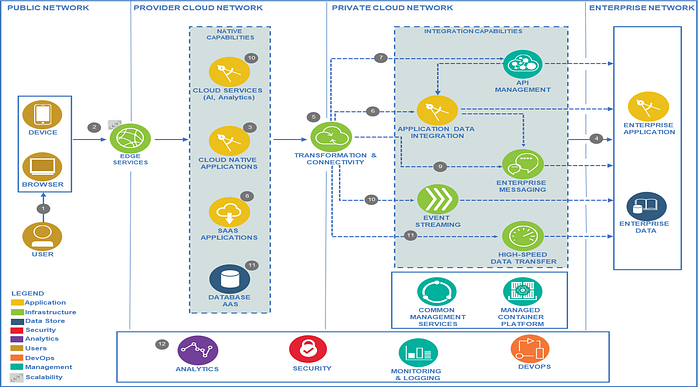
iPaaS, or Integration-Platform-as-a-Service, is a self-service cloud-based solution that standardizes how applications are integrated. Developers, consultants and even non-technical users can use iPaaS out-of-the-box to quickly build the integration flows for sharing data within an organization or with multiple companies.
With iPaaS, organizations can more easily connect different applications, data, business processes, and services, whether they are hosted on-premises, in a private cloud, or within a public cloud environment. iPaaS also gives DevOps and IT departments a way to build integrations quickly and enable real-time updates throughout the organization's application estate.
Modern Integration Patterns: 1. API management. Create, secure, manage, share, and monetize APIs across clouds while you maintain continuous availability.
2. Application and data integration. Integrate your business data and applications quickly and easily across any cloud system.
3. Enterprise messaging. Simplify, accelerate, and facilitate the reliable exchange of data with a trusted, flexible, and security-rich messaging solution.
4. Event streaming. Use Apache Kafka to deliver messages more easily and reliably and to react to events in real time.
5. High-speed data transfer. Reliably send, share, stream, and sync large files and data sets at maximum speed.
6. Platform-level security, automation, and monitoring. Quickly set up and manage gateways, control access on a per resource basis, deploy your integration flows, and monitor all of your traffic.
Benefits of iPaaS
Compared to traditional integration methods, iPaaS delivers these benefits:
- Faster time to value: Operations and development teams can help themselves to iPaaS—they simply subscribe and start integrating.
- Better integration results, with less work and fewer specialized skills: iPaaS typically offers intelligent work-saving tools and a high-productivity interface that can help users "punch above their weight" and achieve better, richer integrations in a short period of time--and without having to build new integration functionality each time.
- Improved scalability: The self-service model of iPaaS scales easily as your integration needs grow.
- Reduced integration costs: iPaaS solutions are typically much less expensive and time consuming than custom integrations, message-oriented middleware, and enterprise integration projects such as enterprise service bus (ESB) and enterprise application integration (EAI). The reduced cost and faster implementation make integration a possibility for more mid-sized and smaller businesses as well.
- Improved connectivity: When processes and data are updated across applications throughout the organization, anyone can get the data they need when they need it.
- Built-in API management: iPaaS eliminates the need to publish customer APIs or combine APIs from other services. It's all in the iPaaS platform, creating a more scalable and secure solution for managing APIs.
- Simplified and improved B2B integration: Every business has its own process for exchanging information with partners. Different applications used at different companies make it difficult to communicate. Businesses can use iPaaS to improve B2B integration and ultimately increase revenue and improve time to market.
iPaaS Use Cases:
Companies today turn to enterprise iPaaS to more easily manage applications and data, quickly integrate legacy systems, and solve complex integration problems as they modernize applications. Common uses of iPaaS include:
Low-overhead application integration. With iPaaS tools, companies can more quickly and seamlessly create integrations than they could with an EAI, SOA or ESB. IPaaS vendors often offer interfaces that require less coding, present integrations visually, and include prebuilt connectors.
Seamless, silo-busting data synchronization across environments. By simplifying app-to-app integration, a iPaas solution eliminates the need for batch data transfers, and integrates data from on-premises and cloud applications in real-time as it us updated.
Integration of multiple devices. Organizations that need to integrate data between a number of different computing and IoT devices can use iPaaS to streamline the process. For example, an electricity supplier could use iPaaS to aggregate and analyze data collected from meters and instrumented devices located throughout the delivery system, from the distribution center to the customers' homes.
B2B integration opportunities. To ensure the secure and efficient flow of data between company and vendors, iPaaS eliminates the need to build code based on APIs or use EDIs. iPaaS offers self-service capabilities that provide easier partner access and makes onboarding partners and customers easier.
Integrations in highly regulated industries. In industries such as healthcare, pharma, and finance, iPaaS makes it easier to integrate data and systems quickly, cost-effectively, securely and in strict compliance with industry and government regulations.
Learn how CVS Health used iPaaS to integrate its entire ecosystem for about one-third the cost
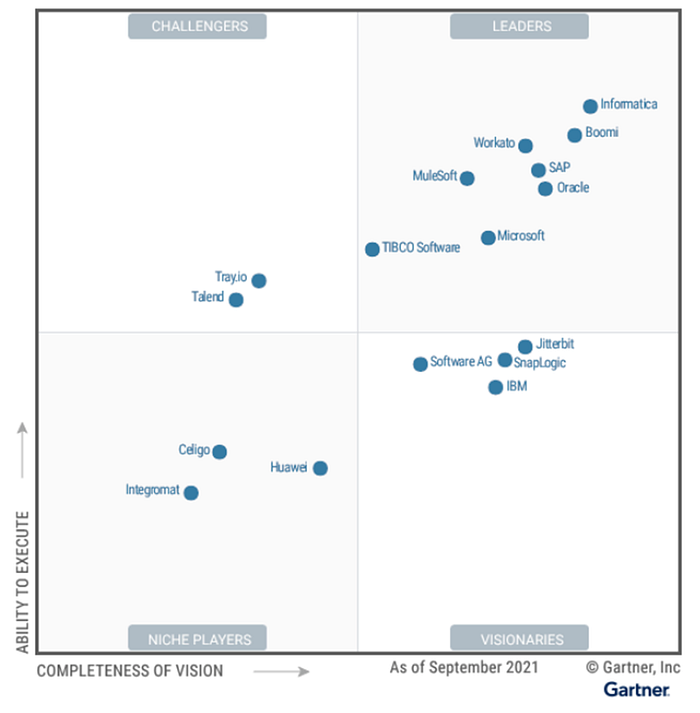
There are various middleware products available to help with your Enterprise Integration Platform related needs.
- You can refer to Garner report and evaluate based on your enterprise requirement which product is best suitable for your Enterprise integration journey.
References: 1. IBM Integration Platform as a Service 2. Cloud Application Integration Architecture 3. Integration Field Guide 4. Modern Integration Architecture 5. Agile Integration 6. IBM Cloud Pak for Integration 7. Evaluate your Integration Maturity