

In the age of Generative AI, interoperability and real-world context are king. But how do we orchestrate specialized agents into a cohesive system while ensuring seamless access to external tools and data?
I still recall the day our team at a Fortune 500 retailer tried to integrate three AI agents — one for demand forecasting, another for procurement negotiation, and a third for logistics scheduling. Without a structured protocol, each connection to an external API became a bespoke connector, and each handoff between agents felt like a crackling game of telephone. Deadlines slipped, budgets ballooned, and frustration spread. 😓
This pain is why Google's Agent2Agent (A2A) and Anthropic's Model Context Protocol (MCP) are so transformative. First, A2A creates a common language for agents to collaborate. Then, MCP acts as a universal adapter, letting agents plug into databases, knowledge bases, and service APIs without one-off code. In this article, we'll dive deep into both protocols, explore multiple real-world examples, and equip you to design robust multi-agent workflows. 1. Why Open Protocols Matter: Setting the Stage 🔍
Picture a global enterprise with dozens of AI agents — inventory forecasters, financial analysts, service desk bots, HR assistants — each specialized for a domain. Without open standards, every time two agents need to collaborate or one needs to call an external service, developers must write custom glue code. This leads to
- Spaghetti Integrations: One-off connectors, brittle and costly to maintain.
- Security Blindspots: Inconsistent authentication models across integrations.
- Scaling Roadblocks: Every new agent or tool adds exponentially more effort.
In contrast, adopting A2A and MCP unlocks:
- Modularity: Agents and tools become interoperable building blocks.
- Maintainability: One protocol replaces dozens of bespoke connectors.
- Innovation Velocity: Teams focus on core logic, not plumbing.
In my experience, teams that standardize integration see a 60% drop in maintenance ticket backlogs within six months, enabling them to innovate rather than patch the pipeline. ✨
Deep Dive: Agent2Agent (A2A) 🗣️
Core Features and Principles
- Agent Discovery: A central registry (or decentralized mesh) lists agent endpoints and capabilities.
- Secure Delegation: OAuth2 or JWT-based tokens manage who can delegate tasks.
- Context Sharing: Structured JSON payloads convey goals, progress, and state.
- Event Streaming: Agents subscribe to event feeds for updates (e.g., Kafka or Webhooks).
- Fault Tolerance: Built-in retry logic and fallback agent binding.
At its heart, A2A uses familiar web standards:
- HTTP Methods:
POST /delegate,GET /status,PUT /context - JSON Schemas: Define
Task,Context, andResultobjects. - TLS Encryption: Ensures confidentiality in transit.
Cross-Cloud Marketing Campaign
A marketing director wants to roll out a global ad campaign. Agents involved:
AudienceAgent (hosted on AWS): Analyzes customer segments.
- CreativeAgent (Google Cloud): Generates ad copy and imagery.
- BudgetAgent (Azure AI): Allocates spend across channels.
- DeployAgent (On-premise): Schedules and launches campaigns.
Workflow
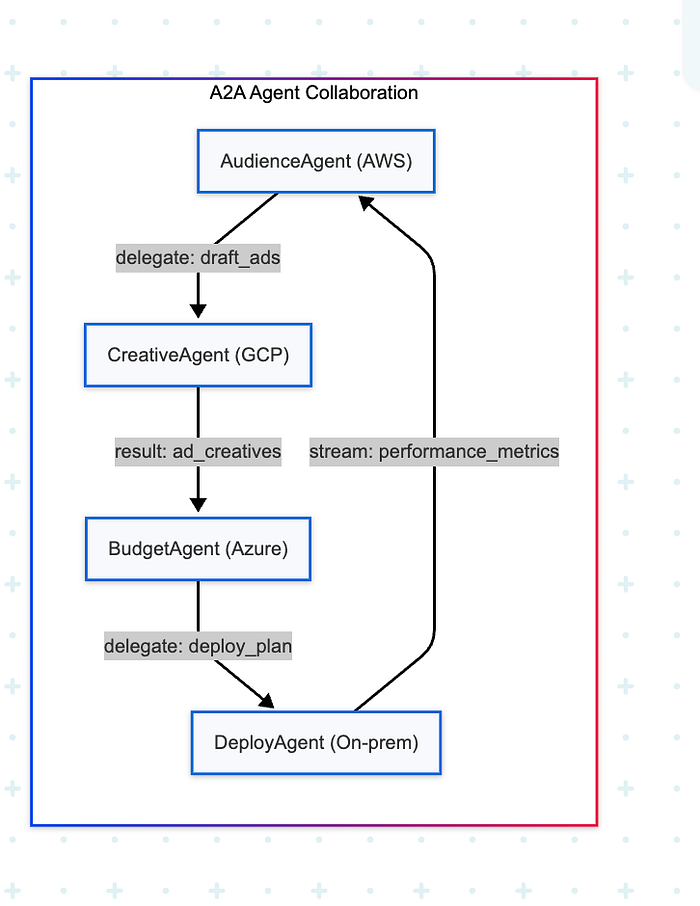
- AudienceAgent identifies high-value segments in North America and Europe.
- AudienceAgent uses A2A to delegate creative drafts to CreativeAgent with context:
POST /delegate HTTP/1.1
Host: audience.registry.company.com
Content-Type: application/json
Authorization: Bearer eyJhb...

{
  "from": "AudienceAgent",
  "to": "CreativeAgent",
  "task": "draft_ads",
  "context": {
    "segments": ["NA_Prospects", "EU_Retarget"],
    "tone": "friendly",
    "assets": "global_product_line"
  }
}- CreativeAgent processes this, calls internal LLMs, and returns a context-rich result with ad variations.
- BudgetAgent picks optimal spend, delegated via A2A, then updates DeployAgent.
- DeployAgent launches ads across platforms, streams performance events back to all agents.
This entire multi-cloud, cross-platform choreography runs on A2A messages — no custom SDKs required. The event stream logs, traceable by correlation IDs, ensure observability and auditability.
import requests
# Discover available agents
registry_url = 'https://a2a.registry.company.com/agents'
response = requests.get(registry_url, headers={'Authorization': f'Bearer {token}'})
agents = response.json()
# Delegate task to CreativeAgent
delegate_payload = {
    'from': 'AudienceAgent',
    'to': 'CreativeAgent',
    'task': 'draft_ads',
    'context': {
        'segments': ['NA_Prospects', 'EU_Retarget'],
        'tone': 'friendly'
    }
}
requests.post(
    f"{agents['CreativeAgent']['endpoint']}/delegate",
    json=delegate_payload,
    headers={'Authorization': f'Bearer {token}'}
)
Use correlation IDs in headers (X-Correlation-ID) to trace complex multi-agent workflows.
Model Context Protocol (MCP) 🔌
Core Features and Principles
- Tool Registration: Tools expose a JSON manifest detailing methods, params, and schemas.
- JSON-RPC Invocation: Agents call methods over HTTP with standard RPC messages.
- Streaming Context: Tools can push updates (e.g., live sensor data) via Webhooks.
- Authentication & ACLs: Fine-grained access control lists govern which agents can call which methods.
- Schema Enforcement: Requests and responses validated against JSON schemas.
Under the Hood: JSON-RPC and Tool Manifests
- Manifest Example (
tool_manifest.json):
{
  "tool_name": "weatherAPI",
  "methods": {
    "getForecast": {
      "params": {"location": "string", "date": "string"},
      "returns": {"forecast": "string", "temperature": "number"}
    }
  }
}- Invocation Pattern:
POST /invoke HTTP/1.1
Content-Type: application/json
{
  "jsonrpc": "2.0",
  "id": 1,
  "method": "weatherAPI.getForecast",
  "params": {"location": "NYC", "date": "2025-05-20"}
}
Real-Time Healthcare Triage Bot 🏥
Scenario: A hospital deploys a triage assistant to analyze patient symptoms, fetch medical records, and schedule appointments:
- SymptomAgent: Processes patient input via chat.
- EMRTool: Exposes Electronic Medical Record system.
- SchedulerTool: Provides calendar booking API.
- PharmaDBTool: Offers drug interaction lookup.
Workflow
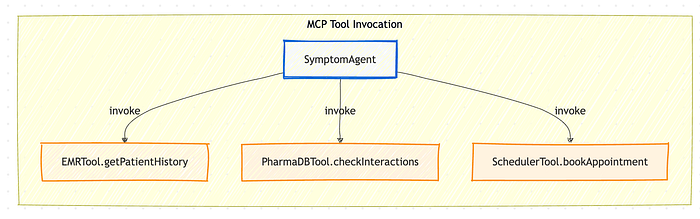
- SymptomAgent parses input: "I've had chest pain and shortness of breath since this morning."
- Agent calls EMRTool.getPatientHistory via MCP:
{
  "jsonrpc": "2.0",
  "id": 100,
  "method": "EMRTool.getPatientHistory",
  "params": {"patient_id": "P12345"}
}
3. Response includes past cardiovascular issues. Agent then calls PharmaDBTool.checkInteractions to verify current meds:
{
  "jsonrpc": "2.0",
  "id": 101,
  "method": "PharmaDBTool.checkInteractions",
  "params": {"drug_list": ["DrugA", "DrugB"]}
}
4. With context, SymptomAgent recommends immediate cardiologist consult and books via SchedulerTool.bookAppointment.
This end-to-end medical workflow — secure, auditable, schema-driven — runs on MCP without custom API code for each system! 🔒
MCP Tool Registration & Invocation
import requests
# Load tool manifest
tool_manifest = requests.get('https://mcp.tools.company.com/EMRTool/manifest').json()
# Build a JSON-RPC call
rpc_payload = {
    'jsonrpc': '2.0',
    'id': 100,
    'method': 'EMRTool.getPatientHistory',
    'params': {'patient_id': 'P12345'}
}
# Invoke the tool
tool_endpoint = tool_manifest['endpoint'] + '/invoke'
response = requests.post(tool_endpoint, json=rpc_payload)
history = response.json()['result']
Cache tool manifests locally and refresh periodically to reduce latency.
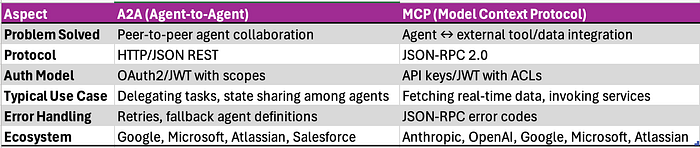
Comparative Analysis: A2A vs MCP 📊
End-to-End Supply Chain Orchestration 🏭
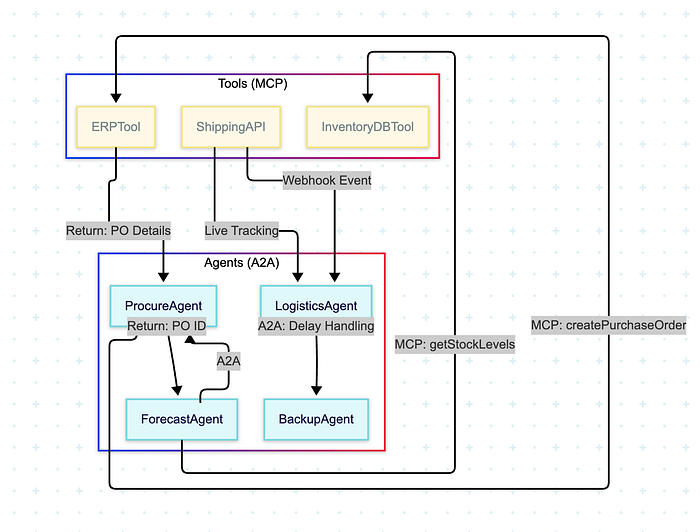
Agents & Tools:
- ForecastAgent (A2A): Demand forecasting
- ProcureAgent (A2A): Supplier negotiations
- LogisticsAgent (A2A): Shipment planning
- InventoryDBTool (MCP): Live inventory data
- ERPTool (MCP): Purchase order creation
- ShippingAPI (MCP): Freight booking
Step-by-Step Flow:
- ForecastAgent queries InventoryDBTool.getStockLevels to check on-hand quantities.
- If stock < threshold, ForecastAgent delegates
create_poto ProcureAgent via A2A. - ProcureAgent invokes ERPTool.createPurchaseOrder through MCP, receives
po_id. - ProcureAgent updates ForecastAgent with
po_idand expected arrival. - As the order ships, LogisticsAgent picks up events from ShippingAPI.trackShipment (MCP Webhooks).
- LogisticsAgent auto-delegates delay mitigation tasks to a BackupAgent via A2A if ETA slips.
Observability & Governance:
- Tracing: Correlation IDs link A2A messages and MCP calls in logs.
- Auditing: Immutable event store captures each task delegation and tool invocation.
- Access Controls: ACLs prevent unauthorized agents from invoking sensitive MCP methods.
Monitoring & Compliance
- Metrics: Track A2A request latencies and MCP RPC success rates.
- Alerts: Auto-notify DevOps if an agent's failure rate exceeds threshold.
- Governance Dashboards: Visualize multi-agent workflows, tool usage, and policy adherence.
Implementation Best Practices
- Standardize Schemas: Define JSON schemas upfront for tasks, context, and results.
- Versioning: Version your protocols and manifests to support backward compatibility.
- Correlation IDs: Embed in headers for end-to-end tracing.
- Circuit Breakers: Implement throttling and fallback agents for resiliency.
- Security First: Use OAuth2 scopes for A2A and ACLs for MCP.
- Local Caching: Cache manifests and agent directories to reduce startup latency.
- CI/CD Integration: Automate manifest publishing and protocol conformance tests.
In my experience, investing in robust observability from day one saves countless hours troubleshooting distributed workflows.
FAQ ❓
Q1: Can I use HTTPS/2 or gRPC instead of HTTP/1.1? While A2A specs define HTTP/1.1 REST, many platforms support HTTP/2 or gRPC wrappers — just ensure payloads match schema.
Q2: How do I handle version upgrades for agents?
Embed a protocolVersion field in messages and use backward-compatible schema evolution.
Q3: What about latency in global deployments? Employ regional agent registries and CDN for manifest caching. Utilize asynchronous event streams when possible.
Q4: Are there mature SDKs? Microsoft's Copilot Studio and Atlassian Forge provide built-in helpers. Open-source community SDKs are emerging rapidly.
Q5: How to secure sensitive data? Encrypt payload fields at rest, use field-level ACLs, and purge logs according to compliance policies.
Adopting A2A and MCP transforms fragmented AI agents and tangled connectors into a cohesive, modular, and resilient system. Agents communicate effortlessly, tools integrate seamlessly, and teams focus on innovation rather than plumbing.
References & Further Reading 📚
- Google. Agent2Agent (A2A) Protocol Specification. GitHub.
- Anthropic. Model Context Protocol (MCP) Specification.
- Microsoft. Copilot Studio Documentation.
- Jain et al. Secure Multi-Agent Orchestration, 2023.
- Zhang & Lee. Universal Tool Adapters for LLMs, 2024.