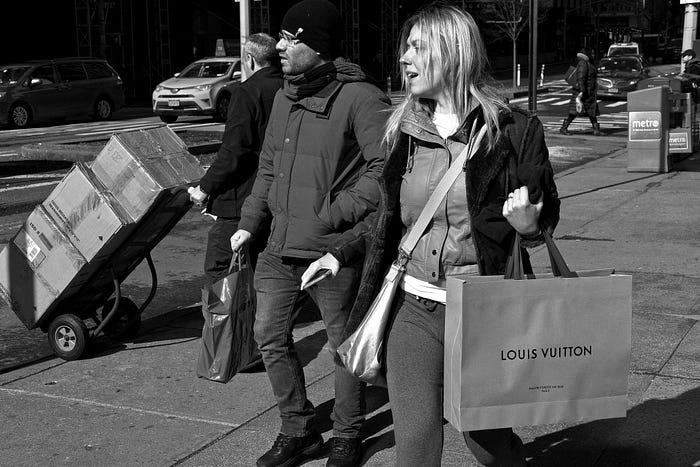


All of us are consumers, we have to be. We have to buy things, we have to eat, we have to wear clothes and we have to co-exist with our fellow human beings. This is part of what it means to be a human and/or Penguin in the 21st Century.
We first exchange our time and effort for an agreed amount of money, then swap this money for things we want. Well… that's how the poor and working middle class do it and always have.
Wealthy people let investments do it for them. Which is why they don't teach investments at school.
All of us have some choice about what things we want to spend our money on. There are products necessary for our survival, we'll pay for those regardless and then there are 'luxury items'. When times are tough and the necessities are fast becoming luxury, that's when the poorest are hit hardest.
And wealthy politicians come out and tell everyone they can have pasta and cheap beans for lunch and ride out the recession. Meanwhile, they continue to have 'luxury items'
I live within a short bus ride of a large and famous shopping centre in London. There are two of these consumerism cathedrals in London. You can't buy much in there that's useful — but you can pay over the odds for almost every item of clothing and pointless frippery if you're thus inclined.
Some people call them luxury items or designer wear… I refer to them as items which are 'high in twat tax'
Everything has a value
What amount of money would you pay a skilled artisan from a non-prosperous country to create something designed specifically for you? A bag perhaps, a pair of shoes, a shirt or tailored suit? Let's pick a T-shirt as a simple example. They're quite easy to make and relatively low cost overall.
How much would you pay? Hold that figure in your head. I have no doubt it'll be slightly different for everyone. We all have different ideas about the concept of money and how much things are worth.
I think I'd pay around £250 for a perfect T-shirt. The sort of T-shirt which clings in all the right places, is made from premium material which has been ethically sourced. I've budgeted £100 for the cloth and £75p/h for the seamstress or tailor to put it together. I've allowed them two hours, that includes the time required to measure me.
I think that's reasonable.
That's the absolute top-end I'm prepared to pay for a T-shirt with the full five-star treatment to make it perfect for me. If I don't get to choose the material and I don't get the whole thing altered to fit my feathery body then the price I'm prepared to pay drops incrementally.
The price comes down if you don't have an artisan tailor or seamstress in place and instead are using factory garment workers who, while they may be skilled, aren't tailoring this T-shirt to my gorgeous krill-filled body. The price drops if the material you're using isn't of the highest quality and isn't ethically sourced.
So here's a realistic answer.In order to fairly pay for decent materials and the wages of a garment worker at about £15p/h, let's say I'd pay a maximum of £45 for a decent quality T-shirt.
Let's have a follow up question. What am I prepared to pay for a 'designer T-shirt'?
Well…. it depends. If the designer can guarantee they're using the best materials and they pay their workers ethically then the answer is exactly the fucking same…. I'll pay £45.
That's my limit for a non-artisan T-shirt.
Do I pay £45 for every T-shirt I buy? No. There are market forces acting on the supply and demand chain, so I'll pay about £18 — £28 for a decent T-shirt. I'm fine with that. I would spend up to £45 but I don't have to because I think I can get the quality and comfort I want at this price.
If I had to pay up to £45, I would. And given the current state of the British economy, I will certainly have to.
So what's the Twat Tax?
If you buy a small car for £100 it's going to be shit and the engine will drop out the second you get it home. You've purchased yourself a skip with wheels. If you buy a car for £1000, it might get you from A to B a few times but won't last all that long.
If you buy a second hand car for £10,000 you can expect it to be okay but not set the world on fire. If you acquire a car for £50,000 you've likely hit the upper limit of the market. If you buy the car for £100,000 then you've purchased a whole bunch of bullshit and paid a lot of twat tax.
Twat tax is the total amount of money for everything on top of the fair top end price. The market will naturally find this place. For reference the average price of a car in the UK is around £20,000.
Designer products sell for much higher amounts because people are convinced expensive things are better.
And sometimes they are… but only up to a point.
There is a point beyond which you cannot increase the quality of an item in any meaningful way. What you're adding is social value or hijacking consumer psychology to ensure they pay over the odds.
Back to my T-shirt.
The ideal T-shirt for me is somewhere between the £45 and the £250 price range. Something which fits so perfectly, is the perfect colour and is the most suitable material for me.Perhaps I'd be tempted to pay over the odds — but never more than £250 which, as discussed, is the maximum I'd be pay for the ultimate T-shirt experience.
Writing 'Latoste' or 'Jimbob O'Hara' or 'Louis Bellend' onto a shirt does not magically increase the quality of the shirt. It does not magically make it fit better. It does one thing and one thing only.
It increases the rarity of the shirt relative to the population.
There are only a certain number of people who can afford to have 'Louis Bellend' written across their chest. And by buying this T-shirt, I have somehow joined a secret group of people who feel they are better than everyone else. I have bought group inclusion into a social strata that was previously outside of my reach.
Which as an argument is a bit bizarre but humans love this sort of thing.
If you're unique (but not too unique) then you belong to a special group of humans who own a thing X and are to be revered. If you're too unique then you're the sort of person who wears blue tights and shits themselves on command. You can only really get away with this if you're exceptionally wealthy. Then you're not 'weird', you're 'eccentric'.
If a brand can convince you to pay £800 for a poor quality T-shirt with THEIR name on it, then to my mind you're not only paying a a twat tax of £755, you've also been co-opted as a wage slave to do their marketing for them.
You're paying them to walk around like a fatuous billboard.
You're buying the illusion of a lifestyle. I see it all the time at Westfields where people shop to be seen shopping. If you step into a shop and buy a handbag for £3500, what you're really purchasing is the admiration of people in your social circle. You look out into the world and presume everyone thinks you're an enviable success.
But I think you're a twat.
And make no mistake, when you see those handbags being touted by your favourite celebs and instagram influencers, do you really think they've bought them? Do you really think wealthy and influential people pay the high levels of tax that the average person pays?
Of course they don't. They're paid. They get paid to advertise the stuff with the stuff itself. They're paid with the Twat Tax you've given them.
Should you stop paying Twat Tax?
It's up to you. I'm not telling anyone how to spend or not spend their own money. I wouldn't dare, I'm a libertarian. The cogs of capitalism largely turn on the basis of people buying shit they don't need. If you want to spoil yourself because a pair of shoes or an absurdly low car make you feel better about yourself, do it.
However, the vast majority of us have too much stuff and could do with less of it, the world could do with a lot less plastic and disposable things at the moment. Perhaps now is the time to question the validity of incessant consumerism or consider redistributing some of the wealth. Perhaps for every Luis Vuitton handbag bought a decent percentage of the twat tax is donated to feeding the homeless or sent directly into schools.
Add it as a community tax. Include it in the price.
If corporations are more than prepared to fake inclusivity, LGBTQ+ friendliness and feminism then they can at least put money on the table. We could make purchasing luxury goods a social good.
Companies could do this. Most won't. It isn't on brand. Which is why it'll remain 'The Twat Tax' for now at least.
And as a result I reserve the right to give you a withering look when you try and drop the name of your new bag into conversation… or when you attempt to do 80mph on a side street in some sort of super car, revving as you go.
If it makes you feel better, you can tell yourself this is socialist jealousy… but it isn't. Even if I had a billion pounds I wouldn't pay high levels of Twat Tax. I might have a £250 T-shirt, but only by finding an out of the way artisan tailor to support. I would continue to live a fairly modest life because I don't really think there's much moral good in luxury items.
I'd never have a yacht.
You've taken money that could've done social good and you've bought yourself something overpriced. You may be signalling that you're wealthy and successful but let me tell you what I see… insecurity. If you need to purchase things in order to create the illusion of success then you haven't really thought about what the word 'success' really means.
And as the looming recession starts to kick everyone in the collective crotch, it'll be those people who have over-leveraged their life to pay for a lifestyle who will struggle first. The super wealthy have investments that protect them from the downturn. Armies of workers shorting the markets.
It's the bottom half of society that pays the price in the luxury markets — those who would max out a credit card to get the latest gadgets and those people in sweatshops around the world whose livelihood will be shattered when the demand for 'Louis Bellend' handbags drops away.
I think success means the best for everyone. A happier world is a safer world for future generations. I won't pay exorbitant Twat Tax.
More Penguin on silly consumerism?