


GLOBAL EMPLOYEE RETENTION
There was a time when long-term service was a badge of honor-when employees joined a company, built a career, and retired with a pension and a gold watch. That era is fading fast. In today's digital economy, job-hopping has become the norm, not the exception. Modern workers are changing roles, industries, and even career paths at unprecedented rates. What was once seen as instability is now often viewed as ambition, adaptability, or even necessity.
This evolution in workplace behavior is driven by both cultural shifts and technological disruption. The rise of automation and artificial intelligence has not only transformed the nature of work but also how workers relate to employers. Tasks once considered stable are being reshaped by machines; job descriptions evolve faster than skills can keep up. In this volatile environment, both employees and organizations are constantly recalibrating their expectations.
According to a 2025 workforce report, one in two U.S. employees is either actively seeking or passively monitoring new job opportunities — the highest "open to leave" rate in ten years. The U.S. Bureau of Labor Statistics further notes that the median tenure for private-sector employees is just 3.5 years, meaning that half of American workers have been in their current job for fewer than 42 months.
The traditional notion of a "career home" is being replaced by a series of stepping stones, each offering learning, exposure, or higher pay.
The AI Paradox: Technology as Both Enabler and Disruptor
Artificial intelligence was once hailed as the great equalizer in hiring — objective, data-driven, and efficient. Yet, it has also created new complexities in how companies identify and retain real talent. AI-powered recruitment platforms can screen thousands of candidates in seconds, ranking them based on keywords, work history, and behavioral predictions.
But this very efficiency often strips away the human nuance that defines workplace loyalty, potential, and fit. As a result, even high-performing employees feel like data points in a massive algorithmic shuffle. Automation, designed to simplify hiring, can inadvertently erode the personal connection between employer and employee, the foundation of long-term commitment.
This is where retention becomes more than an HR metric; it becomes a moral and strategic imperative. Holding on to employees you know and trust is no longer just about reducing turnover costs. It's about preserving institutional memory, nurturing trust, and shaping a resilient company culture capable of weathering technological and economic turbulence.
Why Workers Leave: The Six Hidden Fault Lines
Global staffing firm Randstad identifies six primary causes of employee turnover:
- Retirement — an inevitable demographic factor, particularly in aging workforces.
- Low wages — a reflection of widening income disparities and cost-of-living pressures.
- Burnout — fueled by digital overload, blurred work-life boundaries, and unrealistic productivity demands.
- Toxic work environments — often perpetuated by weak leadership, poor communication, or unchecked internal competition.
- Lack of recognition — when contributions go unnoticed, motivation erodes quickly.
- Limited growth opportunities — in an era where continuous learning is vital, stagnation drives exit decisions.
Addressing these issues requires more than perks and pay raises. It demands structural change — redefining career progression, fostering empathy-driven leadership, and aligning technological tools with human values.
Who's Getting Retention Right?
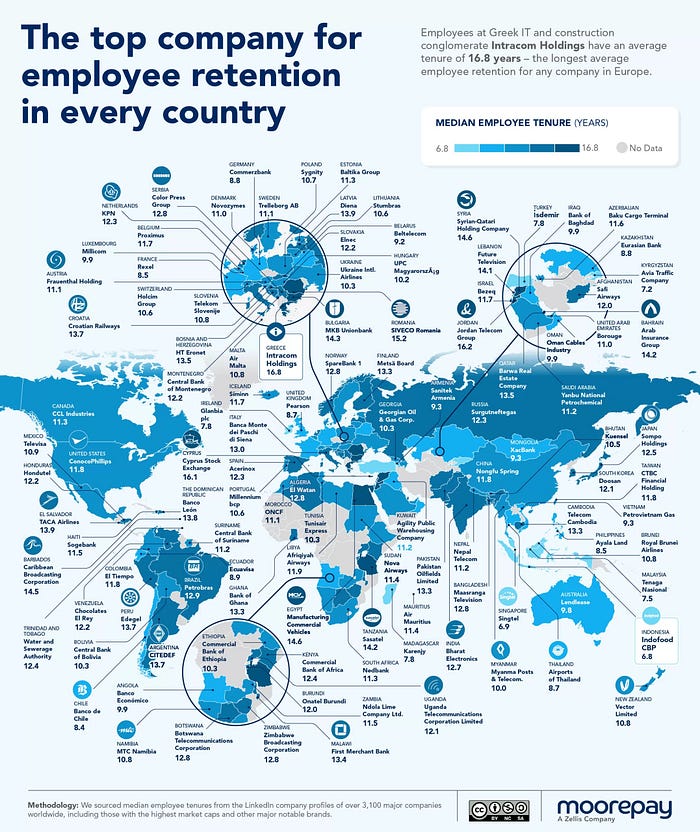
To uncover which companies have managed to reverse the global turnover tide, HR and payroll firm Moorepay conducted a large-scale analysis of LinkedIn data from over 3,100 major companies worldwide. The study identified the top firm for employee retention in every country, offering an illuminating snapshot of where loyalty still thrives.
In Greece, for instance, Intracom Holdings, an IT and construction conglomerate, leads Europe with an extraordinary median employee tenure of 16.8 years. This is not only the highest in the region but a signal that even in technology-driven industries, human connection and long-term trust can coexist with innovation.
In Croatia, national rail operator Hrvatske Željeznice maintains a median tenure of 13.7 years, while CCL Industries in Canada averages 11.3 years. Across the Asia-Pacific region, Midea Group in China and DBS Bank in Singapore show similarly strong figures, underscoring that stable careers still exist, but typically within companies that offer purpose, progression, and protection.
The U.S. Picture: ConocoPhillips Leads the Way
In the United States, the results are both surprising and instructive (below). The company with the highest employee retention is ConocoPhillips, the energy giant, with a median tenure of 11.8 years, over three times the national average. Its ability to retain staff in an era of volatility reflects the enduring appeal of industries offering stability, clear career pathways, and strong internal cultures.
Other long-tenured U.S. employers include Union Pacific (10.8 years), Verizon (8.4 years), AT&T (7.8 years), and Comcast (7.6 years). Firms like Texas Instruments, Cisco, and Chevron also appear among the top 10, with average tenures exceeding seven years. Even in the high-turnover tech sector, these organizations demonstrate that strategic investment in training, mentorship, and employee development can translate into lasting loyalty.
Interestingly, several defense and manufacturing firms — Lockheed Martin (7.1 years), Boeing (6.7 years), and General Electric (6.6 years) — also rank highly. These industries typically emphasize technical mastery, long project timelines, and structured advancement — all conducive to retaining skilled professionals over decades.

The Human Core of Retention
What unites these companies is not their industry but their philosophy. They treat retention as a function of trust, not tenure. Their employees feel valued, respected, and connected to something larger than their individual roles. That sense of belonging has become the ultimate differentiator in the post-AI workplace.
In a world where digital resumes and machine-learning models can predict turnover risk with uncanny precision, the companies that succeed are those that resist reducing people to data. They invest in mentorship rather than micromanagement, in growth rather than surveillance. They understand that retention is not a policy — it's a culture.
Looking Ahead: Loyalty in the Age of AI
As automation continues to reshape industries, employee tenure may continue to shorten on average. However, this doesn't have to signify a decline in commitment or quality. Rather, it marks a new era of intentional loyalty — where workers stay not because they have to, but because they choose to.
Employers who navigate this transition successfully will be those who integrate technology with empathy, data with dialogue, and efficiency with humanity. The firms highlighted in Moorepay's analysis provide a blueprint: focus on purpose, cultivate trust, and design careers that grow alongside technology. In the end, no AI can replicate the quiet strength of an employee who believes in the mission — and stays to see it through.
Originally published at https://khanfk.substack.com.