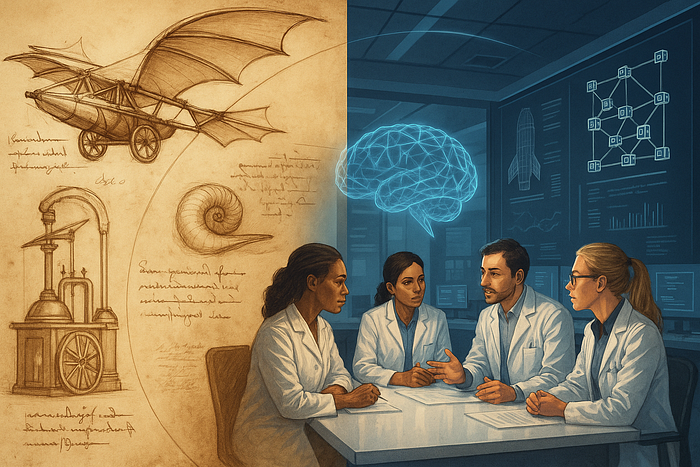

From Matt Ridley's timeless lessons to research-first leadership in the AI era — how to turn slow-cooked ideas into market-shaping revolutions.
How's your weekend going?
I've been reading, and I'm here sharing my thoughts, specially those connected to the new Dean's Research-to-Startup Launchpad for the entepreneurial employability track for BTech junior scholars at my School.
With AI headlines multiplying and ChatGPT in every conversation, you might believe we're living in a golden age of innovation. Yet, Matt Ridley, in his compelling book How Innovation Works (thank you David Boronat for the recommendation), warns of a paradox: despite unprecedented computing power and capital, we may be in a slowdown.
Our inventions are more incremental than epoch-making. We perfect filters for selfies while critical infrastructure — like mass transit, sustainable energy storage, or global water purification — lags behind. Corporations hoard cash rather than invest in truly risky, transformative R&D.
Ridley's history of transformative inventions — from the S-bend toilet to the container ship — offers 15 universal principles. Here, I reinterpret them for the AI era, through the lens of research-first leadership, core-tech prioritization, and the career-to-venture acceleration model we run at my Dean's Research-to-Startup Launchpad at Woxsen University in India.
There are fifteen ideas, commented one by one. Let's start.
1. Innovation is Slow-Cooked
Ridley's core claim: genuine breakthroughs are almost never the result of a single "lightbulb moment." The Wright brothers didn't just dream up flight — they iterated for years on gliders. Edison's lightbulb emerged after testing thousands of filaments.
For AI-era leaders, this means reframing expectations. A "minimum viable model" may be trained in weeks, but real-world adoption cycles are long. At the Launchpad, we structure projects to survive a year-plus runway from proof-of-concept to product-market fit, mapping progress through Technology Readiness Levels (TRLs).
Leaders should invest in infrastructure for compounding progress: shared datasets, reproducible pipelines, and cross-team knowledge repositories. This builds what I call innovation muscle memory — the capacity to keep advancing even when the market isn't watching.
2. Innovation is a Crossroads
Ridley says: "Innovation happens when ideas have sex." Historically, major breakthroughs occurred in cosmopolitan, trade-rich hubs — Florence, London, Silicon Valley.
In 2025, the crossroads is increasingly interdisciplinary. The next generation of billion-dollar solutions will come from AI + X: AI plus genomics, blockchain plus energy markets, quantum computing plus materials science.
At Woxsen, our Launchpad intentionally forces collision between domains: CS students work with biotech labs, business students with AI research groups. This reflects a research-first truth: most innovation value is in recombination, not invention ex nihilo.
3. It's a Team Sport
The "lone genius" myth ignores the reality that transformative products emerge from teams with complementary expertise.
For AI-era leadership, the undervalued role is the translator — someone fluent in both deep technical and commercial languages. In my Research-First Leadership article, I argue this is why the next decade's CEOs will often be research-trained engineers: they can navigate both the lab and the boardroom without an interpreter.
If you're building AI ventures today, your org chart should explicitly fund and protect these bridge roles — they are the glue between research excellence and market traction.
4. Built on Trial and Error
Edison's 10,000 "failed" lightbulbs weren't mistakes; they were the data set for success. Bezos' "we need big failures" philosophy is similar.
In deep-tech, experimentation is capital. At the Launchpad, every failed prototype is logged in a shared "failure library." Why? Because in research-first ecosystems, failure isn't waste — it's negative knowledge that accelerates the next iteration.
AI-era leaders must budget for experimental loss the way they budget for marketing. It's part of the operating cost of discovery.
5. Serendipity is Real — But Prepared Minds Win
Post-its, penicillin, the microwave — all serendipitous, but recognized by people ready to act.
In AI + research, prepared serendipity means having mechanisms to surface unexpected results. At the Launchpad, "off-track findings" from experiments trigger cross-domain review meetings — because the pivot from "failed chatbot" to "successful customer analytics tool" is often just one recognition away.
Your job as a leader? Design your org for discovery, not just delivery.
6. Innovation is Inevitable — But Its Form Isn't
Multiple inventors arrived at the lightbulb independently. Search engines were inevitable in the 1990s — but Google wasn't.
Today, LLMs are inevitable. Which companies turn them into enduring platforms is a matter of leadership and execution discipline.
At Launchpad, we train students to be form-shapers: the people who decide which inevitable trend to pursue, when to enter, and how to differentiate. This skill — strategic timing — is often more valuable than technical genius.
7. Innovation ≠ Invention
Meucci's uncommercialized telephone is a cautionary tale. Invention is the spark; innovation is the firewood and the oxygen.
In AI-age ventures, user adoption engineering is as important as model accuracy. Our Launchpad PoCs must clear an adoption readiness review before investor pitches — if you can't explain how your AI integrates into someone's workflow, you don't yet have an innovation.
8. The Rollercoaster Cycle
Amara's Law: short-term overestimation, long-term underestimation. Blockchain in 2017. Genomics in 2000.
For research-first leaders, this means keeping R&D alive through the "trough of disillusionment." At Launchpad, teams are taught to secure patient capital and structure milestones for long-term credibility.
In other words: ride the hype wave for visibility, but anchor in research depth so you can outlast it.
9. Fragmented Territories Win
Innovation thrives in competitive, fragmented ecosystems. Centralized empires stagnate; Renaissance city-states flourished.
In large AI companies, mimic this with autonomous "startup pods" — Bezos' two-pizza teams are an example. At Launchpad, each project team competes for resources quarterly, even if they're in the same cohort. Competition sharpens innovation edges.
10. Big Companies Struggle to Innovate
Bureaucracy suffocates experimentation. The only cure: competition — internal or external.
In AI leadership, this means incentivizing internal disruption before market disruption forces it. Structure KPIs around customer problem-solving, not product preservation. Launchpad teams rotate leadership to prevent status-quo lock-in.
11. Innovation Often Starts from the Bottom
Governments often fund research but fail at commercializing it. Private-sector agility often translates science into usable tech faster.
At Launchpad, early-stage innovation is student-led, faculty-advised. The lesson for AI leaders: give permission and micro-funding to small, independent teams. Many of the best pivots emerge from unofficial side projects.
12. Regulation and Patents: Double-Edged Swords
Patents can protect — or paralyze — innovation.
In fast-moving AI, defensive IP hoarding is often less effective than strategic openness. For example, publishing certain model architectures can seed an ecosystem that your company then services. This "research visibility" approach is core to our Launchpad playbook.
Said that, they might be a great source of innovation as there is job done that save your development from research to startup in the 18 months funnel of innovation. I think it's worth take it advance as a booster, yet I share the Matt Ridley's pesimism that they might delay your growth. Again, every is a matte of balance.
13. Expect Resistance
Every major technology — from umbrellas to ridesharing — has met vested opposition.
For AI leaders, resistance is a signal: you're threatening an incumbent's comfort zone. Plan stakeholder engagement strategies early, blending advocacy, transparency, and coalition-building.
14. Innovation Doesn't Destroy Jobs — It Changes Them
From Luddites to ATM fears, every wave triggered job-loss panic. Net effect? More jobs, more leisure.
AI leaders must own the workforce transition: reskilling programs, redeployment pathways, and new career architectures. At Launchpad, project plans must include a "human impact narrative" — explaining how adoption changes roles, not just profits.
15. Freedom is the Secret Ingredient
Prosperity needs innovation. Innovation needs freedom to experiment. And experimentation needs leaders who protect the space for it.
Edison's "99% perspiration" isn't just about hard work — it's about persistence through ambiguity. At Launchpad, this is the Final Challenge slide: "You're not here to get a BTech diploma. You're here to redefine what human inquiry can achieve."
Closing Thought
The real AI-age question isn't whether technology will change the world — it already has. The question is whether you will shape the direction of that change.
Whether you're a BTech junior scholar of my School of Technology with a wild PoC, a researcher sitting on uncommercialized IP, or a CEO navigating post-LLM markets, these 15 principles are your field guide. And in the research-first, core-tech decade ahead, the winners will be those who can translate invention into adoption, faster than anyone else.
If you lead a research lab, manage an AI product team, or are launching a deep-tech startup, I'd love to hear your take: Which of these 15 principles do you think is most often ignored in today's innovation culture? Share your thoughts in the comments or connect with me for a deeper conversation.
Let's do it