

Introduction — Unveiling the Human Thinking Process
"Errare humanum est, sed perseverare diabolicum." ("To err is human, but to persist is diabolical.") — Lucius Annaeus Seneca (c. 4 BC-AD 65)
In "Psychology of Intelligence Analysis," Richards J. Heuer explores the complexities of the human thought process, shedding light on how our minds inherently form models for processing information. This phenomenon, as Heuer's research reveals, is intrinsic to the functioning of the human cognitive process and extends beyond intelligence-related activities. The analytical process itself reinforces the brain's natural inclination to create models, even if not explicitly labeled as such. Individuals establish expectations and understandings about cause-and-effect relationships, guiding the processing and interpretation of information through these mental models or filters.
Heuer emphasizes that the pitfalls presented by the human mental process are inherent and cannot be entirely eliminated; they are an integral part of who we are. However, he advocates for training individuals to recognize and address these mental obstacles through the development of offsetting procedures.
For intelligence analysts, self-awareness about their reasoning processes is paramount. It goes beyond focusing solely on the judgments and conclusions; analysts should contemplate how they arrive at judgments. According to Richards J. Heuer, fostering such self-consciousness is key to navigating the complexities of analysis, particularly when information is incomplete, ambiguous, or intentionally distorted. Tools and techniques designed to elevate critical thinking play a crucial role in enhancing analysis under these challenging conditions. These intellectual devices include methods for structuring information, challenging assumptions, and exploring alternative interpretations, empowering analysts to navigate complex issues with more discernment.
Issue of Perception — Why Can't We See What Is There To Be Seen?
The principles below highlight how our expectations, mindsets, and existing images influence our perception. Awareness of these tendencies is crucial for objective analysis.
#1 exercise Question: What do you see?

Comment: The article is written twice in each of the three phrases. This is commonly overlooked because perception is influenced by our expectations about how these familiar phrases are normally written.
#2 exercise Question: What do you see?
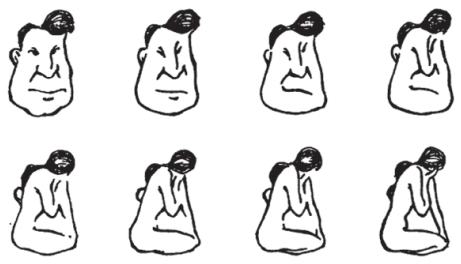
Comment: Impressions resist change. — The illustration depicts a sequence of drawings that gradually transform from a man into a woman. When viewed in isolation, the right-hand drawing in the top row has an equal likelihood of being perceived as either a man or a woman. However, test subjects who initially see a clear depiction of a man tend to persist in perceiving a man, even after an "objective observer" (someone who has seen only a single picture) acknowledges that the figure has become a woman. Likewise, those who begin at the woman's end of the series are inclined to persist in seeing a woman.
#3 exercise Question: What do you see?

Comment: - Now look again to see a different image: a young woman if your original perception was an old woman, or the old woman if you first perceived the young one. - When you have seen the image from both perspectives, try shifting back and forth from one perspective to the other. Do you notice some initial difficulty in making this switch? It is difficult to look at the same information from the different perspectives.
In light of the above-mentioned, here are the fundamental principles related to perception:
· We tend to perceive what we expect to perceive;
· Mind-sets tend to be quick to form but resistant to change;
· New information is assimilated to existing images.
Cognitive Bias (Cognitive Traps)
Intelligence analysis is subject to cognitive traps, many of which are also present in other areas, such as research.
"Cognitive biases are mental errors caused by our simplified information processing strategies. It is important to distinguish cognitive biases from other forms of bias, such as cultural bias, organizational bias, or bias that results from one's own self-interest. In other words, a cognitive bias does not result from any emotional or intellectual predisposition toward a certain judgment, but rather from subconscious mental procedures for processing information. A cognitive bias is a mental error that is consistent and predictable." — Richards J. Heuer
The most common types of cognitive biases are:
· Confirmation Bias — The tendency to favor information that confirms one's pre-existing beliefs or values and reject information that contradicts them;
· Perception of Causality — The inclination to see a cause-and-effect relationship between events, even when they may be coincidental or unrelated;
· Overemphasis on the Present — Giving undue weight to recent events and ignoring historical context or trends;
· Anchoring Bias — The reliance on the first (sole) piece of information encountered (the "anchor") when making decisions, even if subsequent information contradicts it;
· Groupthink — The desire for harmony or conformity in a group, leading to irrational or dysfunctional decision-making;
· Satisficing — Accepting the first option that meets a minimum threshold rather than exploring all possible options for the optimal solution;
· Availability Heuristic — Estimating the likelihood of an event based on its availability in memory, often influenced by recent or vivid examples;
· Mirror Imaging — Projecting one's own beliefs, values, or thought processes onto others, assuming they think the same way;
· Wishful Thinking — Allowing hopes and desires to influence judgments about the likelihood of a particular outcome.
Structured Analytical Techniques (SAT)
Analytical techniques play a crucial role in minimizing the adverse impact of cognitive traps on analysis. Categorized by their nature, the following types of analytical techniques are recognized:
· Empirical;
· Diagnostic;
· Consensus-building;
· Imagination;
· Reframing Devices;
· Diagrammatic.
It's essential to understand that each SAT comes with its own set of advantages and disadvantages. Here are some of the most commonly used and relevant analytical techniques:
Review of Historical Data
Analyzing historical data offers several advantages, including the straightforward ability to explore readily accessible existing data, the opportunity to investigate events with a significant time lag between detection and impact, facilitating the study of rare occurrences, and, crucially, the generation of hypotheses that should be tested prospectively. However, this approach is not without limitations. Challenges may arise from missing data points, unrecoverable or unrecorded information, interpreting data without sufficient understanding of local conditions, verifying information, establishing cause and effect, and variations in the quality of recorded information.
Simple Induction
Inductive reasoning is a type of reasoning that derives generalized conclusions from a finite collection of specific observations. As it constructs and assesses propositions that are abstractions of observations (i.e., generalizations based on individual instances), the premises of an inductive logical argument lead to a conclusion that can be considered probable but not certain.
Analysis of Competing Hypotheses (ACH)
Analysis of Competing Hypotheses (ACH), also known as Competing Hypotheses Analysis (CHA), involves identifying alternative explanations (hypotheses) and evaluating all evidence to disconfirm rather than confirm hypotheses. At the heart of ACH is the idea of competition among a series of plausible hypotheses to see which ones survive testing for compatibility with available information. The surviving hypotheses, those that have not been disproved, undergo further testing. ACH may not always provide the correct answer, but it can assist analysts in overcoming cognitive limitations.
Core Assumptions Checklists
Checklists serve as a straightforward tool for identifying e.g. risks, offering a list of standard factors that require consideration. Typically derived from experience, either through prior assessments or learning from past failures, checklists may explicitly outline and challenge the key assumptions underpinning an analysis. By pinpointing specific assumptions shaping the basic analytical framework, checklists assist analysts in ensuring that common issues are not overlooked, simultaneously enhancing their understanding of the most important dynamics at play.
During the checklist application, the analyst systematically goes through each element of the process, reviewing the presence of listed items. This method is most useful when employed to verify comprehensive coverage after using more imaginative techniques that identify new problems. Therefore, it is well-suited for the final phase of analysis, serving as a fundamental "stress test" to examine the underlying viability of a proposed hypothesis. However, it's essential to note that this method may somewhat restrict imagination in identifying new threats by potentially overlooking less apparent problems.
Indicators
Indicators refer to pre-established sets of observable phenomena regularly reviewed to track events, identify trends, and signal unforeseen changes. Utilizing indicators proves valuable for analysts, especially in moments of sharp divergence of opinions regarding event interpretations. These indicators offer an objective baseline, infusing rigor into the analytical process and elevating the credibility of the final output.
The best indicators possess several key characteristics: they are easily observable, providing stability for tracking trends over a substantial period; they measure only one aspect, ensuring uniqueness; and they are reliable, accurately capturing the intended concept. Analysts, however, must conduct periodic reviews of the validity and relevance of their selected indicators. Narrowly conceived or outdated indicators may inadvertently reinforce analytical bias by reflecting flawed assumptions.
Chronologies
Chronologies and timelines serve as tools for organizing information into designated time periods, aiding the analytic process by enhancing the analyst's ability to comprehend data flows, identify gaps, and establish relationships between causes and effects. While chronologies present events in a narrative form, following the order of occurrence, timelines visually represent the chronological spectrum. Typically, timelines take the form of a long bar labeled with dates and the specifics of pertinent events.
This clear and concise representation of data not only facilitates the formulation of essential connections and correlations between events, individuals, places, and factors, but also highlights areas where evidence or pieces of data are missing.
Structured Brainstorming
Structured brainstorming is a widely employed technique rooted in the collaborative process of group work, fostering open discussion among members, spontaneous expression of thoughts, and the development of the most acceptable ideas. This process unfolds in two distinct stages:
a) In this phase, a group of analysts freely presents numerous ideas and proposals related to the problem at hand. Criticism and filtering of ideas are suspended during this stage, encouraging the stimulation of imagination. Possibilities are voiced that may not emerge from individual members working in isolation. All ideas and opinions, regardless of their nature, are allowed to exist during the initial discussions.
b) Following the free expression of ideas, the same group reconvenes to discuss and refine the fixed ideas. Opinions related to erroneous arguments and evaluations are set aside, and the focus shifts to consolidating balanced and evidence-based opinions. Only after this stage are these refined ideas transferred to paper, marking the beginning of the development process.
This technique provides analysts with the opportunity to generate a greater number of ideas than they could individually. The processing and consideration of diverse ideas contribute to the creation of a qualitatively higher-quality analytical product.
Multiple Scenario Generation
Scenario analysis involves the development of descriptive models depicting various potential futures. It is a process that analyzes possible future events by considering a broad range of alternative outcomes. Instead of settling on a single, exact vision of the future, scenario analysis consciously explores the diverse ways a situation might evolve. This approach anticipates surprise developments and is particularly useful when dealing with little concrete information or highly ambiguous or uncertain threats.
After defining the context of a problem and the relevant issues, analysts identify potential changes by examining sets of scenarios, including "best cases," "worst cases," and "expected cases." While scenario analysis cannot accurately predict the probability of changes, it assesses impacts and helps institutions develop the strength and resilience needed to adapt to foreseeable changes.
However, the main limitation of scenario analysis is the inherent speculation involved, especially when uncertainty is high and data availability is limited. This may increase the likelihood of producing unrealistic scenarios.
Structured What-If Technique (SWIFT)
The SWIFT method assumes that a significant event has occurred, carrying the potential for a major negative or positive impact. It challenges analysts to explain how the event unfolded. Shifting the focus from the mere possibility of an event to understanding its causation enables analysts to make more informed judgments about the likelihood of such developments and aids in developing systems' capacity to respond to potential threats.
In a SWIFT analysis, participants are presented with a hypothetical scenario. They are then prompted to construct a chain of reasoning based on evidence and logic to plausibly explain how the event unfolded. For negative scenarios, participants assess the level of damage or disruption, consider the difficulty of overcoming the situation, and evaluate the mechanisms in place for mitigation. In positive scenarios, analysts calculate the overall impact and identify how such a situation could be best facilitated. This method is valuable for candidly evaluating existing controls and safeguards, especially when there is a prevailing mindset hindering creative problem-solving or when analysts struggle to focus on high-impact event consequences due to perceived low probability.
SWIFT is particularly relevant in situations where a prevailing mindset impedes creative problem-solving or when analysts find it challenging to focus on high-impact event consequences due to perceived low probability.
Devil's Advocacy
Devil's advocacy acts as a safeguard for high-confidence analytic judgments by constructing the most compelling case for an alternative, substantially different analytic perspective. This method challenges analysts to adopt a contrary assessment, aiding in the identification of flaws and faulty logic entrenched in a hypothesis.
When assuming a contrary stance, analysts thoroughly reevaluate the evidence supporting the original analytic judgment. They scrutinize data for oversights, evaluate source quality, and examine underlying assumptions to identify potential weaknesses that could support an alternative explanation. This process either reaffirms the structural integrity of the original judgment or exposes its vulnerabilities. Through this more critical lens, analysts can effectively critique their hypotheses.
Red Hat (Red Team) Analysis
In the red hat analysis method, analysts aim to predict the behavior of groups or individuals by immersing themselves in the scenario from the subject's perspective. This approach compels participants to transition from the role of observers to decision-makers operating within an established operational framework.
During the exercise, experts are given a predefined context and, guided by the facilitator, are tasked with placing themselves in the shoes of the target by simulating how that subject would respond. The focus is not only on mirroring the target's viewpoint but on logically deducing how the subject is expected to think, behave, and react to encountered stimuli.
This technique offers the advantage of introducing novel and diverse stimuli, such as the human dimension, which may be overlooked in more traditional analyses. However, its effectiveness hinges on participants possessing a nuanced understanding of the culture and operational context of the subjects. Experts lacking this foundation may draw inconsistent conclusions from the task.
Cause-and-Effect Analysis
Cause-and-effect analysis is a structured method used to identify potential causes of an undesirable event or problem. This approach organizes potential contributory factors into broad categories, facilitating the consideration of all possible hypotheses. However, it does not independently pinpoint the actual causes, as rigorous empirical testing is required for that determination. The information is typically structured in a fishbone or Ishikawa diagram.
The expert initiates the process by identifying the positive/negative effect to be analyzed and placing it in a leader box. Subsequently, the main categories of causes are determined and represented by the remaining boxes in the fishbone diagram. The expert then proceeds to populate possible causes for each category with branches and sub-branches, describing the relationships. The result is a visually accessible illustration of all likely contributory factors.
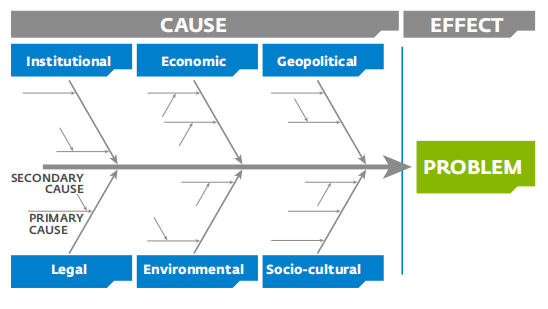
The cause-and-effect analysis provides a structured pictorial representation of a list of causes associated with a specific effect. It facilitates the consideration of all potential scenarios and causes generated by a team of experts. This analysis is particularly valuable at the outset of an analysis to broaden thinking about potential causes. Inputs for cause-and-effect analysis may come from the expertise and experience of participants or a previously developed model used in the past.
Conclusion
Understanding the complexity of the human mind and acknowledging our inherent biases are crucial for intelligence analysts. Equipping oneself with specific approaches, or tools, enhances the understanding of choices and actions. This self-awareness minimizes mistakes in the analytical process, contributing valuable insights to real-life situations and professional endeavors.