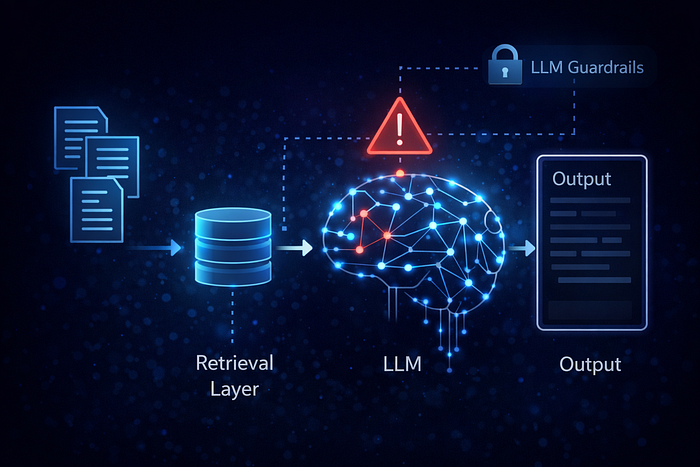
Retrieval-Augmented Generation (RAG) has rapidly become the default architecture for deploying large language models in enterprise environments. By grounding model outputs in external knowledge bases, organizations aim to reduce hallucinations, improve factual accuracy, and safely integrate AI into production workflows.
As RAG adoption grows, so does the focus on "AI security." Most defensive efforts today concentrate on prompt injection, jailbreaks, and model-level guardrails. However, this focus misses a critical and increasingly exploitable attack surface: the retrieval layer itself.
In many enterprise RAG systems, attackers do not need to manipulate prompts or tamper with model weights. They only need to influence what documents are retrieved.
The Blind Spot: Retrieval Is Trusted by Default
In a typical RAG pipeline, retrieved documents are implicitly trusted once they enter the context window. The model treats them as authoritative ground truth, regardless of their origin, provenance, or semantic consistency with the rest of the corpus.
This assumption creates a dangerous asymmetry: while prompts and models are heavily scrutinized, the data feeding the model often is not.
Enterprise knowledge bases are rarely static. They are built from:
- Internal documentation
- User-generated content
- Automatically ingested external sources
- Vendor feeds and integrations
- Continuous updates across distributed teams
Each ingestion point represents a potential vector for adversarial influence.
How Retrieval Poisoning Works in Practice
Retrieval poisoning attacks do not rely on overtly malicious payloads. Instead, they exploit subtlety.
An attacker introduces documents that:
- Mimic legitimate authority or internal style
- Reinforce misleading narratives across multiple sources
- Gradually shift semantic consensus rather than inject obvious falsehoods
When these documents are retrieved alongside legitimate ones, the model synthesizes them into a coherent response — often without triggering any existing security controls.
Crucially, these attacks bypass:
- Prompt injection filters
- Output moderation
- Model alignment constraints
From the model's perspective, it is simply doing its job: summarizing and reasoning over the provided context.
Why Existing AI Defenses Fail
Most AI security tooling assumes that the primary risk lies in user input or model behavior. This assumption no longer holds in RAG-based systems.
Prompt filters operate too late in the pipeline. By the time the prompt is evaluated, the context has already been poisoned.
Model-level guardrails are blind to document provenance. They cannot distinguish between a trusted internal policy document and a carefully crafted adversarial lookalike.
Content moderation focuses on surface-level policy violations, not on semantic manipulation or authority mimicry.
The result is a class of attacks that is low-noise, persistent, and difficult to detect using traditional approaches.
What Retrieval-Aware Security Actually Requires
Securing RAG systems requires shifting the defensive focus upstream, to the point where documents are selected and weighted.
At a minimum, retrieval-aware security should include:
- Cryptographic provenance validation to establish document authenticity
- Semantic anomaly detection to identify subtle deviations from corpus norms
- Authority- and trust-weighted retrieval rather than naive similarity ranking
- Separation between retrieval control and generation, preserving framework and vendor neutrality
These controls operate before content ever reaches the model, preventing poisoned context from influencing outputs rather than attempting to "fix" responses after the fact.
Research Evidence and Practical Evaluation
Recent research has begun to formally analyze this attack surface and evaluate mitigation strategies under controlled conditions.
A technical preprint published on Zenodo documents a multi-layer defense approach for retrieval poisoning in enterprise RAG systems, including:
- A realistic threat model aligned with real-world ingestion workflows
- Evaluation across multiple poisoning and adversarial manipulation scenarios
- Consistent detection of retrieval-layer attacks with no false positives on legitimate data
The work emphasizes that securing RAG systems is not about replacing existing AI defenses, but about complementing them with controls designed for the retrieval pipeline itself.
The preprint is available here: https://zenodo.org/records/18449664
An overview of the research framework and system architecture is available at: https://sentinelrag.com
Why This Matters Now
RAG is moving quickly from experimentation into regulated, high-impact environments: finance, healthcare, legal systems, and government operations.
In these contexts, trust in AI outputs is inseparable from trust in the underlying data. If retrieval integrity is compromised, model correctness becomes irrelevant.
The industry has already learned this lesson in other domains, from supply-chain security to software dependency management. RAG systems are no different — they simply compress the attack surface into a context window.
Organizations deploying RAG in production should treat retrieval as a first-class security concern, not an implementation detail. The cost of ignoring it will not be theoretical.
Author
Fabio Petti is an independent security researcher focused on AI system integrity and security risks in enterprise Retrieval-Augmented Generation deployments.