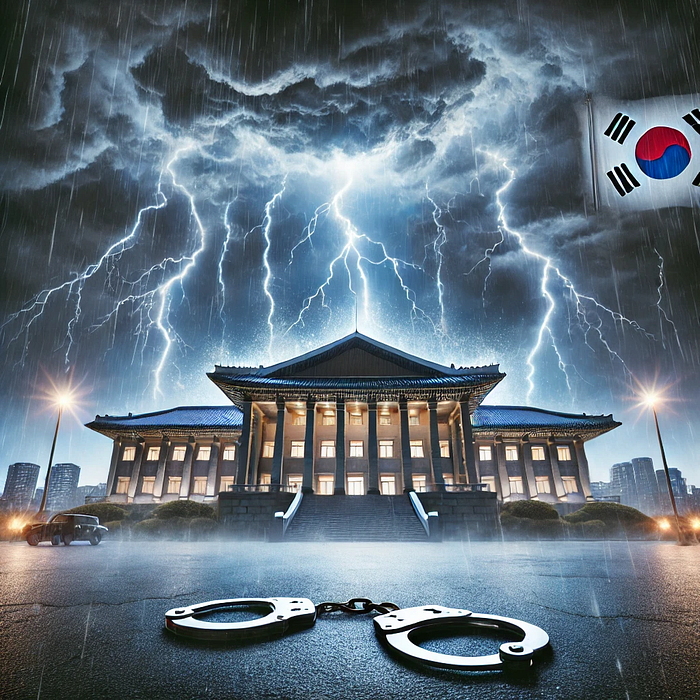
The country's Corruption Investigation Office for High-ranking Officials announced a travel ban on President Yoon Suk-yeol.
This means that even if there are critical international visits or conferences, President Yoon cannot leave South Korea.
Why? Because authorities fear he might flee.
And that's not all. South Korea's Special Investigation Headquarters also announced the arrest of recently resigned Defense Minister Kim Yong-hyeon on charges of "insurrection" and "abuse of power."
In addition, former Minister of the Interior and Safety Lee Sang-min, former counterintelligence commander Yeo In-hyeong, and Army Chief of Staff Park An-soo have all been barred from leaving the country.
While Yoon remains president in name, his power has effectively been stripped away, and South Korean prosecutors are now conducting a thorough reckoning.
The Power of Prosecutors and the Blue House Curse
South Korea operates under a unique prosecutorial independence system, granting prosecutors the autonomy to investigate and make decisions on cases without interference, even from their superiors. This independence, combined with a strong anti-corruption sentiment among the public and fierce political rivalries, has led to an almost inevitable outcome for past presidents: a tragic fall from grace.
The "Blue House Curse" seems unbreakable:
- South Korea's first president, Syngman Rhee, was ousted in a military coup and died in exile in the U.S.
- Park Chung-hee, credited with the "Miracle on the Han River," was assassinated along with his wife.
- Chun Doo-hwan and Roh Tae-woo were imprisoned for treason and corruption.
- Kim Young-sam and Kim Dae-jung suffered reputational damage due to their children's scandals.
- Lee Myung-bak was sentenced to 17 years in prison.
- Roh Moo-hyun, under relentless investigation, tragically leapt to his death.
- Park Geun-hye, Park Chung-hee's daughter, became South Korea's first impeached president and was sentenced to 22 years in prison.
Yoon Suk-yeol, once the prosecutor responsible for sending Park and Lee to prison, now finds himself ensnared in the same curse.

A Self-Made Coup: Yoon's Desperate Gambit
On the night of December 3, Yoon declared martial law in a last-ditch effort to consolidate his power. However, this self-styled "coup" unraveled in just six hours. Observers believe his actions were driven by two main motivations:
- Protecting First Lady Kim Keon-hee: With Kim facing imminent investigation, Yoon seemingly risked everything in her defense.
- Breaking the Blue House Curse: He hoped martial law would secure his authority, but instead, it hastened his downfall.
Yoon's gambit not only cost him his presidency but also turned him into a global laughingstock. Now, his path forward appears to lead inevitably to prison.
Reality Outshines Korean Dramas
South Korea's political drama resembles a real-life "Game of Thrones." From Yoon's travel ban to the arrests of key officials in his administration, the country once again showcases the brutal and intricate nature of its political rivalries.
Yoon Suk-yeol, once hailed as a "fearless prosecutor," is now a suspect under investigation. His impulsive actions have exacted a heavy toll, and he is likely regretting them as he contemplates his downfall.
Yet in South Korea, these dramatic twists are par for the course. Reality often outpaces the wildest plotlines of Korean dramas.
In the end, in this world, what goes around comes around.