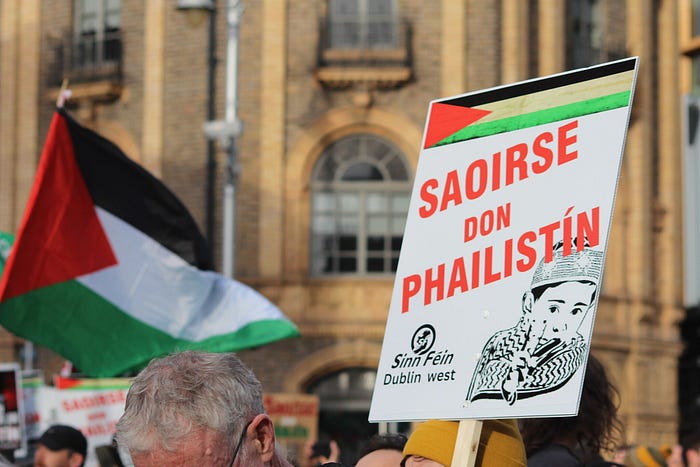

One nation among them though has been always vocally pro-Palestine and critical of the state of Israel.
And that is Ireland.
I had the privilege of living in the Emerald Isle for 3 years and I learnt a lot about its culture and customs. And I think I know why they support the Palestinians so much.
Their solidarity is largely born out of a perceived shared experience of subjugation by an occupying state.
Ireland was under English and then British rule for more than 800 years. While under British control, Ireland was often subjected to violent and discriminatory rule from London, most infamously with the Great Potato Famine in the 1840s, during which roughly 1 million people are estimated to have died from hunger. The failure of the British government to adequately help the starving population forced over 1 million more to emigrate.
But this got me thinking — there is an interesting way in which people relate to this conflict.
It is already surprising enough that this conflict has come to the centre stage of the world's collective attention, much more than any other ongoing conflict in the world right now (perhaps with the exception of the Russia-Ukraine war).
I noticed that people see in this conflict what they want to see.
The Irish, with their history of colonialism and expulsion, see a colonial story.
The Americans, with their history of race relations, see a race story.
The Arab world sees a pan-Arab story.
And the wider Muslim world sees a story of a struggling Muslim nation.
It seems like everybody wants to look at Israel-Palestine and see a reflection of themselves or their history (hint: intersectionality & identity politics).
When in reality, this conflict doesn't have anything to do with you.
The more we try to attach a broader meaning to this conflict, the more we run away from the solution to it.
The more we treat it as anything but a territorial dispute, the more we embolden the voices that don't want peace.
Imagine this — if the Israeli-Palestinian conflict could be treated as a territorial dispute, it wouldn't be so hard to resolve. Someone gives up a piece of land here and there, someone gets a piece of land, and even though it might be politically uncomfortable, the two sides would eventually come to an agreement.
But if you treat it as a colonial project, nothing short of "decolonisation", i.e. the complete erasure of the Israeli state, would suffice.
If you treat it as an "Arab issue", you are dooming the Arab States and Israel to endless conflicts and wars (which was the case for most of the 20th century).
If you treat it as a religious issue, well then you are opening another dangerous door — which religion would dominate the other?
The more we make an effort to look at this conflict for what it is rather than what we want it to be, the closer we will be to its resolution.
The Israeli-Palestinian conflict is not the playground for some woke progressive college kids, who go and protest to feel good and morally righteous about themselves, it is a real issue that involves real people and needs real-life solutions.
If you read this far and like this article, please consider commenting and following me on Medium.