

A century ago, many of our grandparents might have stood on the edge of an American farm, unwelcome. Not because they lacked the money, the grit, or the dream to work that land, but because their skin was the wrong color and their birthplace the wrong country.
Back then, states like California, Washington, and Texas passed so-called Alien Land Laws — legal weapons designed to keep "aliens ineligible for citizenship" (code for Asian immigrants) from buying or leasing farmland. These laws, upheld by courts and woven into the fabric of local communities, made sure Asian families stayed one step away from the American Dream.
You'd think we would have learned something from that ugly chapter in our history. But across the United States today, state legislatures are dragging these ghosts from the attic — repackaged as modern "national security" measures.
The Return Nobody Asked For
In Florida, Senate Bill 264 (signed into law in 2023) prohibits "foreign principals" from designated "countries of concern" — including China, Russia, Iran, North Korea, Cuba, Venezuela, and Syria — from acquiring agricultural land or any real estate within 10 miles of military bases or critical infrastructure unless narrow exceptions apply. Chinese nationals face stricter limits: They may only purchase one residential property (under two acres) at least five miles from military or critical sites, and only if they hold a valid non-tourist visa or asylum status. Governor Ron DeSantis defended it by saying, "If you look at the Chinese Communist Party, they've been very active throughout the Western Hemisphere, in gobbling up land, and we don't need to have CCP influence in Florida's economy."
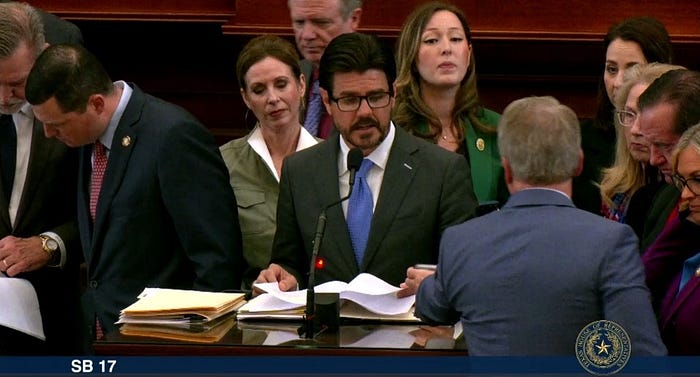
In Texas, Senate Bill 17 (signed into law in June) restricts certain foreign nationals, primarily from China, Russia, North Korea, and Iran, from purchasing or leasing agricultural land, oil and gas interests, or property near critical infrastructure and military bases. Senator Lois Kolkhorst (R-District 18), who authored SB 17, defended the measure, saying, "This legislation is different, better, and more constitutionally sound, and predicated on national security issues."
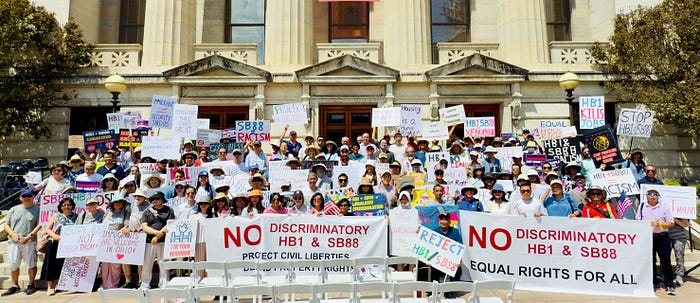
In Ohio, legislators are considering near-identical bills House Bill 1 and Senate Bill 88 (both named the "Ohio Property Protection Act"), which would prohibit both business and individuals from countries labeled as foreign adversaries from buying agricultural land or property within 25 miles of military bases or critical infrastructure in Ohio. The Ohio Secretary of State's office currently designates China, Cuba, Iran, North Korea, Russia and Venezuela under the regime of Nicolás Maduro are considered foreign adversaries. Senator Terry Johnson (R-District 14), sponsor of SB 88, stated, "This legislation is essential to protect Ohio's resources and to ensure that our land remains in the hands of those who have a genuine stake in the well-being of our state."
In Indiana, House Bill 1183 (signed into law in 2024) prohibits persons — defined as individuals or entities tied to foreign adversaries listed by the U.S. Secretary of Commerce (including China, Russia, Iran, North Korea, Cuba, and Venezuela) from purchasing, leasing, or acquiring: any agricultural land or real property within 10 miles of Indiana military installations. Representative Kendell Culp (R-District 16), author and sponsor of HB 1183, said, "We cannot afford to let our enemies control even a fraction of our food supply or conduct surveillance near our military resources."
The justification? Protect America from espionage, sabotage, or covert influence.
No one disputes that our country must guard its security. But let's not kid ourselves: these blanket bans don't distinguish between a foreign government and a grandmother trying to buy a house for her children. They don't target shady corporations; they sweep up students, green card holders, even U.S. citizens with family ties abroad.
The Poison of Fear and Xenophobia
Let's be clear: when states ban people from owning property based solely on birthplace or passport, that's not security — it's discrimination. And discrimination feeds fear. For Asian Americans, who already shoulder suspicion and scapegoating, these bans send an unmistakable message: You will never truly belong.
We've seen this before. A century ago, Alien Land Laws tore apart families who had invested everything they had in a patch of earth. They stripped immigrants of land they'd lawfully purchased, cast suspicion on entire communities, and made Asian success itself seem suspect — un-American. The message then is the same as now: You are a perpetual foreigner.
Fear is a powerful tool — but when wielded carelessly, it corrodes democracy at its roots. These new bans thrive on the fear of "the foreign," smearing entire communities as spies and saboteurs without evidence. They fracture neighborhoods, pit neighbor against neighbor, and give bigotry a badge of law.
We know the pattern. When COVID-19 hit, reckless leaders branded it the "China Virus" or "Kung Flu". Conspiracy theories and racist slurs ignited violence. From 2020 to 2022, thousands of hate incidents were reported — many targeting Asian elders and women. In New York, 84-year-old Vicha Ratanapakdee was killed on his morning walk. In Atlanta, eight people — six Asian women — were murdered by a gunman inflamed by the same hateful narrative. On the streets of San Francisco, Los Angeles, and countless cities, Asian seniors were shoved, punched, and stabbed for existing.
These attacks were not random. They were the predictable consequences of official fearmongering that painted entire communities as threats. When lawmakers pass bills targeting immigrants from China or other Asian countries, they tell the country, These people don't belong here. Write that into law, and it spills into the streets.
History is clear about where this path leads: more violence, more scapegoating, and more laws that trample basic rights. The surge in anti-Asian hate is not a coincidence — it's the bitter fruit of leaders who fan the flames of suspicion, then stand aside as that fire spreads.
We cannot fall for it. Fear is easy to ignite but hard to control. If we want a society rooted in freedom, fairness, and equal justice, we must reject fear mongering in all its forms — and demand policies grounded in facts, not stereotypes; in equality, not exclusion. Everyone, no matter where they come from, deserves to belong here.
Many Lawmakers Won't Even Listen
Perhaps most insulting of all, many lawmakers pushing these bills refuse to even meet with the very people whose lives they are upending. In Texas, Representative Cole Hefner (R–District 5), Chair of the House Committee on Homeland Security, Public Safety & Veterans' Affairs — the committee where HB 17 (the companion to SB 17) was born — has repeatedly ignored requests to meet with Asian American Texans, including constituents in his own district, who have asked for the chance to explain how these bills would strip away their right to buy a home, invest in a farm, or build a secure future for their families.
This is not hearsay. I can personally account for 15 phone calls, 12 emails, 5 text messages, and 4 in-person visits to Representative Hefner's office in Austin — all failed attempts to arrange a simple face-to-face meeting between him and the Asian Texans whose livelihoods his legislation threatens to upend. That refusal speaks volumes about whose voices he values — and whose he is willing to sacrifice.
Worse still, during House floor debates, Representative Hefner could not answer basic questions from Representative Gene Wu (D–District 137) about whether the bill would apply to visa holders, or whether he even understood the difference between visa holders and permanent residents. When pressed by Representative Rafael Anchia (D–District 103), Hefner was unable to confirm whether the bill would block a real estate investor from Hong Kong from investing in a Texas limited partnership.
Let that sink in: Representative Hefner authored a bill he cannot fully explain — and then refused to look into the eyes of the very people whose lives this discriminatory law will harm the most. Is that representation? No, it is not. It is willful neglect — irresponsible, egregious, and unacceptable.
Protests and Pushback
Communities are not sitting quietly. From Texas to Ohio to Florida, Asian American organizations have mobilized rallies, town halls, and marches on state capitols to fight these discriminatory bills.
In June, hundreds of protestors gathered at the Ohio Statehouse in opposition of House Bill 1 and Senate Bill 88. The event brought together Asian Americans, allies, local leaders, and civil rights advocates in a show of solidarity and resistance. Speakers emphasized the importance of unity and the urgency to push back against laws that threaten to divide communities and undermine constitutional rights.
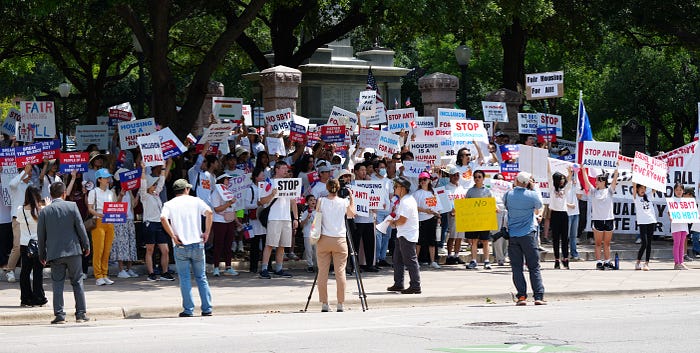
In May, hundreds of Asian Americans and allies filled the steps of the Texas Capitol to protest Senate Bill 17, waving signs that read "Housing is a Human Right" and "Equality for All, Hate for None."
In Florida, Chinese American homeowners are joining civil rights groups to challenge the bans in court while organizing neighborhood gatherings to inform families of their rights. National advocacy networks like Asian Americans Advancing Justice and local coalitions are coordinating legal aid, media campaigns, and voter outreach.
For many, this isn't just about property — it's about proving that they belong here as full participants in democracy, not perpetual foreigners to be eyed with suspicion.
A Constitutional and Moral Fight
Civil rights groups are already fighting back in the courts, arguing these bans violate the 14th Amendment's promise of equal protection. They're right.
But the fight shouldn't rest on lawyers alone. It depends on neighbors standing together — testifying at statehouses, voting, organizing, and reminding lawmakers that America doesn't belong to those who fear the "other." It belongs to everyone who works hard to build a life here, no matter where they came from.
Who Gets to Call This Place Home?
Alien Land Laws were a stain on our nation's past. Reviving them — with slick new names and the same old suspicions — will be a stain on our future.
We can protect national security without sacrificing civil rights. We can guard against foreign interference without branding immigrants as traitors. And we can stand up for the simple idea that the American Dream should not have a loophole for fear and bigotry.
If we fail to do so, we are telling a new generation of Asian Americans what our grandparents were once told: You may live here, but you will never belong here.
I won't accept that. Neither should you.
How You Can Help Stop This
These modern Alien Land Laws and anti-Asian bills are not unstoppable — but it takes all of us to fight back. Here's how you can help:
- Reach out to your legislators. Call, email, and visit your state representatives and senators. Tell them directly how these laws hurt real people in their districts. Demand they vote no on discrimination disguised as security.
- Make financial contributions. Donate to local campaigns and community organizations fighting these bills and supporting civil rights lawsuits. Just remember: campaign finance rules vary by state — so check your local guidelines before giving.
- Attend rallies and demonstrations. Show up. Stand side by side with Asian American communities at state capitols, courthouses, and community centers. Visibility matters — so does solidarity.
- Vote. Elections at the local and state level decide whether these bills live or die. If you're eligible, register and vote in every election — not just for president, but for your state lawmakers, mayors, and county commissioners too.
- Run for office. The best way to protect our communities is to be in the room where these decisions are made. If your leaders won't listen — replace them. We need more allies at every level of government.
- Unite. Even if this fear doesn't touch you personally, stand with those it does. Racism thrives when good people stay silent. As Desmond Tutu reminded us: "If you are neutral in situations of injustice, you have chosen the side of the oppressor."