

And neuroscience finally explains why you keep falling for it
Let me ask you something uncomfortable.
Think about the last truly beautiful moment in your life. Maybe it was a quiet morning with someone you love. A meal that tasted perfect. A conversation that made you feel completely seen.
Were you actually there for it?
Or were you thinking about what you had to do next?
If you're honest — and most of us have to be, because most of us do this — you weren't fully there. You were physically present but mentally somewhere else. Somewhere in the past, replaying an old conversation. Or somewhere in the future, rehearsing a worry that hasn't happened yet.
This is not a character flaw. This is your brain doing exactly what it was designed to do.
But here's the problem: that design is costing you your life.
The "Tomorrow Trap" — And Why We All Fall Into It
There's a phrase most of us say almost every day without realising how dangerous it is.
"There's always tomorrow."
We say it when we don't fully show up for the people we love. We say it when we delay the conversation, the decision, the moment of connection. We say it when we're sitting at dinner with someone important but scrolling through our phone, telling ourselves the real quality time will come later — on the weekend, on holiday, someday when things calm down.
But here's the thing nobody tells you about tomorrow: it never actually arrives.
When tomorrow comes, it becomes today. And then we push it to the next tomorrow. And the next. And somewhere in that endless chain of postponed living, entire years go by — and we look back wondering where they went.
This is not a philosophical observation. It is a documented psychological pattern. And your brain has a specific mechanism that drives it.
What Your Brain Is Actually Doing
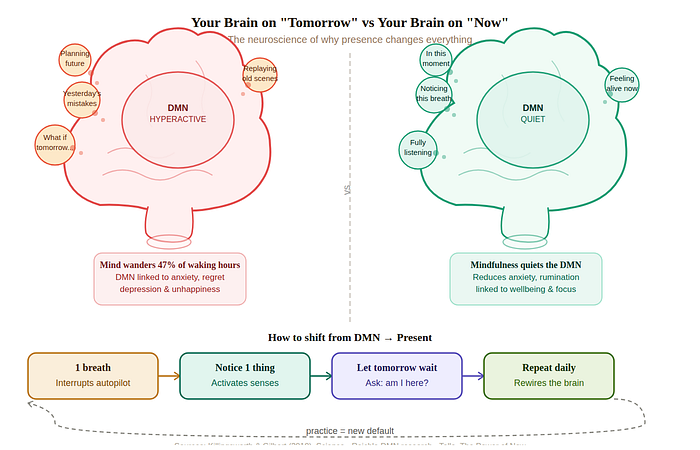
Neuroscientists call it the Default Mode Network — or DMN.
Here's what it is in plain language: when you are not actively focused on a task in front of you, your brain automatically switches into a kind of mental "screensaver mode." It starts drifting — to memories of the past, to anxieties about the future, to imagined scenarios, to self-referential thinking loops.
This network was discovered by neurologist Marcus Raichle and has since become one of the most studied systems in modern neuroscience. Researchers have found that the average person's mind wanders roughly 47% of the time — nearly half of their waking hours — away from what is actually happening in front of them.
And here's the kicker: studies show that the default mode network is about self-focus and mental time-travel — and when it hijacks the mind, it starts to mull over worries, ruminating over what happened before and what will happen next.
You are not lazy. You are not weak-minded. Your brain is running a survival program that was useful thousands of years ago, when remembering past threats and anticipating future dangers kept you alive. But in modern life, that same program keeps you mentally absent from the only moment that is actually real: this one.
The Science of Living in the Present
This is where it gets genuinely fascinating.
When researchers study what happens in the brain during mindfulness and present-moment awareness, they find something remarkable. During meditation, a reduction in Default Mode Network activity is observed — suggesting a decrease in mental rumination and greater mindfulness of the present moment.
In other words: when you are truly present, your brain physically quiets the network responsible for regret and worry. You are not just feeling calmer — your neural patterns are measurably different.
The opposite is also true. Connectivity between particular default mode network areas of the brain has been linked to higher levels of rumination in depressed individuals — the depressive among us ruminate about regrets, failures, shame, and anger. Living in the past and future isn't just unpleasant. It is neurologically associated with depression, anxiety, and a persistent sense that life is passing you by — because it is.
Abraham Maslow, the psychologist who gave us the hierarchy of needs, put it simply: "The ability to be in the present moment is a major component of mental wellness."
This isn't a wellness trend. It is a clinical fact.
The Illusion of "Someday"
Here is the most brutal truth about the "someday" mindset:
Everything you currently have will eventually be gone.
The people you love. The health you take for granted. The ordinary Tuesday evening that feels unremarkable now but that you will one day wish you could return to.
None of this is meant to be morbid. It is meant to be clarifying.
We spend so much of our lives waiting for life to begin — waiting until we have more money, more time, more certainty, more confidence — that we miss the life that is already unfolding. We treat the present as a waiting room for the future we're planning.
But the future never arrives as we imagine it. It arrives as another present moment — and if we haven't practiced being here, we'll miss that one too.
Eckhart Tolle, whose work on present-moment awareness has reached millions of readers worldwide, wrote that most human suffering comes not from actual events but from the mind's tendency to resist the present — to be mentally somewhere other than where you are.
The suffering isn't in the moment. It's in the rejection of the moment.
What "Being Present" Actually Looks Like
Here's where a lot of advice about mindfulness goes wrong: it makes presence sound passive. Like you just sit there and breathe and everything becomes peaceful.
That's not what presence is.
Presence is active attention. It is the deliberate choice, made again and again, to bring your focus back to what is actually happening — not what happened, not what might happen.
It looks like putting your phone down at dinner and actually listening to what the person across from you is saying — not composing your response before they've finished.
It looks like doing the thing you're doing fully — not doing it while mentally already in the next task.
It looks like noticing your own life as it happens, instead of reviewing it afterwards and wishing you'd paid more attention.
It is not about perfection. You will drift. Your mind will wander to next week, to last year, to the conversation you wish had gone differently. That is normal. That is the DMN doing its job.
The practice is simply this: notice when you've drifted, and come back.
Do that enough times, and something changes — not just in how you feel, but in how your brain is wired.
Three Small Shifts That Change Everything
You do not need a meditation retreat or a complete life overhaul to start living more presently. You need small, consistent redirections.
1. The One-Breath Reset Before any significant interaction — a conversation, a meal, a moment with someone you care about — take one deliberate breath. Not as a ritual, but as an anchor. It interrupts the autopilot. It brings you back. One breath is enough to shift from "elsewhere" to here.
2. Name What You Notice Presence is strengthened by observation. When you eat something, notice one specific thing about it — the texture, the temperature, one flavour. When you're with someone, notice one specific thing about them in this moment. The practice of noticing is the practice of presence.
3. Let Tomorrow Wait When the "I'll do it tomorrow" thought arises, ask yourself one question: What would it mean to show up for this moment as if it mattered? Not to pressure yourself — but to remind yourself that this moment is the only place life actually happens. Tomorrow is hypothetical. Now is real.
The Life You're Already Living
Here's what I want you to sit with.
Your life is not waiting for you somewhere in the future. It is not going to start properly once you've sorted everything out. It is not on hold until conditions are better.
Your life is happening right now, in the most ordinary moments — in the cup of tea you drank without tasting it, in the conversation you were half-present for, in the evening you spent thinking about tomorrow instead of living tonight.
The extraordinary life most people are chasing is not somewhere else. It is made of the same moments they keep dismissing as ordinary.
The only difference between a life that felt fully lived and one that felt like it slipped by is not circumstance. It is attention.
Where is yours right now?
A Note on This Work
In my one-on-one coaching sessions, this is one of the patterns I see most consistently — people who are brilliant at planning their life but struggling to actually inhabit it. People who have everything they said they wanted, but feel strangely absent from their own experience.
The work of coming back to the present is not dramatic. It doesn't happen in one session or one revelation. It happens in small moments of redirection, practiced over time, until presence becomes the default instead of the exception.
If you recognise yourself in any of this, I'd love to talk.
📩 Reach out: Neha.srivastava9994@gmail.com
Personal one-on-one sessions — tailored to where you are and what you need.
If this article spoke to something in you, share it with someone who needs to read it. You never know whose moment it might reach.