
It's another transitioning year in my design career. A lot of uncommon things happened this year: I started my 2nd job in a startup in NYC, We have switched to 'work from home' for the most of the year because of the pandemic, I have the chance to work with a group of like-minded product peers and mentors, and finally move one step closer to become a product thinking person.
Recap
I made a quite significant jump for my last career move in two senses:
- I spent 7 years working in a company's innovation organization. It was an inspiring experience as I started my career there, and it was a safe and encouraging environment for me to explore different interests and establish various skill sets. I was exposed to Design Thinking and Lean Startup principles, which have a great impact on me. At the end of the 7th year, I made up my mind to step out of my comfort zone and joined a more drastically changing environment — A startup.
- With this opportunity, I switched my focus from font-end prototyping for innovative concepts to UX design for real-world products. I had the chance to apply the principles to products that are being used by customers. It was in this period, I was able to learn and appreciate how different things can become between theory and reality. I realized: I need to move more upstream in the product design process to make a more fundamental impact effectively. I want to think about product design in an earlier stage rather than fixing UX issues for a product feature which may not represent real user needs.
This Year: 2020
I joined another Fin-tech startup that offers me the opportunity to work closer in a product environment: I got a product designer title, but what's more exciting is that I am having the opportunity to define product features by discovering real user needs and business problems.
Retro
At the end of the year, I think it is a good time to reflect on the work I have been doing over the year. As a product designer, I have created 130 user stories as of today (2020/12/31). To learn a bit more insight, I assigned one or more tags to each of the stories. These tags are: UI, Usability, Product Feature, User Flow. There are 170 instances of these tags getting assigned eventually.
UI — Visual representations, styles that are consistent with branding. It could be improving existing product components or something new.
Usability — Solving some identified user problems, so they they can achieved their goal easier.
Product Feature — Adding a non-existing feature to deliver user value, which in turn creates business value.
User Flow — Refactoring the path of how users get jobs done, so that they can be more productive.
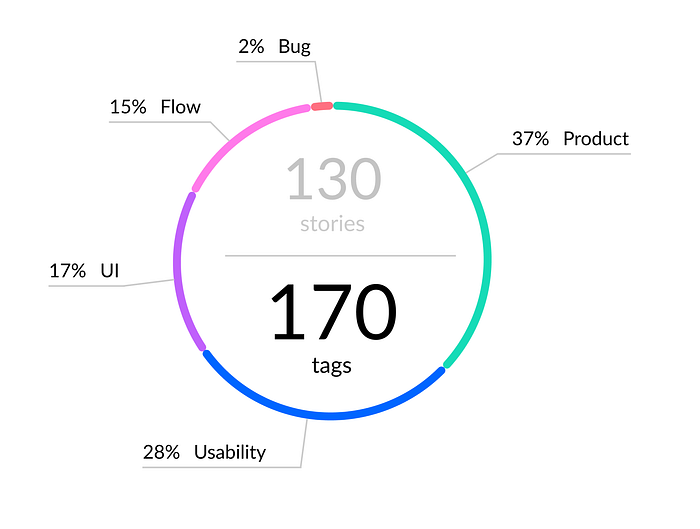
These tags represent the type of work I have done. I am pretty satisfied with the results:
37% of the user stories are about adding new features that try to deliver user value. I still have to validate them though, at least this is a good sign to begin with. It aligns with my goal in general — spending more time on building the right things instead of fixing things.
28% of the stories are about usability, which makes 'jobs to be done' easier, quicker and more human errors could be avoided. But this could be beneficial only if we make sure those are high frequent activities. Otherwise, time is better spent on other things more critical.
Could be better …
UI vs Usability Because each story could have multiple tags on it, which tells me some interesting facts: Out of 29 stories with UI tag on it, 55% of them also have the Usability tag. This is good and bad: More than half of the UI stories have Usability as a goal and could be measured by relevant metrics, which is good. But the other 45% UI changes are less measurable. These stories are mostly about fixing some style inconsistent, and some are about making it good looking to attract eyeballs. I think this is something I need to improve next year.
Long vs Short I noticed two types of epics:
- Epics took a long time to complete(could be over 45 days), because there were a lot of feedbacks from internal stakeholders that needed to be addressed before we could release.
- Epics were pretty short (typically 7 days — that's one dev cycle for our team), and there are some tailing epics were created for the feedback we received from both external and internal stakeholders.
When I examined the process for the two different epics, I found the discussion was more fruitful and less distractive for those shorter epics than the longer ones. In general, most of the hesitation that keeps us from quick release turned out to be unnecessary and overthinking. Instead of seeking perfection, iteration is more effective because facts only exist out of the building. We need to get things out quickly.
UI vs Usability vs Product Feature vs User Flow ? As I used these tags in retrospect, it helps me to understand what I have done, but provides less guidance on what I should do and justify the importance of why I should be doing it. For example, UI changes could be the outcome of user stories, and it could also be an approach to solve a specific problem. This generic tag doesn't do much of the justification for me. A better tag should remind me if this is something I should be working on before I even invest the time. And it can help me, in review, to do better planning for the future.
2021 Plan
I would like to make some adjustments and make some resolution to be achieved in next year:
- Effort allocation Keep spending more time on discovering and defining problems and solve them with first principle thinking instead of only patching the symptoms. Besides doing addition to the product, also think about subtraction: Make things simple, remove features that do not deliver user value or business value.
- Release cadence Don't try to solve a big problem at once. Decompose the problem, solve smaller ones. Release small, release more. Iteration over perfection.
- Tags Each user story would be assigned with one or more tags: Admin Productivity, Customer Experience, Customer Value. There are two types of end-users on our platform, so it's worth distinguishing them with admins (who value work efficiency) and customers (who decide whether they would like to pay us base on the value gained and whether they would like to stay and spread the love base on the overall experience).
- UI consistency As the first designer to join the company, I was too excited to contribute design changes to the product. It is essential for the design and development team to agree to stick to the same UI library, especially We don't have a dedicated UI/UX designer. This is what I learned from my last job, also as the first designer. However, I overlooked that the company's products are built with the same UI library but with different versions(e.g. Bootstrap 3 vs Bootstrap 4). A second mistake I made was that I have been creating new UI elements for wire-framing every time. Even though I try to stick to the same style with the existing UI library, I inevitably created some variations each time, which introduces inconsistency over time. For next year, I would like to start creating and maintaining reusable design assets (e.g. Figma components), and make sure it conforms to the same versions the development team is using.
- Stay Healthy This is not a take away from the above retro but I believe that's the most important lesson we all learn this year. I like a mantra from a fitness app — 'Discipline sets me free'. Don't give up the routine of exercising, wish everyone a better and healthier new year!
— 2020.12.31