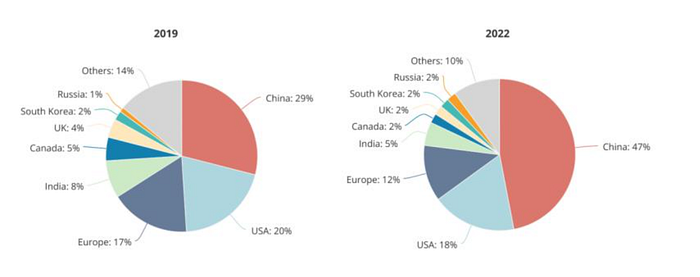

A Chinese tech publication recently claimed that Chinese researchers are systematically replacing Indian engineers in Silicon Valley's AI ecosystem. The data they cite is real — Chinese nationals now comprise 47% of top AI research positions, up from 29% in 2019. But this framing reveals a dangerous misunderstanding of how breakthrough innovation actually works.
We've Been Solving the Wrong Problem This Entire Time
The narrative that AI success comes down to national talent pipelines — whether Chinese mathematical rigor or Indian engineering excellence — fundamentally misunderstands the nature of the transition we're experiencing. This isn't about which country produces better AI researchers. It's about the obsolescence of the entire framework we use to think about talent.
When I see articles celebrating how "Chinese researchers are taking over Silicon Valley AI," I recognize the same category error that led people to ask which city would become "the next Silicon Valley." They were optimizing for the previous game while a completely different game was emerging.
The real question isn't which nationality produces the best AI talent. It's why we're still thinking about intelligence as something that can be geographically optimized.
The Hidden Cost of Homogeneous Excellence
Let me tell you what the Chinese media article gets wrong about their own success. They celebrate what they call "low cultural friction" — the ability of Chinese researchers to integrate seamlessly into work-focused environments without religious constraints or caste complications. They frame this as a competitive advantage.
This is precisely backwards.
The most important AI breakthroughs I've observed don't come from teams optimized for harmony. They come from teams optimized for productive cognitive dissonance. When DeepMind solved protein folding, it wasn't because they had the smartest biochemists. It was because they had biochemists arguing with game theorists who were arguing with quantum physicists.
The Chinese researchers' mathematical foundations are undeniably strong — no one disputes the rigor of their educational system. But celebrating "low cultural friction" as an advantage reveals a misunderstanding of what creates breakthrough innovation. Friction isn't a bug in innovative teams; it's a feature.
The most dangerous teams are the ones where everyone thinks the same way, even if they think really well.
The Democratization of Research Infrastructure
Here's what the nationality-focused analysis completely misses: while everyone debates which countries produce the best PhD programs, the infrastructure for doing breakthrough AI research has become democratized beyond recognition.
Three years ago, conducting meaningful AI research required institutional affiliation with places like Stanford or MIT. Today, a motivated individual with access to cloud computing and open-source tools can replicate and extend work that previously required million-dollar lab budgets.
Some of 2024's most impactful AI contributions came from researchers working entirely outside traditional academic hierarchies. A teenage autodidact in Lagos improved multimodal reasoning by combining techniques no established researcher had thought to connect. A former chef revolutionized robotic learning by applying intuitions about hand movements that computer scientists had never considered.
The question isn't whether Chinese or Indian or American institutions produce better researchers. It's whether institutional affiliation still matters for the kind of distributed, collaborative intelligence that defines the AI frontier.
The Emergence of Human-AI Collaborative Intelligence
But here's the deeper shift that makes the entire nationality debate feel antiquated: the most important AI advances now come from human-AI collaboration, not pure human intelligence.
The research methodology itself has changed. Instead of humans slowly grinding through mathematical proofs, we now have humans using AI systems to explore vast solution spaces, with the humans providing intuitive leaps and the AI providing computational verification. The bottleneck isn't who has the strongest mathematical background — it's who can most fluidly dance between human insight and machine capability.
This requires an entirely different skill set than traditional research excellence. It's not about having the deepest knowledge in a specific domain. It's about having the cognitive flexibility to rapidly synthesize insights across domains while leveraging AI systems to handle the computational heavy lifting.
The Chinese article frames this as a transition from "implementation" skills to "research" skills. But that's still thinking in terms of the previous paradigm. The actual transition is from individual human intelligence to hybrid human-AI intelligence architectures.
The Cognitive Architecture Framework
The organizations winning in AI aren't optimizing for researchers from specific educational backgrounds. They're optimizing for cognitive architecture — teams that can think in ways no individual human ever could.
Instead of hiring for nationality or even individual brilliance, they're hiring for complementary intelligence. They want teams where the collective cognitive capacity exceeds the sum of individual talents.
This means assembling people who think in fundamentally different ways: pattern recognizers who can spot hidden structures, synthesizers who can connect insights across disparate fields, rapid experimenters who can test hundreds of hypotheses, and systems integrators who can translate breakthroughs into scalable applications.
The most successful AI teams I know have deliberately diverse cognitive approaches. Not diverse in the surface-level demographic sense, but diverse in their fundamental reasoning patterns and problem-solving methodologies.
What Individual Practitioners Should Do
If you're a software engineer worried about being displaced, or a researcher trying to stay relevant, here's what matters: stop optimizing for fitting into existing categories and start developing meta-cognitive skills.
The professionals thriving in this transition aren't the ones with the strongest traditional credentials. They're the ones who can rapidly adapt their thinking patterns, collaborate fluidly with AI systems, and architect solutions that transcend their individual cognitive limitations.
This means developing what I call "cognitive complementarity" — the ability to think in ways that productively clash with and enhance other thinking systems, both human and artificial.
Instead of competing based on your educational background or cultural identity, focus on developing unique reasoning patterns that become more valuable when combined with AI capabilities.
The Real Revolution
The Chinese media celebrates their researchers' success as national validation, just as Americans once celebrated their dominance in previous tech waves. But this misses the deeper transformation happening.
We're moving beyond geography-based innovation entirely. The future of AI development isn't about which country produces the best researchers — it's about creating cognitive architectures that transcend the limitations of any individual human mind, regardless of nationality.
The most profound breakthroughs now emerge from distributed collaboration between humans and AI systems, where the humans provide intuitive leaps and contextual understanding while AI handles computational verification and exploration of vast solution spaces.
This makes traditional questions about talent pipelines feel increasingly irrelevant. The bottleneck isn't access to smart people from specific educational systems. It's the ability to architect teams that can think in ways no individual human ever could.
The real revolution isn't Chinese researchers replacing Indian engineers. It's the obsolescence of human-only intelligence in favor of hybrid human-AI cognitive architectures.
And that revolution transcends all national boundaries entirely.
The data on Chinese researcher representation is from the MacroPolo Foundation's 2022 report tracking global AI talent. The cultural observations about Indian caste dynamics in Silicon Valley reference recent legal cases including the Cisco employment discrimination lawsuit. But the framework for understanding this transition as cognitive architecture evolution rather than national competition — that's the insight that changes everything.