

Startups worship speed. "Move fast, break things" isn't just a slogan — it's survival. Our CTO hammered it in: ship fast or die slow. And so we did. We pushed features daily, sometimes hourly. Until one day, speed caught up with us — a bug slipped through. And that bug didn't just break something. It went viral.
The Culture of Speed
At the time, we wore speed like a badge:
- CI/CD pipelines auto-deployed to production.
- Feature flags hid unfinished work.
- QA cycles were shortened or skipped.
ASCII sketch of our pipeline:
[Commit] --> [CI/CD] --> [Prod in <30 min]The motto was: Better to be in front of users today than perfect tomorrow.
The Bug
The feature was small: a referral program widget. The bug was smaller: a string formatting issue in the referral link generator.
Instead of generating clean links like:
https://ourapp.com/ref?user=aliceIt shipped with an extra random token due to a malformed template:
https://ourapp.com/ref?user=alice&bugged_token=XYZ123XYZThe kicker? The random token exposed debug info. It wasn't catastrophic (no PII leak), but it looked… funny. Users shared it. Screenshots hit Twitter. Memes followed.
Going Viral
At first, we panicked. The bug made us look amateurish. But then something unexpected happened:
- Users loved the quirky links.
- The meme spread faster than our marketing ever did.
- Sign-ups spiked because people wanted to "try the broken link app."
ASCII diagram of traffic that week:
Requests per minute:
Before bug:   ||||
After bug:    ||||||||||||||||||||||||||
Engineering Aftermath
Internally, though, it was chaos:
- Pager alerts fired at midnight as traffic surged.
- Logs filled with malformed tokens.
- Engineers scrambled to patch without killing the viral wave.
Benchmark snapshot:
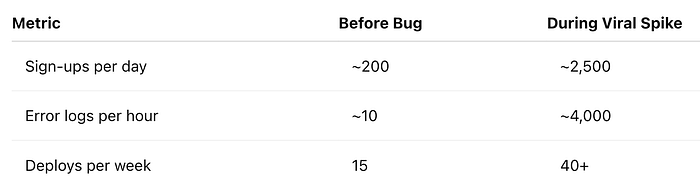
The trade-off between stability and speed had never been clearer.
Migration Decision Tree: Speed vs. Safety
         +----------------------------+
         | Is this feature critical?  |
         +-------------+--------------+
                       |
           Yes         |       No
            |          |       |
            v          |       v
   Add QA/slow rollout | Ship fast,
       + monitoring    | accept risks
The Human Side
For the engineers, it was both exhausting and hilarious. We were firefighting at scale, but also watching our bug trend on social media. One teammate joked:
"We just spent $0 on marketing. Thank the bug."
The CTO, who coined ship fast, laughed too — but added a caveat: speed needs guardrails.
Final Thoughts
Bugs aren't always disasters. Sometimes they reveal the real tension between speed and safety. In our case, the viral bug became free publicity — but it also forced us to mature. We introduced better monitoring, staged rollouts, and tighter code reviews.
The lesson: speed wins early, but resilience wins long-term. And occasionally, the internet will turn your mistakes into marketing gold.