
1. Deletion Methods
a. Listwise (Complete Case) Deletion
- How it works: Remove entire rows (cases) with any missing values.
- When to use:
Data is MCAR (Missing Completely at Random).
Missingness is minimal (<5% of data).
- Pros: Simple, no computational overhead.
- Cons:
Loss of sample size → reduced statistical power.
Biased results if data is not MCAR.
b. Pairwise Deletion
- How it works: Use all available data for each calculation (e.g., correlation uses all non-missing pairs).
- When to use:
Missingness is MCAR or MAR.
Different variables have different missing patterns.
- Pros: Retains more data than listwise deletion.
- Cons:
Can produce inconsistent sample sizes across analyses.
Biased if missingness is MNAR.
2. Imputation Methods
a. Mean/Median/Mode Imputation
- How it works: Replace missing values with the mean (numeric), median (skewed data), or mode (categorical).
- When to use:
Small missingness in MCAR data.
Quick baseline approach.
- Pros: Simple, fast.
- Cons:
Underestimates variance.
Distorts relationships between variables.
b. Regression Imputation
- How it works: Predict missing values using linear/logistic regression on other variables.
- When to use:
Missingness is MAR (predictable from other variables).
Strong correlations exist between variables.
- Pros: More accurate than mean imputation.
- Cons:
Overestimates model fit (imputed values are perfect predictions).
Doesn't account for uncertainty.
c. K-Nearest Neighbors (KNN) Imputation
- How it works: Replace missing values with the average of the *k* most similar rows.
- When to use:
Data has meaningful similarity (e.g., clustering).
Missingness is MAR.
- Pros: Captures local patterns.
- Cons:
Computationally expensive for large datasets.
Sensitive to choice of k.
d. Multiple Imputation (MICE — Multiple Imputation by Chained Equations)
- How it works:
- Create multiple imputed datasets with random noise.
- Analyze each dataset separately.
- Combine results (Rubin's rules).
- When to use:
Missingness is MAR or MNAR.
High-quality imputation needed.
- Pros:
Accounts for imputation uncertainty.
Gold standard for MAR data.
- Cons:
Complex to implement.
Computationally intensive.
e. Time-Series Imputation (Forward/Backward Fill, Interpolation)
- How it works:
Forward fill: Use last observed value.
Linear interpolation: Estimate missing values between two points.
- When to use:
Time-series or longitudinal data.
Missingness is MAR.
- Pros: Preserves trends.
- Cons:
Can introduce artificial patterns.
Not suitable for non-sequential data.
3. Model-Based Methods
a. Maximum Likelihood (Expectation-Maximization — EM Algorithm)
- How it works: Uses observed data to estimate missing values iteratively.
- When to use:
Missingness is MAR.
Data follows a known distribution (e.g., normal).
- Pros: More efficient than multiple imputation.
- Cons: Requires distributional assumptions.
b. Bayesian Imputation
- How it works: Treats missing data as parameters and estimates them using Bayesian inference.
- When to use:
Small datasets with MNAR missingness.
High uncertainty in missing values.
- Pros: Handles uncertainty rigorously.
- Cons: Computationally complex.
4. Advanced Techniques for MNAR Data
a. Selection Models
- How it works: Models the missingness mechanism explicitly (e.g., Heckman correction).
- When to use: When missingness depends on the missing values (MNAR).
- Pros: Corrects for bias.
- Cons: Requires strong assumptions.
b. Pattern-Mixture Models
- How it works: Analyzes different missingness patterns separately.
- When to use: When subgroups have different missing data mechanisms.
- Pros: Flexible for MNAR.
- Cons: Hard to interpret.
c. Sensitivity Analysis
- How it works: Tests how results vary under different MNAR assumptions.
When to use: When MNAR is suspected but unverifiable.
- Pros: Quantifies bias risk.
- Cons: Doesn't "fix" missingness.
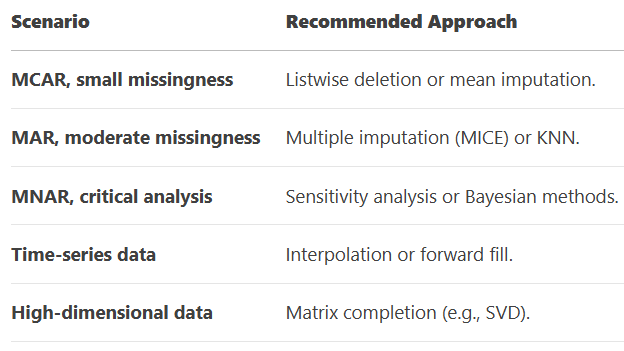
Note:
MCAR: Deletion or simple imputation is acceptable.
MAR: Use MICE, regression, or KNN.
MNAR: Requires advanced modeling (Bayesian, sensitivity analysis).
Always report missingness patterns and justify your method.