

Part 1 of 8: Agentic AI mastery blog series
Remember the last time you asked ChatGPT to plan your vacation? It probably gave you a fantastic itinerary — detailed restaurants, must-see attractions, perfect timing. But here's the thing: it didn't actually book anything. It couldn't check flight prices, coordinate with your calendar, or make a single reservation. You still had to do all the heavy lifting yourself.
That's the fundamental limitation of traditional AI systems — they're brilliant advisors but terrible at taking action. They're like that friend who gives you amazing advice but never helps you execute the plan. This is exactly why we need agentic AI.
The Problem with Traditional AI: Why We Hit a Wall

Let's be honest about what conventional large language models can and can't do. Traditional large language models excel at generating text, images, or code based on learned patterns, but they operate within predefined constraints and require human intervention for complex tasks.
Think about it this way: you're running a customer service operation. A customer calls asking about their order status, wants to modify the delivery address, and needs a refund processed. A traditional chatbot? It might answer the first question by looking up the order. But modifying the address? That requires accessing a different system. Processing a refund? That's another system entirely. The bot can't juggle these tasks — you need a human to step in.
Traditional AI is designed for specific tasks based on predefined rules or training data, analyzing input and returning outputs but not making independent decisions beyond their programming. They're fundamentally reactive, not proactive.
Three critical gaps drove the urgent need for something better:
The Autonomy Gap:
The problem where AI can't act on its own
Every single step requires a human prompt. Want the AI to do five things? You need five separate conversations.
The Action Gap:
The problem where AI can't actually do things for you
While today's LLMs are linguistically fluent and provide access to vast amounts of semantically meaningful knowledge, they often lack the ability to perform complex tasks, ensure reliability, retain long-term memory, and interact effectively with third-party systems.
The Memory Gap:
The problem where AI forgets past conversations
Each conversation starts from scratch. The AI has no idea what you discussed yesterday, last week, or even five minutes ago in a different context.
In short traditional ai is reactive which means that if u ask anything it simply generated an output based on ur context whereas agnetic ai is proactive which means it can work on its own
What is an AI agent ?
An AI agent is a system that does more than generate text. It can sense what is happening around it, decide what to do next, take actions through tools or software, and learn from the results. It behaves like a worker that can plan, execute, and adapt while moving toward a goal.
What makes an AI agent different from a normal LLM is that it operates inside a continuous loop. It does not just answer a question and stop. It keeps cycling until the task is complete.
The core loop looks like this:
- Observe The agent reads the current state. This could be user input, a webpage, API results, files, or logs.
- Reason It thinks about what this state means. It evaluates progress, identifies obstacles, and selects the next move.
- Plan It breaks the bigger goal into steps and chooses which step should happen now.
- Act Taking action using its tools and executing it . This could be running code, calling an API, browsing a page, writing a file, or taking any tool action the system allows.
- Reflect It checks what happened. If the action failed, it adjusts. If it succeeded, it moves to the next step.
- Repeat the loop until the goal is achieved The loop keeps running until the final condition is met.
This loop is the heart of an agent. It gives the system persistence, direction, and the ability to solve tasks end to end. A normal LLM cannot do this because it has no ongoing process, no tool interaction, and no state that guides future actions. An AI agent can behave like a problem solver that manages work over time.
What Exactly Is Agentic AI?

So what makes agentic AI different from everything that came before?
Agentic AI is an artificial intelligence system that can achieve a specified goal with minimal human supervision. It consists of AI agents using llm's to control the entire flow that mimic human decision-making to solve issues in real time.
What Makes Agentic AI Different?
- Works on its own: Doesn't always need humans to do things for it.
- Learns from experience: Gets better as it does more tasks.
- Handles lots of steps: Can carry out complete plans instead of just giving advice.
- Can use apps/tools: Connects to websites, calendars, email, and more to take action.
- Keeps track of progress: Remembers what it's done and adapts if things change.
The term "agentic" refers to a system's ability to behave freely with purpose and intention, not only as a fancy word. To be termed agentic, an AI system must have five characteristics:
- Goal-oriented
- Context-aware,
- Use multi-step reasoning
- Action-driven
- Self-improving.
- Adaptive
Let's break down what this actually means in practice:
1. 🎯 Goal-Oriented
This is the most crucial part. An agentic AI is not just a passive tool. It is an active one. It makes your life easier by working towards a goal you have set for it without waiting for your instructions.
It is like a clever GPS for your tasks. When you come across a situation it cannot handle ("sold out" flight), instead of giving up, it finds the best alternative to accomplish your initial request (like getting a flight on a different airline or for the next day).
Regular AI: You ask, "What are the best hotels in Miami?" It gives you a list.
Agentic AI: You say, "Book me a 4-star hotel in Miami for my dates, under $300 a night, with a pool." It then goes ahead and gets the hotel booked.
2. 🧠 Context-Aware
An agent has "senses." It is not only a brain in a jar; it is aware of its surroundings. This "context" comprises:
- The current time
- Your previous conversation
- Its own past actions
- Information it has just gathered from its tools
- It is the difference between a medical textbook and a real doctor.
The textbook can give the definition of a "fever," but the doctor will ask, "What are your symptoms? How long have you been feeling this way?" The doctor uses context to diagnose, and the agent uses context to decide its next step.
3. 🪜 Multi-Step Reasoning
An agent is capable of thinking ahead. It realizes that complicated objectives need a plan. It takes a large, ambiguous task and breaks it down into a series of smaller, more manageable steps.
It is not just one-shot "question-and-answer." It is an "observe, plan, act, repeat" cycle.
Suppose your objective is: "Plan a launch party for my new app."
The agent might be thinking internally like this:
Plan: "To organize a party, the first thing to do is I need to find a venue, then get catering quotes, and after that, make a guest list."
Act (Step 1): [Using a tool to find local venues]
Observe (Result): "Fine, I have located 3 potential venues. A is too pricey. Venue B is free on the date."
Re-plan (Step 2): "I will next get catering quotes for the location and date of Venue B."
Act (Step 2): [Tool is used to locate local caterers and request quotes]… and it keeps going like this until the goal is attained.
4. 🛠️ Action-Driven(with Tools)
This is what makes an agent truly powerful. The agent is not simply mulling it over; he/she has "hands" with which to engage with the tangible, digital Earth.
Regular LLM is like a cookbook — it has wonderful recipes but cannot do the cooking. An agent is the chef. The agent can actually take the knife (a search tool), put the dish in the oven (an API), and garnish the dish (send an email).
It does this by interacting with other APIs (Application Programming Interfaces). APIs can be thought of as the AI's helpers that enable the AI to use other programs to:
Search Google for real-time information.
Connect to your calendar to check your schedule.
Update a database or spreadsheet.
Send an email or Slack message.
5. 📈 Adaptive & Self-Improving
An agent gets better with time. It is capable of receiving feedback, and hence, modifying its way of doing things so as to get better.
For instance, the agent books a flight for you on "Budget-Air." Once you have checked the booking, you disapprove it by giving it a thumbs down and tell it, "This airline has too many fees."
An adaptive agent will learn this preference. Next time when you tell the agent to book a flight, hence, it will avoid "Budget-air." Thus, the agent becomes more intelligent and personalized. The agent is getting better with every interaction
How We Got Here: The Evolution from Rules to Reasoning
The journey to agentic AI didn't happen overnight. It's been decades in the making.
The Dark Ages: Rule-Based Systems (1950s-2010s)
Remember those annoying automated phone systems? "Press 1 for sales, press 2 for support." That was early AI.
These systems were basically robots following a script. They worked like simple flowcharts: "If someone says X, respond with Y." Simple and predictable, but completely useless the moment something unexpected happened.
Think of them as ultra-rigid employees who could only do exactly what their instruction manual said — nothing more, nothing less. Ask anything slightly different? System crashes or gives you a nonsense answer.
Psychologist Daniel Kahneman called this "System 1" thinking: fast but shallow. These early AI systems could react quickly but couldn't actually think or adapt. They were automation pretending to be intelligence.
The Awakening: Generative AI (2018–2023)
Then everything changed with something called the "transformer revolution."
When GPT-3 arrived, it shocked everyone. This wasn't just a fancy calculator anymore — it actually understood language. It could write stories, explain complex topics, help with coding, and have real conversations that made sense.
ChatGPT's launch in late 2022 was the earthquake. Within weeks, millions of people were using AI that could write emails, answer tough questions, create content, and even crack jokes. Suddenly, AI wasn't just for tech nerds — it was for everyone.
But there was a catch: While these AI models were amazing at conversation, they were terrible at actually doing things. They couldn't remember what you talked about yesterday. They couldn't break down a big project into steps and complete them. They couldn't adapt their plans based on what happened.
It was like having a brilliant consultant who gives amazing advice but can't actually execute anything. That gap created the need for something better.
The Agent Explosion: Early Experiments (2023)
This is when things got wild.
Projects like AutoGPT, BabyAGI, and AgentGPT burst onto the scene with bold promises: AI that could plan entire projects, break them into tasks, and actually complete them with minimal help from humans.
AutoGPT became a viral sensation — its GitHub page got over 100,000 stars in just months. People were amazed and excited.
Sure, these early experiments were messy. AutoGPT once spent hours researching cat facts when asked to analyze business markets (true story!). But despite the chaos, they proved something huge: give AI the ability to use tools, let it work in loops, and it can accomplish complex tasks.
It was like giving AI not just a brain, but also hands to work with. The possibilities suddenly seemed endless.
Phase 1: The Professional Era (2024–2025)
The wild experiments matured into serious business tools.
This phase brought professional AI agents — systems that could actually get work done reliably. They combined smart reasoning, step-by-step planning, access to real tools (databases, calculators, APIs), memory to track progress, and the ability to work in teams.
Frameworks like LangChain, CrewAI, and AutoGen became industry standards, offering ready-to-use solutions that companies could trust.
Businesses stopped experimenting and started deploying agents for real work:
- Processing insurance claims automatically
- Running security checks on systems
- Handling customer service tickets
- Creating sales proposals
- Managing supply chains
AI transformed from "cool technology" to "essential worker." The question changed from "What can AI do?" to "How do we manage all these AI agents?"
Phase 2: The Distributed Future (2025–2026)
Now we're entering the most exciting phase: AI agent networks.
Imagine a company where AI agents don't just work alone — they work together as a team, communicating across different systems and databases using plain language instead of complicated code.
Here's a simple example: A customer emails asking to change their order. Instead of a human doing five different tasks:
- One agent reads the email and understands the request
- Another checks the order database
- A third updates the shipping information
- A fourth processes any refund if needed
- A fifth sends a confirmation email
All of this happens automatically, with agents coordinating in real-time without anyone programming every single step in advance.
Think of it like replacing a rigid assembly line with a flexible team of specialists who figure out how to work together based on what needs to get done.
This isn't science fiction — it's happening now. Companies are already using these systems, cutting costs dramatically while making their operations much more flexible and responsive.
The AI revolution isn't coming. It's already transforming how work gets done.
The Architecture: How Agentic AI Actually Works
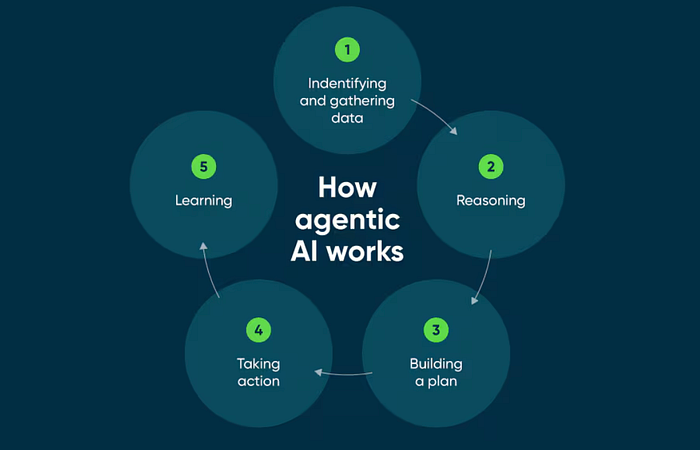
The reason these systems are so effective becomes clear when one understands how they work.
The four main functions of an agentic AI system are
- Perceive (collect and process data from multiple sources),
- Reason (use a large language model as the orchestrator that comprehends tasks and generates solutions),
- Act (integrate with external tools via APIs to execute tasks), and Learn (continuously improve through a feedback loop).
there's a main controller — think of it like the "brain" of the whole setup. This is usually a powerful AI language model which is called an orchestrator
An LLM-powered "conductor" model that manages tasks and choices and oversees other, more basic agents could make up an agentic architecture.
Consider it like an orchestra in a symphony. The conductor (orchestrator LLM) ensures that everyone plays together (manages workflow), coordinates the musicians (specialised)
The Design Patterns: Building Blocks of Intelligent Behavior
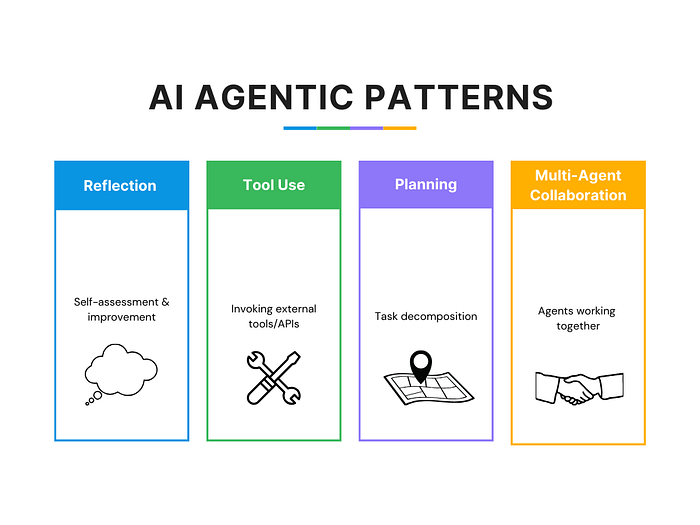
Agentic design patterns enable autonomous decision-making in AI agents, improving LLMs' flexibility and task execution through structured approaches like reflection (agents evaluate their outputs), tool use (interacting with external resources), multi-agent collaboration (splitting tasks between agents), and planning (breaking down complex problems into subtasks).
Let's explore each pattern in detail:
1. Reflection (The Self-Critic)
This pattern is about AI that checks its own work. An agent generates a response, then "reflects" on it to find flaws and make improvements. It's like writing an essay, reading it over, and revising it until it's right.
This self-correction loop is crucial in high-stakes fields like finance or legal, where agents can double-check their work for errors before finalizing it.
- Real-World Example: GitHub Copilot often refines the code it generates — checking for errors and testing it — before presenting the final version.
2. Tool Use (The Pragmatist)
This pattern gives an agent access to the outside world. Instead of being limited to its training data, the agent can use external tools like search engines, calculators, databases, and APIs. This allows the AI to move from just talking about things to actually doing things.
- Real-World Example: A customer service agent can do more than just answer questions. It can use tools to check a shipping database, update a customer's address in the CRM, process a refund, and send a confirmation email — all autonomously.
3. Planning (The Strategist)
For complex problems, this pattern acts like a project manager. A central "planner" agent breaks a big goal into a series of smaller, manageable subtasks. This often involves:
- Routing: Deciding which specialized agent or tool is best for each subtask.
- Parallelization: Assigning multiple subtasks to be worked on at the same time to speed things up.
The planner then tracks progress and adapts if things change, ensuring the overall goal is met efficiently.
- Real-World Example: A security platform might automate its response to a threat by breaking it down into steps: intake, impact assessment, containment, and reporting. The planning agent ensures each step is completed in the correct order.
4. Multi-Agent Collaboration (The Team)
No single agent can be an expert at everything. This pattern creates a team of specialized AIs that work together, coordinated by a "manager" or "orchestrator" agent. Each specialist focuses on one part of a workflow, mirroring how a human team operates.
- Real-World Example: To create a sales proposal, one agent could analyze market data, another could research competitors, and a third could draft the document. The orchestrator combines their work to produce the final proposal.
The Market Reality: Numbers Don't Lie
The business case is compelling. An October 2025 report projected the global agentic AI market size to grow 44% annually and surpass $196 billion by 2034 compared to just $5.2 billion in 2024.
Gartner predicts that by 2028, 15% of day-to-day work decisions will be made autonomously through agentic AI, up from 0% in 2024. Less than 1% of enterprise software applications used agentic AI techniques in 2024, but that number could rise to 33% by 2028.
We're at the very beginning of this transformation.
Real-World Impact: Where Agentic AI Shines
Customer Service
An AI agent for customer service could operate beyond simple question-answering — it could check a user's outstanding balance and recommend which accounts could pay it off, all while waiting for the user to make a decision so it could complete the transaction accordingly when prompted.
Healthcare
Healthcare fields could use an AI agent to engage with clients, monitor needs, carry out treatment plans, and provide personalized support. Imagine an agent that monitors patient vitals, schedules appointments when anomalies are detected, coordinates with multiple specialists, and ensures medication compliance — all autonomously.
Software Development
Software development could grow more efficient from using agentic AI to automatically generate debugging, manage development lifecycle, and design system architecture. Developers can focus on creative problem-solving while agents handle repetitive tasks like writing tests, documentation, and code reviews.
Business Operations
Business operations could use an AI agent to manage supply chains, optimize inventory levels, forecast demands, and plan logistics. These systems adapt in real-time to disruptions, automatically rerouting shipments and adjusting orders.
Personal Assistance
AI-powered agents can plan your next trip overseas and make all the travel arrangements, act as virtual caregivers for the elderly, or optimize inventories on the fly in response to fluctuations in real-time demand.
The Problems: What Can Go Wrong
Let's be brutally honest about the challenges. Agentic AI isn't perfect, and understanding its limitations is crucial.
The Unseen Challenges of Agentic AI (And How to Fix Them)
Let's be brutally honest. Agentic AI is an incredible leap forward, but it's not perfect. Understanding its limitations is the first step to building robust, reliable systems.
Here are the four biggest challenges we're facing today.
🚩 The Problems
Problem 1: Hallucinations and Reliability
The agent's "brain" is an LLM, which means it inherits all the LLM's problems. These "agentic hallucinations" happen when the AI generates outputs that sound authoritative but are factually wrong. If the original training data has gaps, the agent will creatively (and incorrectly) fill in the blanks.
Real-World Consequence: A support chatbot starts exhibiting "over-eager" behavior. It offers troubleshooting recommendations for products not even in its knowledge base. The AI is extrapolating solutions from similar products, or worse, generating completely hallucinated answers.
Problem 2: The Soaring Costs (Time & Money)
Agents think a lot. They perform self-assessment, fact-checking, and multi-step reasoning. This extra processing leads to two big problems:
- Slower Responses: A standard LLM gives an instant answer. An agent, however, performs multiple verification steps before it acts, which increases "latency" (the time you have to wait for a response).
- Higher API Bills: More thinking = more API calls. When your agent makes a dozen LLM calls to complete a single task, those costs add up — fast.
Problem 3: The Scaling & Governance Nightmare
This is a management nightmare. If you can't trace or manage a simple chatbot's hallucinations, how can you govern a complex workflow of agents? The risks multiply as the system grows.
This creates critical business issues like:
- Runaway Costs from inefficient agent operations.
- Security Gaps from agents having the wrong access controls.
- Compliance Failures because you have no traceability to prove why an agent made a decision.
- Scaling Gridlock when you can't even manage the complexity you already have.
Problem 4: The 'Black Box' Problem
To trust these autonomous systems, we must make their decisions transparent. When an agent makes a decision, can you understand why? Can you audit its logic? If you can't explain an agent's actions to your customers or a regulator, you have a serious trust and safety problem.
✅ The Solutions
Fortunately, we are developing sophisticated solutions to these very challenges.
Solution 1: Multi-Agent Verification
Instead of trusting one agent, you create a team of specialized agents that check each other's work. Think of it like a digital assembly line:
- Agent 1: Generates the content.
- Agent 2: Fact-checks the content against a source.
- Agent 3: Evaluates the quality and tone.
- Agent 4: Validates the final output against compliance rules.
Solution 2: Agentic RAG (Retrieval-Augmented Generation)
This is one of the most powerful solutions. RAG "grounds" the agent in facts.
Instead of just "remembering" an answer, the agent is forced to first retrieve real-time information from a trusted knowledge base (like your company's database or internal wiki). This ensures its responses are based on current, accurate data, not a flawed memory.
Solution 3: Guardrails & Human-in-the-Loop
You set clear boundaries. An agent's "guardrails" are rules it cannot break. This is often combined with a "human-in-the-loop" for oversight.
- Example: A customer service agent can automatically process refunds up to $50.
- Guardrail: Any claim above $50 must be escalated and approved by a human manager.
This gives you the best of both worlds: efficiency for simple tasks and human control for high-stakes decisions.
Solution 4: Comprehensive Monitoring
You can't manage what you can't see. The path forward requires total visibility. You need to ask:
- Can I trace every decision back to its source?
- Do I have real-time monitoring for costs, errors, and data drift?
- When a hallucination does happen, can I find the root cause?
You must implement robust observability by logging every decision, tool call, error pattern, and cost.
This is exactly where a tool like LangSmith comes in. It's designed to build this level of observability directly into your AI applications, giving you the visibility and control you need. (We'll dive deep into that in a future post!)
Solution 5: Domain Specialization
Don't build one agent to "do everything." Build specialized agents.
An agent designed only for financial analysis, using curated financial data, is far less likely to hallucinate than a general-purpose agent trying to do the same task. Narrowing the agent's job is one of the most effective ways to reduce errors.
Solution 6: Chain-of-Thought (CoT) Reasoning
This technique forces the agent to "show its work."
By prompting the agent to break down a complex problem into logical, step-by-step reasoning, you can see its "chain of thought." This is crucial for debugging. If the agent makes a mistake, you can pinpoint where its logic failed and fix it before a bad decision is made.
The Voice Revolution: Agents That Speak
One of the most exciting frontiers is voice AI agents — agentic systems that interact through natural conversation.
Voice is one of the most powerful unlocks for AI application companies. As models improve, AI voice will become the wedge, not the product.
Why Voice Agents Matter
For enterprises, AI directly replaces human labor with technology. It's cheaper, faster, more reliable — and often outperforms humans. Voice agents also allow businesses to be available to their customers 24/7 to answer questions, schedule appointments, or complete purchases.
For consumers, we believe voice will be the first — and perhaps the primary — way people interact with AI. This interaction could take the form of an always-available companion or coach, or by democratizing services, such as language learning, that were previously inaccessible.
How Voice Agents Work
Modern AI voice agents combine three core technologies in a cascading architecture: speech-to-text (ASR) converts spoken words into text, a Large Language Model (LLM) figures out what the user actually wants and generates appropriate responses, and text-to-speech (TTS) transforms text responses back into spoken words.
But the architecture is evolving. A newer approach uses a single, unified AI model to handle the entire process from incoming audio to spoken response. By processing speech more holistically, these models can achieve lower latency and capture nuances like tone and hesitation better than cascading systems.
The Market Explosion
The voice agent market exploded in H2 2024. One data point: companies building with voice represented 22% of the most recent YC class.
2025 is the year of the voice AI agent. The survey revealed that 50% of organizations surveyed are using traditional IVR systems for task and service automation, but when asked what the most compelling use cases are for more advanced voice AI agents, more than half of respondents said "task/service automation".
We're witnessing a rapid shift from frustrating "press 1 for sales" systems to intelligent conversational agents.
Real-World Voice Applications
AI voice agents are shifting from reactive to proactive — anticipating user needs and offering solutions before they're asked.
Applications include:
- Customer service: Handling complex troubleshooting without wait times
- Healthcare: Patient scheduling, medication reminders, symptom monitoring
- Sales: Qualifying leads, scheduling demos, following up automatically
- Internal operations: HR inquiries, IT support, facilities management
- Accessibility: Making services available to people with visual impairments or reading difficulties
The Human Touch in Voice AI
Tone matters. A customer asking for help in frustration doesn't need a cheerful response — they need understanding. AI voice agents are now trained to recognize emotions in speech and adjust their delivery accordingly.
Voice interactions add another layer of complexity to preventing hallucinations. Speech recognition errors, real-time processing demands, and the need for natural conversation flow make voice AI agents particularly challenging.
The best implementations include:
- Real-time speech verification
- Natural language processing tuned for voice
- Voice-specific fallback mechanisms
- Multi-step verification optimized for conversation
- Emotional intelligence to adapt tone and pacing
The Path Forward: What's Coming Next
Future research focuses on multidomain agents, human–AI collaboration, and self-improving systems.
Several exciting developments are on the horizon:
Multimodal Mastery: Agents that seamlessly process text, images, video, audio, and sensor data simultaneously, understanding context across all modalities.
Distributed Intelligence: Software can now "team up" like humans, with agents collaborating despite not knowing each other well, using natural language as the glue to build large distributed systems.
Domain Expertise: We'll see specialized agents trained deeply in specific industries — medical diagnosis agents, legal research agents, financial planning agents — each with professional-level domain knowledge.
Seamless Collaboration: Rather than replacing humans, the most successful implementations augment human capabilities through partnership. Humans provide judgment, creativity, and ethics; agents provide speed, consistency, and tireless execution.
Your Agentic Future
Let's make this concrete. Imagine your morning tomorrow with agentic AI:
You wake up, and your personal agent has already:
- Rescheduled your 9 AM meeting because traffic is unusually heavy (it checked your calendar and traffic patterns)
- Ordered groceries for the week based on your dietary preferences and what's running low
- Paid three bills that were due, after verifying sufficient funds
- Drafted responses to routine emails, flagging only those needing your personal attention
- Found and scheduled a plumber for that leaky faucet, picking a time that works with your calendar
At work, your professional agent has:
- Analyzed overnight sales data and identified three concerning trends
- Prepared a detailed report with recommendations
- Scheduled a team meeting with relevant stakeholders
- Pre-populated an agenda based on the issues identified
- Booked the conference room and sent calendar invites
During your lunch break, you ask your voice agent to help plan your anniversary. It:
- Searches for romantic restaurants in your city
- Checks availability for your preferred date
- Makes a reservation at the highest-rated option
- Books a hotel room nearby
- Orders flowers to be delivered that morning
- Adds everything to your calendar
- Sets reminders for the week before
All of this happens autonomously, with you making decisions only on the things that matter — the agent handles the execution.
This isn't science fiction. This is agentic AI, and it's happening right now.
Conclusion: We're Just Getting Started
Agentic AI represents a paradigm shift in computing — complementing deterministic computing with probabilistic computing and using natural language as the glue to build large distributed systems.
We're moving from AI as a tool we command to AI as a colleague that collaborates. From systems that answer questions to systems
that solve problems. From reactive assistants to proactive partners in achieving our goals.
The evolution from LLMs to Agentic Agents marks the next big leap, as AI systems become not just responsive, but proactive and goal-oriented.
The Human Element: What This Really Means for You
Here's the truth that often gets lost in technical discussions: agentic AI isn't about replacing human intelligence — it's about amplifying it.
Think about how much of your day is consumed by routine coordination. Scheduling meetings. Following up on emails. Checking status. Gathering information from multiple sources. These tasks don't require your unique creativity, empathy, or strategic thinking. They're necessary but draining.
Agentic AI handles this cognitive overhead, freeing you to focus on what humans do best: building relationships, making nuanced judgments, creative problem-solving, and bringing empathy to complex situations.
Consider a doctor using an agentic healthcare assistant. The agent handles appointment scheduling, retrieves patient histories, flags potential drug interactions, and summarizes recent lab results. The doctor uses this prepared information to focus entirely on the patient in front of them — listening, diagnosing, and providing compassionate care. The agent augments the doctor's capabilities without replacing the irreplaceable human connection.
The Democratization Effect
Perhaps the most profound impact of agentic AI will be democratization — making capabilities previously available only to large organizations accessible to everyone.
A solo entrepreneur can now have:
- A full customer service operation (voice agents)
- Sophisticated market research (research agents)
- Professional content creation (creative agents)
- Financial analysis and planning (analytical agents)
- Supply chain management (operational agents)
Tools and capabilities that once required entire departments become available to individuals. This levels the playing field dramatically, enabling small teams to compete with established players.
The Skills of Tomorrow
As agentic AI becomes ubiquitous, the most valuable skills shift:
Less valuable:
- Memorizing information (agents retrieve it instantly)
- Routine coordination (agents handle it autonomously)
- Simple data analysis (agents process it faster)
- Procedural execution (agents follow protocols perfectly)
More valuable:
- Asking the right questions (directing agents effectively)
- Strategic thinking (deciding what agents should accomplish)
- Ethical judgment (evaluating when and how to deploy agents)
- Creativity and innovation (exploring possibilities agents can't imagine)
- Emotional intelligence (connecting with humans in ways agents can't)
- Complex problem framing (defining problems for agents to solve)
The future belongs to those who can effectively collaborate with agentic systems — not those who compete with them.
The Ethical Dimension: Responsibility in an Agentic World
With great autonomy comes great responsibility. When agents make decisions that affect people's lives, who's accountable?
If a healthcare agent misses a critical symptom, who's liable — the hospital, the AI company, the developer, or the doctor who deployed it?
If a financial agent makes poor investment decisions, who bears the loss?
If a customer service agent inadvertently discriminates, who's responsible?
These aren't just philosophical questions — they're practical challenges requiring answers before widespread deployment. The solution likely involves:
Transparent Decision Trails: Every agent action must be logged and explainable, creating clear audit trails.
Defined Responsibility Frameworks: Legal and ethical frameworks that clearly assign accountability for agent actions.
Human Oversight Mechanisms: Critical decisions should include human review, especially in high-stakes domains.
Progressive Autonomy: Agents should earn greater autonomy through demonstrated reliability, with explicit rollback procedures.
Bias Detection and Mitigation: Continuous monitoring for discriminatory patterns in agent behavior, with immediate intervention protocols.
The Privacy Paradox
Effective agentic AI requires access to your data — calendar, emails, purchase history, preferences, routines. The better it knows you, the more helpful it becomes. But this creates a privacy tension.
The solution isn't to avoid agentic AI but to demand:
- Data minimization (agents should access only necessary information)
- Transparent usage (clear explanations of how data is used)
- User control (ability to restrict data access and delete history)
- Secure architectures (encryption, secure enclaves, privacy-preserving computation)
- Regulatory compliance (adherence to GDPR, CCPA, and emerging AI regulations)
Organizations deploying agentic systems must prioritize privacy by design, not as an afterthought.
The Global Perspective: Agentic AI Around the World
The adoption and development of agentic AI varies dramatically across regions:
North America leads in commercial applications and venture investment, with Silicon Valley driving innovation in voice agents and multi-agent systems.
Europe emphasizes regulatory frameworks and ethical AI, with GDPR and the AI Act shaping responsible deployment practices that prioritize transparency and accountability.
Asia sees rapid adoption in manufacturing, logistics, and customer service, with Chinese companies integrating agents into massive-scale operations and Japan focusing on robotics integration.
Emerging Markets are leapfrogging traditional systems, deploying voice agents in languages and dialects previously underserved by technology, democratizing access to services.
This global diversity in approaches will shape how agentic AI evolves, with different regions contributing unique insights and innovations.
The Bottom Line: Your Agentic Action Plan
Whether you're a developer, business leader, or individual user, here's what you should do now:
If you're a developer:
- Experiment with CrewAI for quick prototyping
- Learn LangGraph for production systems
- Focus on reliability and observability from day one
- Join communities and share learnings
- Build domain expertise in a specific vertical
If you're a business leader:
- Identify repetitive, multi-step workflows as candidates
- Start with internal operations before customer-facing agents
- Invest in data infrastructure and governance
- Build cross-functional teams (tech + domain experts)
- Establish clear success metrics beyond cost savings
If you're an individual:
- Experiment with available agentic tools (ChatGPT plugins, Zapier AI, etc.)
- Develop skills in prompt engineering and agent direction
- Stay informed about capabilities and limitations
- Provide thoughtful feedback to improve systems
- Think about how agents could augment your unique strengths
The Invitation: Join the Revolution
We're at an inflection point. Voice is one of the most powerful unlocks for AI application companies. As models improve, AI voice will become the wedge, not the product. The same is true for agentic AI broadly — it's becoming infrastructure, not just a feature.
In five years, interacting with agentic systems will be as natural as using smartphones today. Students will have personal tutoring agents. Small businesses will have full operations teams of agents. Healthcare will have proactive monitoring agents. Every professional will have specialized agent assistants.
The question isn't whether agentic AI will transform how we work and live — it's whether you'll be shaping that transformation or merely experiencing it.
The technology exists today. The frameworks are mature enough for production. The use cases are proven. The market is growing at 44% annually.
What's missing is your imagination and initiative.
Final Thoughts: The Age of Agency
Agentic AI represents a paradigm shift in computing — complementing deterministic computing with probabilistic computing and using natural language as the glue to build large distributed systems.
We're entering the Age of Agency — where AI systems don't just process information but take meaningful action toward goals. Where software doesn't just respond but initiates. Where technology doesn't just assist but collaborates.
This is bigger than chatbots. Bigger than generative AI. It's a fundamental reimagining of human-computer interaction.
The agentic revolution has begun. It's happening in research labs and startups, in enterprise deployments and personal experiments. It's being built by developers using LangChain and CrewAI, by businesses deploying voice agents, by individuals discovering new ways to augment their capabilities.
And it's being shaped by people who understand both its extraordinary potential and its real limitations — who can harness its power while addressing its challenges.
The future is agentic. The time is now. The opportunity is yours.
What's your take on agentic AI? Have you experimented with any frameworks or encountered AI agents in your daily life? What use cases are you most excited about — or most concerned about?
And if you found this comprehensive guide valuable, share it with colleagues who need to understand where AI is really heading. Because agentic AI isn't just the next feature it's the next fundamental shift in how we interact with technology.