
This article gives you an idea of how the microservices part is implemented using Spring Cloud. Well, in today's modern world apps make our daily activities much easier. Also, big tech giants developing apps having a microservice architecture. This architecture comes in handy for smaller apps each have it's database. The user doesn't even hesitate to change the individual apps based on the database/logic and doesn't affect the other microservices. Let's dive into it. Have a detailed exploration of how microservices architecture plays a crucial role today.
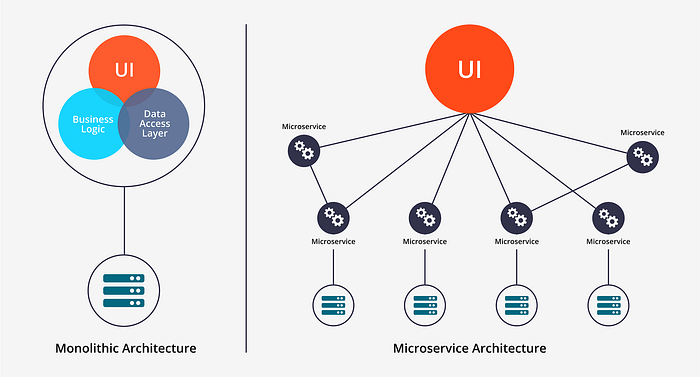
Monolithic Architecture
The monolithic architecture is a traditional approach to application development. It involves constructing an application as a single, indivisible unit. Typically, such a solution encompasses a client-side user interface, a server-side application, and a database, all integrated into a unified structure where all functions are managed and served from a single location.
For any modification done on a product, it should be aware that other logic shouldn't be broken. Also, customization and load balancing are not very easy. The difficult part, If any changes are required by the client, it should be changing other modules as well. Each module should share the same database. Any change / altering field definition will lead to a change in the entire module.
In monolithic applications, there is usually one large codebase lacking modularity. Developers needing to update or modify something must access this single codebase, resulting in changes being made across the entire stack simultaneously.
Microservices Architecture
In microservices, each module is shared with a unique database and Each module can be developed individually without depending on the other modules. we can call one microservices to another also. We can scale each product individually and robust code modification can be made without any hesitation of other modules. The load balance and performance tuning can be done individually on each module. Each module says microservices running on a separate port. We can communicate through third-party APIs for streaming and data services.
We can have multiple tech stacks to develop the microservices. Consider the case that App1 was developed using NodeJs and another App2 can be developed using Java Spring Boot.
We can develop based on the needs of the user and customer. How much scalable the application is needed based on it, we can change the tech stack accordingly.