

The discussion about Indonesia is indeed fascinating; this country is a vast archipelago with a long history of formation that is closely related to the establishment of the Indonesia we see today. This history is kept to be shared, so that it remains alive, giving the next generation evidence of the journey, struggles, and mistakes of the past. Even the first president of Indonesia, Ir. Soekarno had reminded us not to easily forget the history of the nation, which can guide us in understanding our national identity.
JASMERAH
Jangan sekali-kali melupakan Sejarah - Ir. Soekarno The first Indonesian President
However, some of the historical facts have long been unspoken, or worse, have been forced into silence for the sake of a particular group, leaving society baffled, with the fact that the living history we see is the version that is intentionally allowed to endure. Is it true that history is written by the victors?
Therefore, this article aims to invite readers to explore a different side of the past through 3 Untold Indonesian Historical Facts, which may change our perspective on things we've long believed to be true.
1. The Myth of "Indonesia Was Colonized for 350 Years."
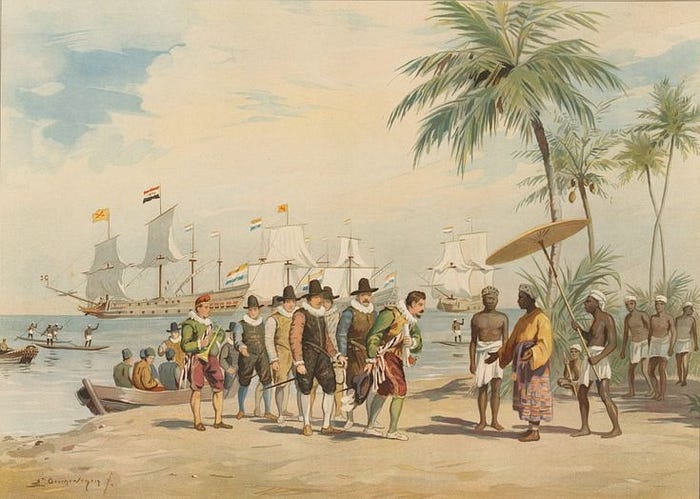
In the Indonesian history curriculum, it is taught that Indonesia was colonized by the Dutch for 350 years. This narrative has been passed down from generation to generation as if it were a noble tradition, creating an endless chain of bias.
In reality, this statement is completely wrong.
So, does this mean the Dutch never colonized Indonesia?
Not exactly, the fact that the Dutch colonized Indonesia cannot be erased, because it is a historical reality. What is factually incorrect here is the assumption that the Dutch colonized Indonesia for 350 years.
Let us thank Gertrudes Johannes Resink, a legal scholar who successfully debunked this legendary myth in his work titled "Indonesia's History Between Myths: Essays in Legal History and Historical Theory."
Resink stated in his findings that the notion of 350 years of colonization is calculated from the Dutch's first arrival in Indonesia in 1596 until independence in 1945. In fact, the Dutch's intention upon arriving in Indonesia was to trade, not to colonize. Although this trade later gave rise to a desire for possession (colonialism).
Furthermore, Dutch colonization did not instantly bring the entire territory of Indonesia under its control for 350 years. Resink analyzed legal documents and treaties belonging to the kingdoms in Indonesia at that time and found that, as late as the 1900s, there were still many kingdoms and regions in the Indonesian archipelago that had not been conquered by the Dutch.
Resink then began to draw the conclusion that not a single region of Indonesia was actually under Dutch control for the entire 350-year period. The longest period was likely 37 years, based on the Dutch occupation of Klungkung, Bali, in 1908.
Then why is Indonesian society so comfortable with the fact that it was colonized for 350 years?
This may be a doctrine propagated by the Dutch or certain parties aimed at dwarfing the power and position of the Indonesian people by casting them as the oppressed, and creating the perception that Dutch power was so strong that it could maintain its hegemony for over three centuries.
2. The Betrayed Promise from the Land of Aceh

Have you ever wondered about the origins of the national airline, Garuda Indonesia?
And would you have guessed that the airline's beginnings were linked to the people's disappointment with their government?
Let's take a look back at 1948, when it all began with President Sukarno's visit to Aceh.
The visit was a strategic move during which President Soekarno met with Tengku Daud Beureueh, a religious leader and leader of the Acehnese people's struggle. Soekarno's sole purpose for visiting was to ask the people of Aceh for their help in the resistance against the Dutch.
In the beginning, Tengku Daud Beureueh asked for a signed document as a guarantee, but Ir. Soekarno refused and assured him that he would use all his authority to guarantee the people of Aceh the right to manage their own affairs in accordance with Islamic law.
This promise seemed promising to the Acehnese leaders, so they allowed Soekarno to mention the urgent needs of the government.
Airplanes? They provided them.
At that time, the people of Aceh willingly dug deep and sold all their jewelry and possessions to make donations. In a short time, 120,000 Straits dollars and 20 kg of gold were collected.
An airplane? It had already been purchased. Its name was RI-001 Seulawah (Golden Mountain), serving as Indonesia's first presidential airplane.
What else was given?
Aceh donated the ship designated UN 58 LB, which was used to distribute weapons for the war needs. A donation of 28 kg of gold by Teuku Markam for the construction of the National Monument (Monas). And what about the rest of his promises?
It turned out that Soekarno was not keeping his word; he refused to implement Islamic Sharia law in any region of Indonesia, dashing Aceh's hopes. Soekarno emphasized in his speech before the people of Amuntai, South Kalimantan, on January 27, 1953, that Indonesia is a national state based on the ideology of Pancasila, and not a theocratic state governed by a specific religious law.
Isn't that a shame?
Even when you've worked so hard toward something you've been hoping for, even going so far as to put up your own possessions as collateral, the results often don't live up to your expectations.
3. GERWANI and the Lubang Buaya Tragedy
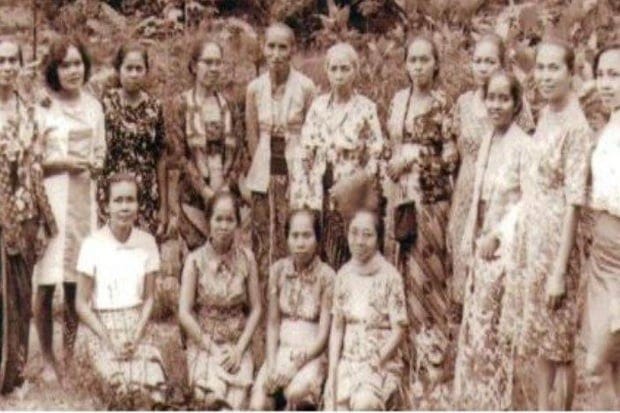
What comes to mind when you hear the name GERWANI mentioned? If you answer that GERWANI was a group of barbaric communist women who had the heart to brutally murder seven generals on the night of September 30, 1965. I understand that, because essentially that is what we have been taught and what we see in the documentaries that air everywhere whenever September 30 rolls around. But the fact is, we have become pawns ready to be played at any time for the benefit of a group or an individual. It can be said that all this time we have been deceived and blinded, so we cannot perceive the truth.
Let's begin this controversial topic: what is GERWANI? Perhaps some readers have never heard of it at all. Gerakan Wanita Indonesia (GERWANI) is a women's mass organization that was originally named the Gerakan Wanita Sedar (GERWIS), formed on June 4, 1950, by six representatives of women's organizations: Rukun Putri Indonesia (RUPINDO) from Semarang, Persatuan Wanita Sedar from Surabaya, Isteri Sedar from Bandung, the Gerakan Wanita Indonesia (GERWINDO) from Kediri, Madura Women, and Perjuangan Putri Republik Indonesia from Pasuruhan.
GERWIS declared itself a non-political organization, but in reality the PKI played a role in determining GERWIS's future political direction. PKI leaders wanted a communist women's organization under the party's umbrella. This was based on a shared desire to achieve national independence and break free from the shackles of feudalism.
The objectives of GERWANI are:
1. Fighting for gender equality. 2. Improving women's prosperity. 3. Education and social awareness. 4. Advocating for women's rights.
From its objectives, wasn't GERWANI a positive organization, considering that women at the time were marginalized?
In fact, didn't the emergence of GERWANI represent a new hope for women in terms of progress toward gender equality?
Indeed, GERWANI even supported a democratic marriage law, opposed polygamy, and assisted women in cases of rape, kidnapping, and arbitrary divorce. GERWANI was also committed to education, notably by establishing the Melati Kindergarten. In early 1965, GERWANI did indeed have close ties with the PKI on certain political matters, such as supporting the liberation of West Irian, agrarian reform, and the confrontation with Malaysia led by Sukarno. GERWANI also received PKI support in the struggle for the new Marriage Law. However, GERWANI remained dissatisfied with the PKI's leadership style, which paid almost no attention to women's issues. So, why was GERWANI labeled with the stigma of "slut"?
This was due to "sexual slander" directed at GERWANI for having established ties with the PKI and for being a progressive women's organization that sought to challenge the patriarchal doctrine that a woman's duties were limited to the kitchen, the bed, and the well. In 1965, an area overgrown with rubber trees in the village of Lubang Buaya was turned into a military training ground for volunteers who would later be deployed to conflict zones such as West Irian and North Kalimantan, in accordance with Sukarno's policy against imperialist threats. Several organizations stepped in to assist, one of which was GERWANI.
Shortly thereafter, a bloody tragedy unfolded, with Lubang Buaya becoming the site of the early-morning execution of seven military officers on October 1, 1965. Soeharto, who at the time served as Panglima Komando Strategis Angkatan Darat (Kostrad), ordered that everyone trained at Lubang Buaya be implicated in the G30S/PKI.
The situation became even more complicated when the press, which had been completely taken over by the Army, reported that GERWANI had used the officers for "lewd acts" during the torture. Furthermore, false confessions emerged from several individuals who posed as perpetrators of the incident, thereby validating the "slander" that had been so meticulously fabricated.
As a result, many women were subsequently arrested without further investigation into whether they were actually involved or not; they were imprisoned, and some even suffered sexual violence. Even if they managed to be released and are still alive today, their names have been forever associated with the label "PKI women," a stigma that carries negative connotations for all time.
Their voices were successfully silenced, after all, who would want to listen to a vicious woman who betrayed the nation? Conclusion
From the various facts above, it can be concluded that the history we have long heard and believed is not entirely accurate in relation to what actually happened. Political interests and the consolidation of power have turned history into an effective tool for achieving their goals. Some historical accounts are also largely unfamiliar to the public because few people find them interesting unless they are relevant to their own lives. What we can learn from this is that it is not enough to hear history from just one side, because history is a complex matter that involves the lives of many people during a specific period. Be a reader with a strong sense of curiosity, one who does not stop at a single source and is willing to listen to perspectives from the other side, so that you are not easily deceived by the interests of certain groups. From the 3 facts we've discussed above, which one surprised you the most? Share your opinion with the people around you.
References