

Book Reviews: Foundation, by Isaac Asimov
Asimov's stories have influenced sci-fi writers since the fifties
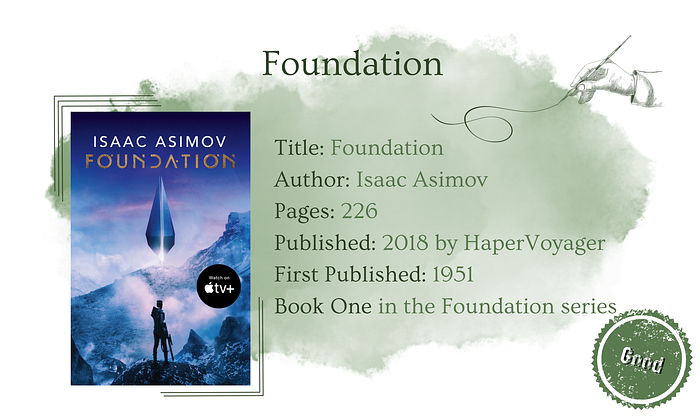
Isaac Asimov is a household name for every fan of sci-fi. His works have highly influenced the genre and beyond. If you heard about the laws of robotics, you've encountered Asimov's works.
A declining empire
Foundation follows the story of the Foundation, a scholarly venture founded by Hari Seldon to try and mitigate the effects of the end of the Galactic Empire. Hari Seldon, the mastermind behind psychohistory, uses the discipline's knowledge to predict the future and how society will behave. He can't predict the actions of any individual human (if it makes you think of physics, you're not alone), but he can predict the actions of civilisations. He knows one thing: the once prosperous Galactic Empire is at the end of its life, and dark ages are about to follow its collapse.
The scientist has a clear aim: reduce the dark ages' duration from 30,000 years to a mere 1,000 years by creating his Foundation. This was just the first step in a series of events that he puts in motion — and the first book in the series follows how humans dealt with the fall of the empire.
"When the Galactic Empire began to die at the edges, and when the ends of the Galaxy reverted to barbarism and dropped away, Hari Seldon and his band of psychologists planted a colony, the Foundation, out here in the middle of the mess, so that we could incubate art, science, and technology, and form the nucleus of the Second Empire." — Foundation, by Isaac Asimov
Isaac Asimov is one of the most famous science fiction writers that has ever lived. Very prolific during his lifetime, the author wrote over three hundred books (40 of those are novels)! I can't even make sense of that number, to be honest, but I find his credentials very impressive, and I have for a very long time admired his work and influence on the field of science fiction, even though I haven't read many of his stories. His most famous works are the Foundation series and the Robot series, both very influential in pop culture and later works of science fiction.
I had never read Foundation before, so I didn't know what to expect. I have to be honest here and say that I did expect slightly more, although that isn't to say that the book disappointed me. I'll explain.
Foundation is often called a saga, so I expected more of the main characters of each time. The book follows the imminent collapse of the Galactic Empire and how the institution created by Hari Seldon deals with the aftermath of this event. Hari Seldon himself is barely a character in the book, although he is an omnipresent figure, the one guy responsible for the existence of the Foundation and everything else that happens, so his name is mentioned often. However, the story follows other characters during each major event covered in this first instalment. There are four distinct moments during the book — the creation of the Foundation itself and then three crises.
I wouldn't go as far as to say the characters are shallow, because they aren't. But they aren't very deep, either. Perhaps because each story arc is quite quick, there's not enough time for character development. Regardless of the reason, though, I miss having more well-constructed and deep protagonists. I love to connect with the characters from the books I read — it doesn't necessarily need to be in a positive way, either. I find characters with questionable traits quite intriguing.
I also found it quite disappointing that women are inexistent in the story. There's one scene where Hari Seldon is questioned about the size of his group and he has a very specific number for people involved in his project, which doesn't account for women and children. So women can't be scientists is the message the book gives. There are also no women involved in the politics of the Galactic Empire (except for one very controlling wife), or even as a merchant. Women aren't part of the story at all. As a woman, it didn't feel great to have zero representation.
Could I have more fluff, please?
For each of the four major events of Foundation, there's a jump in time and a set of different characters (although the main character dealing with the first and second crises is the same). This was a very different and fun way to follow the story, allowing the reader to be right where the action is, without unnecessary boring fluff. As a lover of science fiction, I can attest that too often readers are faced with long and boring preambles and dispensable events. I often think the author is indulging themselves in the need to tell a particular account that doesn't add anything to the main narrative. Asimov doesn't suffer from this ailment — he brings us right to the important moments of his story.
However, I did miss having some fluff in the book. Perhaps, I shouldn't even be so dismissive of it. When reading a story that happens in a different world, I want some background, some world-building. Of course, Foundation doesn't exactly happen in a different world, it's right here in our galaxy. But we don't live anywhere but Earth, and we're currently barely able to leave the planet. So I'm very curious about Asimov's Galactic Empire — the planets they inhabit, the technologies they possess, and the lifestyle they experience. But we get very little information about these mundane aspects of the Galactic Empire. We barely know details or how advanced they truly are. We know next to nothing about the daily lives of normal people. And I did miss that.
For instance, I found it interesting when one of the characters visits Trantor, the Galactic Empire's capital, for the first time. He's taken aback by the fact that the planet lives under metal. There's no visible star, or sky, and the weather is human-controlled. He needs to discover ways to go outside and realises that many of the planet's inhabitants never do so. These little tidbits enchant me, and I truly wish the book had more of these for us.
Asimov's Galactic Empire is fascinating, there's no denying that. However, my brain filled in the gaps with information from other stories altogether…
Have I seen this before?
The feeling of déjà vu is inescapable while reading Foundation. At least, for us in the XXI century who haven't lived under a rock without internet access. The very notion of a Galactic Empire that loses control over the fringes of the galaxy doesn't come across as something new. On the contrary, I'm pretty sure you have a franchise's name on the tip of your tongue.
Of course, I'm talking about Star Wars. While reading Foundation, I encountered so many similarities with George Lucas' franchise that I was honestly shocked by the fact that I didn't know one was based on the other. I was quite surprised when I couldn't find George Lucas himself acknowledging the inspiration anywhere. Asimov was very aware of the similarities, and he was also very gracious about it.
"I borrowed freely from Edward Gibbon's History of the Decline and Fall of the Roman Empire in planning the Foundation series, and I believe that the motion picture Star Wars did not hesitate, in turn, to borrow from the Foundation series." — Asimov in I, Asimov: A Memoir.
Asimov's idea of a Galactic Empire was based on the historical Roman Empire and its fall — thus the dark ages that followed (which we call Middle Ages nowadays). In the same way one can see the similarities between the Roman Empire and the Foundation's Galatic Empire, you can easily see resemblances between Star Wars and Asimov's work. For instance, it's impossible to deny that Corruscant has its roots in Trantor (although Asimov died before Corruscant was on screen).
As much as there are similarities, there are, of course, disparities. Asimov's world is a human one — there are no other races, and even robots aren't present (at least not in this first book). His story has less fantasy and more possible reality (albeit an imagined scientific reality) than Star Wars. The stories are very different and altogether very enjoyable.
One of the main reasons I wished for Asimov to have added more details to this first book is because a lot of my imagined Galatic Empire isn't really the one from Foundation at all — I surely borrowed a lot from Star Wars to fill in the gaps.
Psycho what?
Another fascinating aspect of Foundation is the introduction of psychohistory. The discipline combines psychology and mathematics, using concepts akin to modern physics to describe human behaviour through time. It's a scientifically constructed history of the future of humanity, with precise calculations capable of accounting for human behaviour. Just like in physics, it's not very good at predicting an individual's behaviour and thus their future. But when it accounts for several people as part of a civilisation, it can very accurately calculate and predict future history.
Of course, psychohistory is just science fiction. Aeroplanes were also science fiction at some point, though. But could psychohistory become a reality?
That was something that intrigued me while reading the book. The idea of a social science that can use mathematical concepts to predict future history blew my mind. And I finished the book with the certainty that I would never want it to be real.
Why? Well, quite honestly, because Hari Seldon put in motion events that he wished would have ripple effects for over a thousand years. And, at least during the first book, the characters didn't deviate from his plan. He didn't know exactly how things would turn out or how exactly events would unfold, but they happened as he thought they would. Hari Seldon had a selfless plan, his wish was indeed the good of humanity. But how does one judge what is better for an entire civilization? And what if someone not as altruistic had the power to do what Seldon did? That's a scary thought.
In Asimov's theory, psychohistory can only account for the behaviour of large groups of people, being extremely inaccurate when dealing with individuals. It's also unable to handle too many variables, and it doesn't work if people know the results, as learning about it may change the course of events. But it still frightens me to think someone could accurately predict the future. I'm glad we aren't there yet, and I sincerely hope we will never be.
A book for the ages
It's undeniable how much Foundation has shaped science fiction and how much its portrayal of humanity and empires that break the planetary barrier has moulded modern accounts. The Foundation trilogy won a special Hugo Award for best science fiction series of all time in 1966.
Personally, having read a lot of science fiction, the effects of Foundation were dimmed, but not erased. It was still a captivating read, fascinating at times. And even though I don't have a character to love and meet again in the next book, I'm excited to read more about Asimov's enthralling world and what crises the people from the Foundation will have to deal with.
Want to read more book reviews? I have a collection of them waiting for you right here: