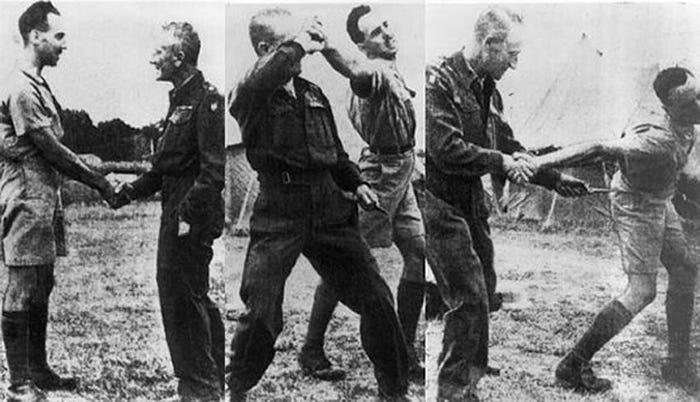


I have an odd question to ask. Who teaches secret agents and spies how to fight and how do they know what to teach them?
The initial gut reaction may be, "Well, the government teaches them!" But, where did the government learn such tactics? As strange as this question may seem, the British government found themselves asking this question during WWII. Their agents were easily flushed out and dispatched by the German's spy hunting apparatus. Something needed to be done and a change needed to be made.
Winston Churchill wanted his clandestine services and special operation forces to fight dirtier. He sought a 'dirty tricks squad' of sorts to restore the equilibrium and improve the survivability of secret agents and spies. But, who could teach his agents these things? The traditional army didn't seem like a good choice for such an odd source of knowledge like this.
Old Winston found his instructors in the oddest of places. They would come from a shadier part of the British Empire. In the 1930's the most dangerous city in the world was Shanghai. It was the home to a criminal underworld that would terrify the toughest policeman. In 1936 Shanghai was Asia's busiest port and according Christopher McDougal's book Natural Born Heroes, the home to 100,000 criminals.
Shanghai was also the home to the "Heavenly Twins", William Fairbairn and Eric Anthony Sykes. These two members of the Shanghai police would revolutionize the British special operations community and the clandestine agents that served England and the Allies.
Fairbairn Meets Shanghai And Shanghai Meets Out On Fairbairn
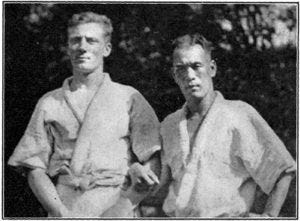
According to McDougal's book, William Fairbairn arrived in Shanghai in 1907. The strapping Royal Marine answered a call by the overwhelmed Shanghai police who were looking for recruits. Fairbairn had been trained by the marines in combat and had front line experience; he'd be able to handle himself, or so he thought.
Fairbairn's first experience as a policeman was to get beaten so badly he had to be taken in a rickshaw to a hospital, where he almost died. He thought to himself, all his military training and front line experience did nothing for him in a knock-down-drag-out street fight. He resolved to learn how to fight dirty. He'd devote himself into learning a method to survive on the streets.
As Fairbairn was recovering in a hospital, he saw a poster. The poster described a Jiu Jitsu instructor named "Professor Ohada" of world renown; he just happened to be headquartered in Shanghai. Fairbairn would become a regular student. He'd also become a student of a famous Wing Chun teacher, Cui Jindong.
Over the next 38 years, Fairbairn was in over 600 street fights. He learned hands on which techniques worked and what didn't. He also learned just about every dirty trick you could imagine. He also became well versed in weapons of all types; from hand guns to knives, he was an expert.
After this long and brutal career, most men would retire. However, Fairbairn received a call from England. His skills were needed for a particular mission. He answered the call and brought his friend Eric Sykes with him. Sykes had a bit of a cloudy background.
Sykes is known to have collaborated with the Shanghai police in some form; being referred to as a sniper instructor. He also worked with firearms manufacturers Remington and Colt. Sykes also seems to have spent a number of years working with Fairbairn and had a similar knowledge of self-defense and shooting tactics.
Special Operations Executive — The Baker Street Irregulars

"Just fold it diagonally until it tightens into a point, then drive it right under the chin. Simple, really."
— Eric Sykes explaining how to kill a man with a folded newspaper — Natural Born Heroes
The Special Operations Executive (SOE) was formed in England in 1940. Its purpose was covert operations in occupied Europe and later Asia. Fairbairn and Sykes would work within this organization to train clandestine agents and commando groups in combat. They were referred to as the "Baker Street Irregulars" or the "Ministry Of Ungentlemanly Warfare", which gives you some sort of idea of their purpose.
By the time the duo arrived to be trainers, they were at retirement age. Both men were in their early 60's and were referred to as the "heavenly twins" for their serene and grandfatherly appearances. However, in action these men consistently stunned and surprised those around them.
A recruit named Henry Hall in McDougal's book related a story where the duo met him and his training group at the top of a flight of stairs. These kindly old gentleman then tumbled down the steps, popping up in a battle crouch, each holding a dagger and pistol. The grandfatherly gentlemen then told Hall and his group they were all dead as the old men dry fired their pistols at the group. This was a common introduction by the twins to their students.
Everything the twins taught was considered highly irregular. Fairbairn had a very negative view of traditional fighting methods. Boxing and wrestling he thought weren't natural defense methods. By this, he meant that size and strength were primary determinants in success. Anything the twins taught didn't require size and strength to be effective.
"We were to be gangsters, but with the behavior, if possible, of gentlemen."
— Robert Sheppard, a recruit of the SOE — Natural Born Heroes
Many of the recruits that would walk through the doors weren't necessarily physical specimens. The SOE went out of their way to recruit those who didn't look like traditional special agents. A grizzled and chiseled soldier type would attract too much attention from the Nazis. An ink salesman, archeologist, or female socialite were more their targets.
One of Fairbairn's favorite lessons was teaching a recruit how to knock somebody unconscious with a box of matches. Obviously, this wasn't the most devastating weapon one would lay their hands on. But one didn't need such a weapon, just the proper method of using their body.

Talking about weapons, the twins also brought their own ideas on weapons to their future students. The Fairbairn-Sykes Commando knife is still in use today with many militaries. As well as the Smatchet, whose wide blade made it look like something from medieval times.
Fairbairn and Sykes also their own ideas when it came to shooting. The pair taught their students not to aim and shoot their pistols in a traditional way. They taught "instinctive aiming". Fairbairn believed that Western gunslingers were so effective because they didn't take the time to use the sights on their guns.
In a gunfight, time is everything. You only have seconds to react. By the time you pull your weapon, get in a stance, aim it, then fire, it's too late. The pair taught their students to aim their body at a target. The gun was only raised to navel level, however, if your body and finger aimed at a target you hit it.
Often their shooting stances and methods looked so ugly, the pair would have to demonstrate their tactics actually worked. In McDougal's book, the recruit Robert Sheppard would recount how Sykes could regularly hit bullseyes with his back facing a target while shooting between his legs.
The training video above is an excellent summation of things Fairbairn and Sykes would teach their students. Aside from the ridiculous 1940's structure of the video, there's a lot to take out of it. The final section showing the gun defenses is a treasure trove if you take it apart and know what you're looking at.
I've spent over 15 years taking martial arts, Krav Maga in particular. The gun defenses these men were teaching in the 1940s aren't far from what we do right now. As I watched the video, I could easily see the similarities. The basics are relatively the same and I'd have every confidence they would work in real life.
The techniques Fairbairn and Sykes demonstrated though weren't formulated in a martial arts class. They were formulated from battles on the street. Fairbairn and Sykes would give these techniques a name, Defendu.
Teachings In Action — The Recruits Get To Work
"Sykes was the instructor who taught me silent killing. If a German came at me I'd kick him in the 'three piece service' and chop him in the side of the neck."
— Nancy Wake, SOE agent — Natural Born Heroes
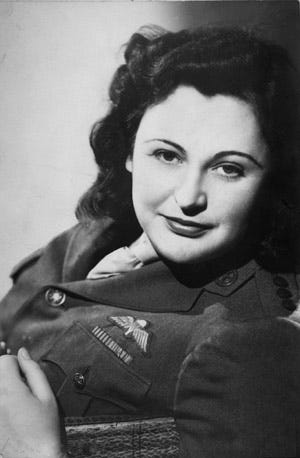
Nancy Wake is very representative of what the SOE would send out into the field. Wake was an Australian socialite, her original skills involved navigating the in-crowd at parties. However when Sykes and Fairbairn were done, she was devastating.
Wake saved a number of downed fliers and coordinated parts of the French resistance against the Nazis. During a raid on a factory, Wake put her SOE training into use. She described how she killed a Nazi soldier with her bare hands.
In an interview with the Australian, she said, "They'd taught this judo-chop stuff with the flat of the hand at SOE, and I practiced away at it. But this was the only time I used it — whack — and it killed him all right. I was really surprised."
Wake was nicknamed the "White Mouse" by the Gestapo and had a bounty on her head. She survived the war and won a number of medals from the British, French, and American governments. Her organization and work with the French resistance were a constant irritant for the Germans.
The teachings of Fairbairn and Sykes were thought of so highly, the men were sent around England to teach various branches of the SOE. Eventually, Fairbairn would end up in Canada teaching at Camp X and Sykes would be responsible for training in England. Sykes would rename the course, "Silent Killing" because he thought it was more representative of what was being taught.
In Donald Hamilton Halls' book "SOE Assignment", he describes the value of Sykes' lessons.
"He taught unarmed combat and quick shooting reactions such as how to kill four people in a room whilst falling down on the ground near the door lintel to make oneself a difficult target. His methods of unarmed combat and silent killing were such that many were able in the years to come to save themselves entirely owing to his instructions."
Conclusion
According to the book "Inside Camp X" by Lynn Philip Hodgson, another lesser known member of the military would visit Fairbairn's camp after the war and stay at a hotel near St. James-Bond United Church. Well, he was lesser known at the time. This man, Ian Fleming, would go on to write the James Bond series of books. One could only wonder if the odd training methods seen at that camp had any influence on his characters.
From the actions of Fairbairn and Sykes and their methodologies, it wouldn't be hard seeing them as a bit Bond-like.
Regardless, these two men appeared just in the nick of time when the Allies needed them. Their experience in dealing with the criminal underworld in their own unique way was invaluable to England and the Allies.
Many of the tactics and weapons they developed are still in use today. Their shooting techniques, now called point shooting are still in use, along with the combat knife they designed.
I can also personally attest that the gun defenses they taught to their trainees also still appear to be in use as well.
So the next time you watch a spy thriller, whether it be James Bond or Jason Bourne, know that there was a real life heavenly duo that may have inspired this character. This duo also inspired many real life training methodologies used in the military and law enforcement today. Our very freedom may owe a debt of gratitude to the hard earned lessons gained by Fairbairn and Sykes on the streets of Shanghai.
Thank you for reading my ramblings, if you've enjoyed what you've read please share. Also, check out Christopher McDougall's book "Natural Born Heroes", I learned much of what I wrote about from that book. It's an excellent read.